Why Your Heat Pump Runs a Defrost Cycle, and What It Costs
A defrost cycle is your heat pump briefly running backwards to melt frost off the outdoor coil. In New York it happens most in damp near-freezing weather.
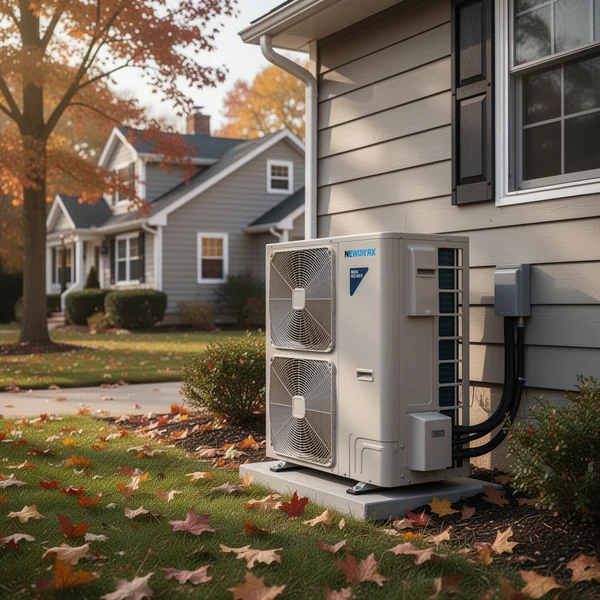
A defrost cycle is your heat pump deliberately running backwards for a few minutes — flipping into cooling mode so hot refrigerant flows out to the outdoor coil and melts the frost off it. It is designed behaviour, not a fault, and a heat pump defrost cycle in cold weather fires most often not during a deep Adirondack cold snap but in the damp 28–40°F stretch that makes up most of a Hudson Valley, Long Island or Finger Lakes winter.
What it costs is the fair question, because while the outdoor coil is being warmed the indoor side is not making heat. On most systems an electric resistance strip energises to keep the supply air from blowing cold across the room, and that strip is the expensive part of the whole arrangement.
What the frost actually is
In heating mode the outdoor coil is the cold side. Refrigerant inside it sits below the outdoor air temperature — that temperature difference is the entire point, because it is what lets the coil absorb heat from air that feels freezing to you. When the coil surface drops below the dew point of the outside air and below 32°F at the same time, moisture in the air condenses on the fins and freezes there.
Frost is an insulating blanket. It blocks airflow through the fins and cuts the coil’s ability to pull heat out of the air, so capacity falls and the compressor works harder for less output. Left alone the unit would ice into a solid block. The defrost cycle is the fix: the reversing valve switches, hot gas floods the outdoor coil, the outdoor fan stops so it does not blow that heat away, and a few minutes later the ice sheets off as water and steam.
What you will see and hear
- A distinct whoosh or clunk as the reversing valve shifts.
- The outdoor fan stopping while the compressor keeps running.
- Visible steam rising off the outdoor unit. Neighbours regularly report this as a fire. It is water vapour.
- Water running out of the base of the unit, then refreezing on the pad in a Syracuse January.
- Indoors: the thermostat showing Aux or Auxiliary Heat for a few minutes, and a slightly cooler supply air feel.
Why cold weather is not when defrost costs you most
This is the part that surprises New York homeowners. Very cold air is very dry — it physically cannot hold much moisture — so at 5°F in Old Forge there is little water available to freeze on the coil. Heat pump capacity is lower at that temperature, but defrosts are infrequent.
The frosting sweet spot is right around and just above freezing with high humidity. That describes:
- The lake-effect belt — Buffalo, Oswego, Watertown, the Tug Hill fringe — where air coming off Erie and Ontario arrives loaded with moisture.
- Coastal Long Island and the city, where marine air keeps winter dew points high and hard freezes are shorter.
- Any New York thaw, the 36°F drizzle days that show up repeatedly between December and March across the whole state.
So a Buffalo heat pump can run more defrosts in a wet 33°F week than in the cold snap that follows it. If your utility bill spikes during mild wet weather rather than during the coldest week of the year, defrost and backup heat are the likely explanation.
What a defrost cycle actually costs
Two costs stack, and they are different sizes.
The smaller one is the defrost itself: heat that was already in your house gets sent back outside to melt ice. The larger one is the backup heat. A heat pump delivers more heat energy than the electrical energy it consumes — that multiplier is its coefficient of performance, and it is why a heat pump can beat resistance heat at all. An electric resistance strip has a coefficient of performance of 1.0 by definition: one unit of electricity in, one unit of heat out, no multiplier. Every minute the strip runs, you are buying heat at several times the price your heat pump charges for it.
We are not going to print a dollar figure here, because there isn’t an honest one. The cost depends on your strip’s kilowatt rating, how many minutes it runs, and your all-in electricity price — and a Con Edison customer in Westchester and a National Grid customer in Onondaga County are not paying the same rate. Get your own number this way:
- Take the total charges on your last electric bill and divide by the kilowatt-hours used. That gives your real per-kWh price including delivery, not just the supply rate the marketing sheet quotes.
- Ask your installer for the kW rating of the backup heat strips they are fitting, or read it off the air handler nameplate.
- Multiply. That is what an hour of pure backup heat costs at your address.
When defrost is normal and when it is a fault
| What you observe | Normal | Worth a service call |
|---|---|---|
| Steam off the outdoor unit for a few minutes | Yes | — |
| A defrost every so often in damp near-freezing weather | Yes | — |
| Solid ice covering the coil face that never clears | — | Yes — sensor, valve or charge problem |
| A block of ice built up under the unit, lifting into the coil | — | Yes — drainage and mounting height |
| Defrosting repeatedly in dry sub-zero weather | — | Yes — often a defrost control set on a timer, not on demand |
| Aux heat showing on the thermostat almost continuously | — | Yes — sizing, lockout setting or a fault |
Two things separate a well-installed New York system from a struggling one. The first is demand defrost — a control that decides to defrost based on measured coil conditions rather than a fixed timer. Ask which one your equipment uses before you buy; a timer-based control in the lake-effect belt will defrost when it does not need to and skip when it does.
The second is mounting height. Meltwater from a defrost has to leave the unit and get away. Set an outdoor unit on a slab at grade in Syracuse, Utica or Watertown and by February it can be sitting in its own refrozen discharge, with drifted snow blocking the coil on top of that. Wall brackets or a tall stand that puts the unit above your typical snow line, with clear ground underneath, is the single cheapest reliability decision in an upstate install.
The New York money picture in 2026
Be clear-eyed about this, because most pages you will find are not. Both federal residential energy credits ended for property placed in service after 31 December 2025. The 25C efficiency credit — which carried a $2,000 annual cap for heat pumps while it existed — and the 25D clean energy credit are both gone. A New York household installing heating equipment in 2026 gets nothing federal. Any quote or article implying a 30% federal credit still applies is describing last year.
What remains is state and utility side. NYS Clean Heat is run by NYSERDA with seven sponsoring utilities — Central Hudson, Con Edison, National Fuel Gas, National Grid, NYSEG, Orange & Rockland and RG&E. PSEG Long Island is not a Clean Heat sponsor and runs its own separate programmes. Rebate amounts are not published as one statewide table; they vary by utility and equipment type, so use the official address-based finder at cleanheat.ny.gov/find-available-rebates rather than trusting a number from a national blog. If solar is part of your plan, the state’s Form IT-255 solar credit is still live and is a separate matter from heating equipment.
What to do next
- Watch the outdoor unit through one damp near-freezing week and count defrosts. That is your real frosting exposure, not the coldest night of the year.
- Look at your thermostat’s aux-heat indicator during those defrosts. If aux is on for long stretches outside defrost, ask your installer about the aux lockout temperature setting.
- Work out your true per-kWh price from your own bill, and get the backup strip kW off the air handler nameplate.
- If the unit sits low to the ground and you are north or west of Albany, price a taller stand or wall bracket before next winter.
- Run your address through the Clean Heat rebate finder to see what your specific utility offers, and read our overview of New York State incentives beyond solar before you sign anything.
- If snow management around the house is already a chore, our notes on snow and rooftop equipment in New York cover the same clearance logic applied to panels.
NY Solar Incentives
Independent New York solar research. We summarise NYSERDA, NY-Sun and federal programme rules from published sources and state plainly when a figure is an estimate. We are not a government agency and do not sell equipment.
Run the arithmetic on your own system
Check the dated program table and your arrangement before counting an incentive. Standard residential NY-Sun blocks are closed; Long Island Affordable Solar has a conditional income-verification route. The NY credit depends on qualified costs and tax liability, while the NYC abatement reduces future property-tax bills. The estimator keeps those timings separate.