The Electrical Work an Induction Stove Actually Needs
What an induction range really demands from a New York home: circuit sizing off the nameplate, the load calculation that decides the price, wiring rules that differ in NYC, and the 2026 incentive reality.
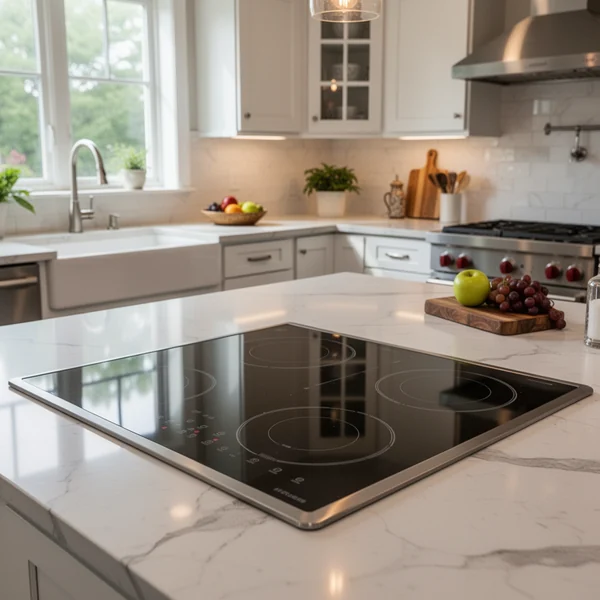
A full-size induction range needs a dedicated 240-volt circuit, sized from the appliance nameplate — commonly a 40 or 50 amp breaker with matching conductors and a four-wire receptacle. The circuit itself is the easy part; in most New York homes the real question is whether the panel and the service can accept another large 240-volt load, and that answer decides whether this is a half-day job or a project with a utility application attached to it.
Here is what the induction stove electrical requirements actually are, in the order an electrician works through them, with the parts that behave differently in New York City, in a co-op, and in a house still on a 100-amp service.
Start at the nameplate, not at a spec you read online
Every range and cooktop carries a rating plate stating its voltage and either its kilowatt draw or the branch-circuit ampacity it requires. That plate governs. As a rough map of what you will find:
- Freestanding and slide-in induction ranges — 240 V, generally calling for a 40 A or 50 A circuit.
- Induction cooktops (no oven below) — 240 V, often 30 A or 40 A, and usually hard-wired to a junction box rather than plugged in.
- Portable single- or double-zone units — 120 V on an ordinary 15 or 20 A circuit. Useful for trying induction before committing; not a substitute for a range.
Do not let anyone order wire before the model is chosen. A 50 A range dropped onto a 40 A circuit is a callback, and a 40 A circuit run for a range that turned out to need 50 A means opening the wall twice.
Three-wire versus four-wire: the pre-1996 New York kitchen
Plenty of houses in Queens, Yonkers, Buffalo and everywhere between still have the old three-wire range receptacle — a 10-30 or 10-50 configuration with no separate equipment ground. New circuits installed today must be four-wire, with the neutral and the ground kept separate all the way back to the panel.
The distinction matters commercially. If you are simply swapping a gas range for an induction one, there may be no existing 240 V circuit at all and you are running a new four-wire circuit regardless. If you are replacing an old electric range and the existing three-wire circuit is sound, the code has long allowed an existing branch circuit of that type to remain in service with a matching three-wire appliance cord — but the moment the circuit is replaced or extended, it comes up to current rules. Your inspector, not your installer, is the authority on where that line falls in your jurisdiction.
The load calculation is the part that costs money
Adding a large 240 V appliance to an existing dwelling is not a matter of “is there a spare slot in the panel”. An electrician performs a load calculation for an existing dwelling under the National Electrical Code’s method for additions, adding the new appliance to the connected load and checking it against the service size.
New York’s housing stock makes this bite. A great many homes built before the 1980s came with a 100-amp service that was perfectly adequate for a gas range, a gas dryer and one window unit. Add an induction range, a heat pump, a heat pump water heater and an EV charger — the four things households are adding right now — and the calculation runs out of service well before the panel runs out of physical space. If you are stacking these projects, sequence them deliberately; the same ceiling shows up in EV Charging and Solar Panels in New York, and the fix is the same fix.
When the calculation fails, there are three routes, in ascending order of cost:
- Load management. Recent code editions permit an energy management system to limit total demand so a service upgrade is not required — for example, a device that will not let the range and the EV charger draw at once. Whether your jurisdiction has adopted a code edition that recognises this is a question for the electrical inspector, and it is worth asking before you accept a service-upgrade quote.
- Panel replacement at the same service size, if the problem is a full or obsolete panel rather than insufficient amperage.
- Service upgrade to 200 A, which involves the utility — Con Edison, National Grid, NYSEG, RG&E, Orange & Rockland, Central Hudson or PSEG Long Island depending on where you are — and their scheduling, not your electrician’s, sets the timeline. Overhead services are usually straightforward; an underground service in a Westchester village or a Brooklyn row house can be a different order of project entirely.
Wiring methods: why an NYC quote and an upstate quote are not comparable
New York City’s Electrical Code restricts the wiring methods permitted in most buildings, so kitchen circuits there are typically run in metal raceway or armoured cable rather than the non-metallic sheathed cable that is standard in a Dutchess County house. Same circuit, same amperage, materially different labour. If you are comparing prices across county lines, you are not comparing like for like.
Permits, inspection and the paperwork that outlives you
Outside New York City, the pattern is consistent: your municipality issues the permit, and the electrical work is inspected by a third-party electrical inspection agency the municipality recognises, which issues a certificate of compliance when it passes. Keep that certificate. It is the document a buyer’s attorney, an appraiser or an insurer asks for years later, and reconstructing it after the fact is far harder than obtaining it on the day.
In New York City, electrical work is filed with the Department of Buildings by a licensed master or special electrician through DOB NOW: Electrical. The homeowner does not file it, and an electrician who suggests skipping the filing is telling you something useful about the rest of their work. The same filing discipline applies to other home energy work in the five boroughs — the process is laid out in Solar Panel Installation in NYC: Permits and Process.
Two more New York-specific items people trip over:
- Co-ops and condos. Expect an alteration agreement, board approval and, in older buildings, a genuine question about whether the apartment’s feeder can carry another 240 V appliance. Many pre-war buildings were never wired for it. Ask the managing agent about the riser capacity before you buy the range.
- The old gas line. Capping or removing the gas supply to the range is plumbing work, not electrical work. In New York City it is filed and performed by a licensed master plumber. Leaving a live, capped stub behind the cabinets is a common shortcut and a bad one.
Ventilation still applies
Induction removes combustion products from the kitchen, but it does not remove the smoke, grease and moisture from cooking. Keep a ducted hood. If you take the opportunity to upsize it, note that the residential mechanical code requires powered makeup air once the hood’s rated exhaust exceeds a set threshold — a real requirement in a tight, recently air-sealed house, and one that inspectors do check.
What this costs you in 2026, and what it does not
There is no federal tax credit for this work in 2026. Section 25C, which had covered qualifying efficiency improvements including panelboard upgrades performed alongside eligible equipment, applied to property placed in service through 31 December 2025 — see the IRS credit page. Section 25D, the residential clean energy credit, terminated for expenditures after the same date. Cooking appliances were never the target of 25C in any case, so treat any page promising 30% back on your induction range as noise.
NYS Clean Heat — NYSERDA with Central Hudson, Con Edison, National Fuel Gas, National Grid, NYSEG, Orange & Rockland and RG&E — covers space heating and water heating equipment, not ranges. If you are doing the kitchen as part of a wider electrification project, the heating equipment may qualify even though the stove does not; check your address in the finder at cleanheat.ny.gov. Any appliance-level rebate offering in New York is administered by NYSERDA, so confirm what is currently open with NYSERDA directly (1-866-NYSERDA) rather than trusting a figure on a manufacturer’s page. What the state still funds beyond panels is summarised in New York State Renewable Energy Incentives Beyond Solar.
What to do next
- Choose the exact model first and download its installation manual — the required circuit ampacity and receptacle type are in it.
- Photograph your panel’s interior label and main breaker rating, and have an electrician run a load calculation for the existing dwelling before quoting.
- If the calculation is tight, ask specifically whether a load management device is accepted by your inspector before agreeing to a service upgrade.
- In a co-op or condo, get the alteration agreement and confirm apartment feeder capacity in writing before ordering.
- Confirm the permit and inspection path — municipal permit plus third-party inspection agency outside the city, DOB NOW filing by a licensed electrician within it — and file the certificate of compliance with your closing documents.
- Arrange the gas cap with a licensed plumber as a separate line, and check your address in the Clean Heat finder if any heating equipment is part of the same job.
NY Solar Incentives
Independent New York solar research. We summarise NYSERDA, NY-Sun and federal programme rules from published sources and state plainly when a figure is an estimate. We are not a government agency and do not sell equipment.
Run the arithmetic on your own system
Check the dated program table and your arrangement before counting an incentive. Standard residential NY-Sun blocks are closed; Long Island Affordable Solar has a conditional income-verification route. The NY credit depends on qualified costs and tax liability, while the NYC abatement reduces future property-tax bills. The estimator keeps those timings separate.