Snow on Solar Panels in New York: What to Do
The short answer is almost always to leave it alone. Here is what snow actually costs a New York system, why clearing it causes more damage than it prevents, and the narrow cases where acting makes sense.
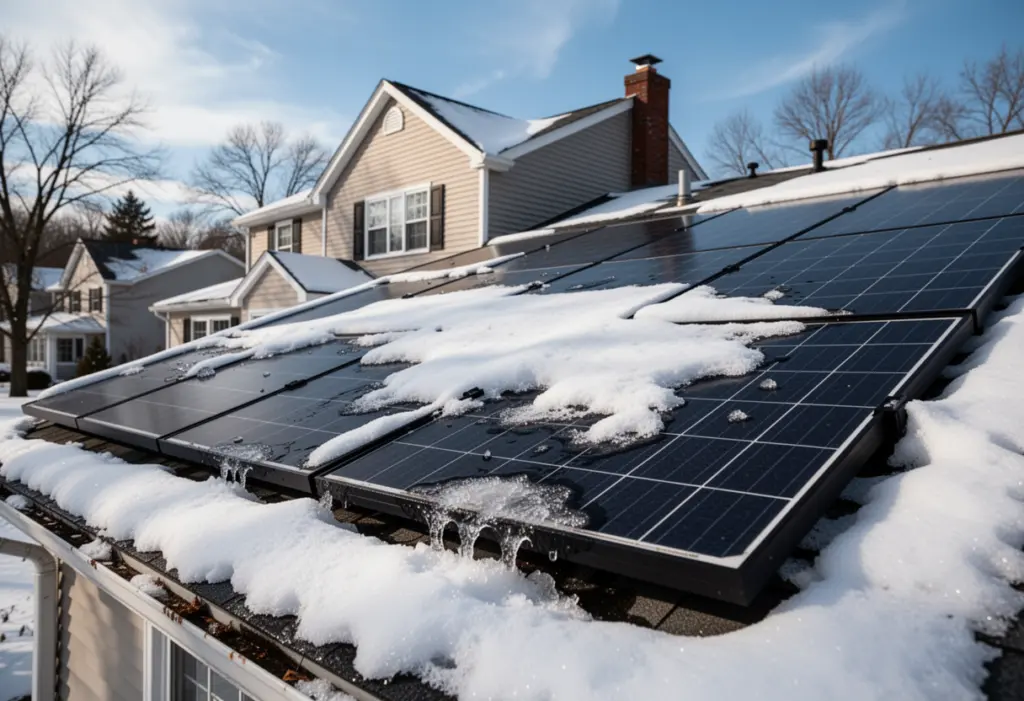
Every New York solar owner has the same January morning: the array is under six inches of snow, the monitoring app is flat, and the roof rake is in the garage. The answer, almost always, is to leave it alone — and the reasons are worth understanding, because the instinct to climb up there is what causes most winter damage to solar systems in this state.
What snow actually costs you
Less than it looks like it does, for three reasons.
The panels are the warm part of the roof. A module under snow still absorbs some light through it and its dark surface holds heat. Combined with a pitched, slick glass face, that usually means snow slides off a solar array before it comes off the shingles around it. Arrays clear themselves in a way roofs do not.
Partial clearing recovers most of the output. Once a strip of glass is exposed at the bottom edge, melt accelerates sharply. The array goes from zero to substantial production in hours, not days.
The lost days are the cheap days. December and January are the shortest, lowest-angle, weakest-production months of the New York year. A system designed for this climate banks its surplus from March to September and draws it down through winter. Losing several days of a month that was already contributing little to the annual total is a small effect on the annual number, which is the number that pays you.
Across a normal New York winter, snow cover typically accounts for a modest single-digit percentage of annual production. It is a real loss. It is not the loss it feels like on the morning you are looking at it.
Why clearing snow is usually the wrong move
The risks are concrete and they are not hypothetical.
- Scratched glass is permanent. The anti-reflective coating on the front of a module is what lets it convert light efficiently. A roof rake, a broom handle or a shovel edge will damage it, and that damage costs you production for the remaining decades of the panel’s life — far more than the snow ever would have.
- Most warranties do not cover it. Damage from homeowner clearing is generally excluded. You will be paying for the replacement and the labour to fit it.
- Ladders on ice. This is the actual danger, and it is the reason installers refuse to recommend it. A winter roof in New York is not a place to be.
- Sliding snow. Clearing the top of an array can release the whole sheet at once onto whatever is below — a porch roof, a car, a gas meter, a person.
The narrow cases where acting makes sense
There are three, and only three.
A ground-mounted array. If you can reach the panels standing on the ground, clearing them is reasonable. Use a soft-bristled snow broom made for panels — one with a foam or rubber blade and a telescoping handle — and pull downward with the slope. Never push up, and never use anything with a metal edge.
A very low-pitch or flat array. Flat-mounted systems, common on New York City and Long Island roofs, do not shed on their own and can stay covered for weeks. This is a case for a professional, not a homeowner with a rake.
Snow that is a structural or safety problem. If snow and ice are loading the array in a way that concerns you, or the array is discharging onto a doorway or walkway, that is a call to your installer. It is a building problem, not a production problem.
If you decide to act and the array is on a pitched roof, the rule is simple: do it from the ground, or do not do it. Nothing about the production you recover justifies being on an icy roof in February.
Ice, which is a different problem
Snow slides. Ice bonds. A freeze-thaw cycle — common across upstate New York and the Hudson Valley — can leave a sheet of ice locked to the glass that will not move until it melts, and trying to break it off is how modules crack.
Ice dams at the eave are a separate matter and a genuine one, but they are a roof-insulation and ventilation problem that existed before the panels did. If you are getting dams, address the attic. Do not attribute it to the array without having someone look.
What good winter design looks like
Most of the snow question is settled at installation, not in January.
- Pitch. A steeper array sheds sooner. New York roof stock is generally helpful here; flat commercial-style roofs are not.
- Racking specified for the local snow load. Erie County, the Tug Hill plateau and the Adirondacks are not Nassau County. Ask what load the system was designed to.
- Where the snow lands. A competent installer thinks about the discharge path before mounting panels above a front door, a driveway or a gas meter. Snow guards exist for this.
- Honest production estimates. A proposal that models New York production without accounting for winter snow cover is overstating your annual number.
What to do this winter
Watch the monitoring app, note the days at zero, and do nothing. When the sun returns the array will clear itself faster than the rest of the roof. If it has been covered for well over a week on a pitched roof, or if it is a flat array that has not moved at all, call the installer and ask them to look — that is what the workmanship warranty is for.
The one number worth tracking is the annual total, not the daily one. If your annual production is coming in close to the estimate, the winter took what it was always going to take.
Frequently Asked Questions
Should I clear snow off my solar panels?
Usually not. Panels shed snow on their own faster than the surrounding roof, and the scratching, warranty exclusions and ladder risk from clearing them cost far more than the few days of winter production you would recover.
How much production do New York solar panels lose to snow?
Typically a modest single-digit percentage of the annual total. The days lost fall in December and January, which are already the weakest production months of the year, so the effect on the annual figure that actually pays you is small.
What is the safe way to clear snow from solar panels?
Only from the ground, only with a soft-bristled snow broom made for panels, and only pulling downward with the slope. Never use a metal-edged tool, a shovel or a standard roof rake, and never climb onto an icy roof.
Does snow damage solar panels?
Snow itself does not. Modules are tested to substantial load ratings and racking in New York is specified for the local snow load. Damage in winter comes overwhelmingly from people trying to remove the snow.
Why is my flat roof solar array still covered when my neighbour's is clear?
Flat and low-pitch arrays, common in New York City and on Long Island, do not shed under gravity the way a pitched array does and can stay covered for weeks. That is a case for asking your installer to clear it professionally.
This article is general information, not tax, legal or financial advice. Incentive amounts, eligibility rules and deadlines change and depend on your utility, your tax situation and your property. Confirm current terms with NYSERDA, your utility and a qualified tax professional before making a decision.
NY Solar Incentives
Independent New York solar research. We summarise NYSERDA, NY-Sun and federal programme rules from published sources and state plainly when a figure is an estimate. We are not a government agency and do not sell equipment.
Run the arithmetic on your own system
Check the dated program table and your arrangement before counting an incentive. Standard residential NY-Sun blocks are closed; Long Island Affordable Solar has a conditional income-verification route. The NY credit depends on qualified costs and tax liability, while the NYC abatement reduces future property-tax bills. The estimator keeps those timings separate.