Heat Pump Noise Rules in New York Towns
New York has no statewide heat pump noise limit. Your town's noise chapter and its zoning setback for mechanical equipment decide where the outdoor unit can legally sit.
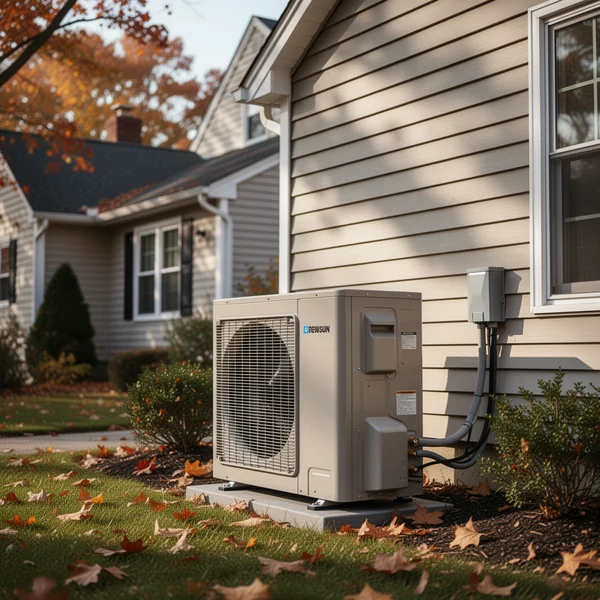
The rule that governs your outdoor heat pump unit is your own town’s or village’s code, not a state law. There is no statewide heat pump noise ordinance in New York, so the limit that applies to your side yard is whatever your municipality wrote into its noise chapter and its zoning setbacks for mechanical equipment — and both are usually online and readable in about ten minutes.
That matters more than it sounds, because a mini split condenser and a ducted outdoor unit both run at their loudest on the coldest and hottest days, and because the person who calls the code enforcement officer is almost always the neighbour whose bedroom window is twenty feet from where your installer wanted to put it.
How a New York heat pump noise ordinance is actually written
Municipal noise codes in New York fall into two broad drafting styles, and which one your town uses changes how you defend a placement.
- A measured dBA limit. The code states a sound level, measured at the property line or at the receiving property’s dwelling, and usually a lower figure for a night-time window. Enforcement requires someone with a sound level meter, which in a small town may mean the building inspector or the county.
- A “plainly audible” or nuisance standard. No number at all. The code prohibits sound that is plainly audible at the property line, or that unreasonably disturbs a person of ordinary sensibilities. These are harder to plan around because the finding is a judgement call.
Many codes carve out an exemption for HVAC equipment serving the property, or set a separate, more permissive standard for it. Some do the opposite and name “air conditioning condensers and heat pumps” explicitly with a stricter rule. Do not assume either way — read the text.
Where your town’s code actually lives
Most New York towns, villages and cities publish their code through one of the commercial code hosts, and the municipal website links to it from the Clerk’s or Building Department’s page. Search the code for noise, then separately for mechanical equipment, condenser, air conditioning and accessory structure. The noise chapter tells you how loud; the zoning chapter tells you how close.
The setback question catches more installs than the decibel question. Zoning codes frequently treat outdoor mechanical equipment as an accessory structure subject to the side-yard and rear-yard setback for the district, and a narrow lot in a village like Ossining or a bungalow block in Queens can leave you with no compliant spot on the side of the house at all. That pushes the unit to the rear, which changes the line-set run and the price.
The unit’s own sound rating, and when it lies to you
Every manufacturer publishes a sound rating for the outdoor unit in dB(A) at a stated distance, on the submittal sheet or engineering data sheet — not the glossy brochure. Ask your contractor for that sheet by model number before signing. Three things about that figure are worth knowing:
- It is usually a cooling-mode, rated-condition number. Heating at low outdoor temperature is a different operating point, and the fan and compressor often run harder there.
- Defrost is the loud mode. When the outdoor coil ices up, the unit reverses, the fan stops and restarts, and there is a distinct whoosh and sometimes a metallic clunk from the reversing valve. In the Hudson Valley and the Southern Tier, damp air in the high twenties and thirties produces far more defrost cycling than a dry ten-degree night in the North Country.
- Sound reflects. The same unit placed in a narrow alley between two houses, with a masonry wall on one side, will read higher at the neighbour’s window than the spec sheet implies. Hard surfaces on two or three sides are the single biggest avoidable mistake.
There is also a seasonal asymmetry that catches people out. A Buffalo winter runs with every window in the neighbourhood shut, so heating noise generates few complaints. The complaints arrive in a Long Island or Westchester shoulder season, when it is fifty degrees at night, the unit is still cycling, and everyone’s windows are open.
Placement choices that keep you out of the argument
- Keep it off the wall shared with a bedroom, yours or theirs. Wall-bracket mounts are compact but transmit compressor vibration straight into the framing; ground pads with anti-vibration isolators do not.
- Avoid the narrow gap between two houses. If it is the only option, ask about a unit with a lower rated sound level rather than accepting the default model in the quote.
- Snow stands raise the unit — necessary anywhere north of the city and on any lake-effect belt — which also raises the sound source above a fence line. Factor that into where you put it.
- Do not box it in. Decorative screens and lattice enclosures that starve airflow cause recirculation, which cuts capacity, drives more defrost cycles and makes the unit noisier, not quieter. Keep the manufacturer’s clearances; they are on the same submittal sheet.
- Talk to the neighbour before install day, not after the concrete pad is poured. It costs nothing and it is the cheapest insurance available.
Landmark districts, co-ops and HOAs add a second approval
A municipal noise code is not the only gatekeeper. In a New York City landmark district the Landmarks Preservation Commission controls what is visible from the street, which is exactly the reasoning that governs rooftop and facade solar equipment — the process is laid out in our guide to solar panels in a historic district in New York, and outdoor mechanical equipment is reviewed on the same logic. In a homeowners association, the association’s covenants may restrict equipment placement; New York’s statutory protections for solar are specific to solar, as explained in can an HOA stop you installing solar in New York, and you should not assume they extend to a condenser.
What this costs you, and what 2026 changed
A relocation to satisfy a setback or a neighbour usually shows up as extra line-set, extra electrical run, and sometimes a second pad or a longer condensate route. Get it priced in the original quote rather than as a change order.
On the incentive side, be clear about one thing before any contractor quotes you: the federal Section 25C credit that covered heat pumps applied to property placed in service through 31 December 2025, and Section 25D terminated for expenditures after that same date. A New York household installing in 2026 gets nothing federal. Anyone quoting you a 30% federal credit on a heat pump this year is wrong, and it is a reason to read the rest of their paperwork carefully.
What remains is state and utility money. NYS Clean Heat is run by NYSERDA with seven sponsoring utilities — Central Hudson, Con Edison, National Fuel Gas, National Grid, NYSEG, Orange & Rockland and RG&E. PSEG Long Island is not one of them and runs its own separate programmes. Rebate amounts are not published as a single statewide table; they vary by utility and by equipment, so use the address-based finder at cleanheat.ny.gov to see what applies to your service address rather than trusting a figure in a sales sheet. Our overview of New York State renewable energy incentives beyond solar covers how these programmes sit alongside each other.
What to do next
- Open your municipality’s online code and read the noise chapter and the zoning setback for accessory mechanical equipment. Print both pages.
- Ask each bidding contractor for the outdoor unit’s submittal sheet by model number, and for the sound rating and required clearances on it.
- Mark the proposed location on a sketch with distances to your property line and to the nearest neighbouring window, and check it against what you printed.
- If you are in a landmark district, a co-op or an HOA, get the placement approved in writing before the deposit.
- Run your address through cleanheat.ny.gov to find your utility’s current rebate, and budget with no federal credit for a 2026 install.
NY Solar Incentives
Independent New York solar research. We summarise NYSERDA, NY-Sun and federal programme rules from published sources and state plainly when a figure is an estimate. We are not a government agency and do not sell equipment.
Run the arithmetic on your own system
Check the dated program table and your arrangement before counting an incentive. Standard residential NY-Sun blocks are closed; Long Island Affordable Solar has a conditional income-verification route. The NY credit depends on qualified costs and tax liability, while the NYC abatement reduces future property-tax bills. The estimator keeps those timings separate.