Hail Damage to Solar Panels in New York
Hail damage is an insurance question first and a warranty question second. The two have entirely different tests, and the conversation that matters happens before the array is installed, not after the storm.
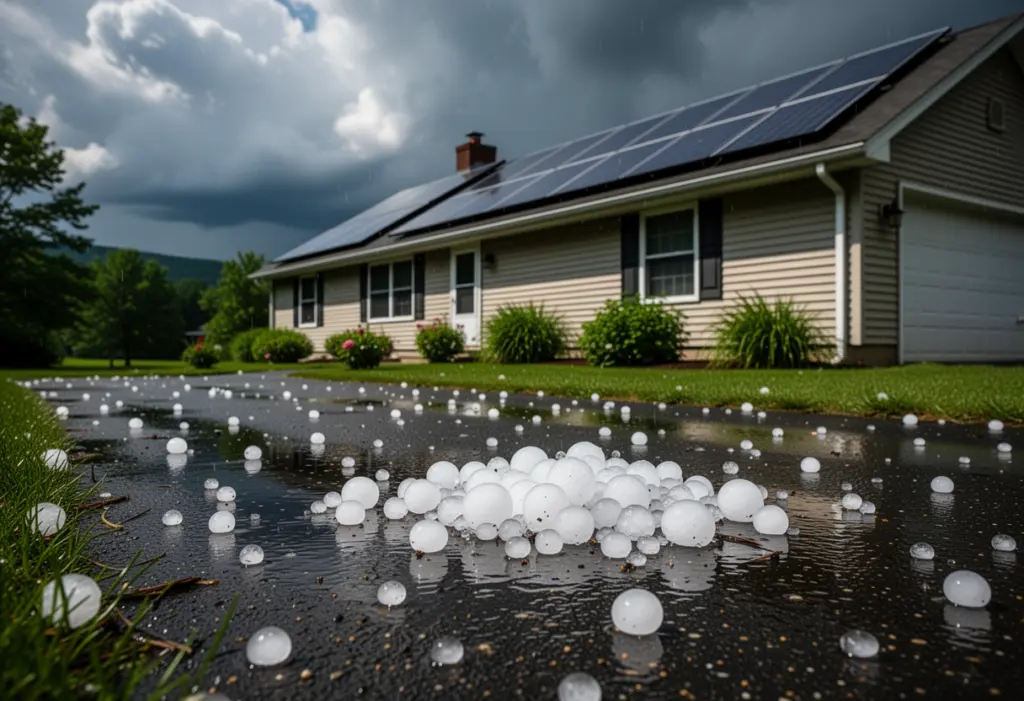
The single most useful thing to know about hail and solar panels is that two different systems can pay for the damage, and they answer different questions. A product warranty covers defects in the panel. Insurance covers events that happen to it. Hail is an event. So the conversation that matters is with your insurer, and the right time for it is before the array goes on the roof.
Settle the insurance question first
Call your homeowner insurer and ask four things plainly.
- Is a roof mounted array covered under the dwelling coverage, or does it need to be scheduled or endorsed separately?
- Does the dwelling coverage amount need to increase to reflect the cost of replacing the system as well as the house?
- Does a separate wind and hail deductible apply to your policy, and if so, what is it?
- Does the insurer need to be notified when the system is installed, and what documentation do they want?
Get the answers in writing, keep them with the installation paperwork, and check them again if you change insurer. A policy that covers the array is a very different position from a policy that has never been told the array exists.
What the panel itself is rated for
Modules are tested against a defined impact, and the rating is stated on the manufacturer datasheet for the exact model. Ask for that datasheet rather than a summary from a salesperson, and keep it: it is the document that describes what the equipment was built to withstand, and it is one of the first things a claim conversation reaches for.
A rating is not a promise about a specific storm. It tells you the panel meets a standard test, which is worth having and is not the same as being hail proof.
After a storm
Do not climb up to look. Hail damage is frequently invisible from a distance and sometimes invisible from arm length: the characteristic failure is fine cracking in the cells beneath intact glass, which shows up as production loss rather than as a visible break.
Do this instead, in order. Photograph the ground level evidence while it exists — hailstones beside something for scale, dents on gutters, damage to the roof covering, marks on decking or vehicles. Note the date and time. Then look at monitoring: compare the days after the storm against the days before, and if the platform reports per panel, look for modules that changed together rather than one that has been low for months.
Report it to the insurer promptly and, if the array is under warranty, to the installer as well, so both files start on the same date. Ask the installer for a proper inspection rather than a visual glance — a technician can test the electrical behaviour of a string and identify modules that are underperforming even when the glass looks perfect.
If the system is leased or on a power purchase agreement
You are not the owner of the equipment, and the claim is not yours to make. The agreement will say who insures the system, who must be notified, and within what period. Find that clause and follow it, because a delay in reporting is the most common way a straightforward repair becomes an argument. Your own policy still covers your roof.
The cost of waiting
A derated array keeps costing money in two directions. Lost production under Phase One net metering is lost at the full retail rate, because that is how exports are credited, and the structure holds for 20 years from interconnection. And the Customer Benefit Contribution continues unchanged on any system interconnected on or after 1 January 2022, because it is charged on the DC size of the system rather than on what it delivers: a 9 kW array in Con Edison territory pays 9 × $1.29, about $11.61 a month or $139 a year, whether every cell is intact or a third of the string is cracked. Systems interconnected before 2022 are outside the charge entirely. Repair speed is worth real money here.
The 2026 tax position on replacement panels
Do not plan a repair around a federal credit. Section 25D was terminated for expenditures made after 31 December 2025, and an expenditure is treated as made when the original installation is completed, so replacement work now earns nothing federally, and any contractor pricing a repair against a 30% federal line is working from a rule that no longer exists.
On the state side, New York keeps 25% of qualified solar energy system equipment expenditure capped at $5,000 on Form IT-255 at a principal residence, limited by your actual New York tax liability and carried forward up to five years. Two cautions specific to a hail claim: the cap is a lifetime figure you may already have used against the original installation, and an expenditure reimbursed by insurance is not the same as one you bore yourself. Put both questions to a tax preparer with the claim documents in front of them, and confirm current programme terms with NYSERDA rather than assuming last year answer.
Frequently Asked Questions
Does homeowner insurance cover hail damage to solar panels?
Frequently yes under dwelling coverage, but not always, and some policies apply a separate wind and hail deductible. Ask your insurer before installation whether the array is covered, whether coverage should increase, and what the deductible is.
Does the panel warranty cover hail?
A product warranty covers defects in the panel, not weather events, so hail is normally an insurance matter. The datasheet for your exact module states the impact rating it was tested against, and is worth keeping.
How do I know if hail damaged my panels?
Often you cannot see it. Fine cell cracking under intact glass shows up as production loss, so compare monitoring before and after the storm, photograph ground level evidence, and ask for a technician inspection rather than climbing up.
Who claims if my system is leased?
The third party owns the equipment, so the claim is theirs. Your agreement says who insures it, who must be notified and within what period. Follow that clause promptly, since late reporting is what turns a repair into a dispute.
This article is general information, not tax, legal or financial advice. Incentive amounts, eligibility rules and deadlines change and depend on your utility, your tax situation and your property. Confirm current terms with NYSERDA, your utility and a qualified tax professional before making a decision.
NY Solar Incentives
Independent New York solar research. We summarise NYSERDA, NY-Sun and federal programme rules from published sources and state plainly when a figure is an estimate. We are not a government agency and do not sell equipment.
Run the arithmetic on your own system
Check the dated program table and your arrangement before counting an incentive. Standard residential NY-Sun blocks are closed; Long Island Affordable Solar has a conditional income-verification route. The NY credit depends on qualified costs and tax liability, while the NYC abatement reduces future property-tax bills. The estimator keeps those timings separate.