Commercial Solar Interconnection in New York: The Real Path
A commercial interconnection is not a larger version of the residential one. The compensation rules are different, the study process is different, and the answer that matters arrives before the panels are ordered.
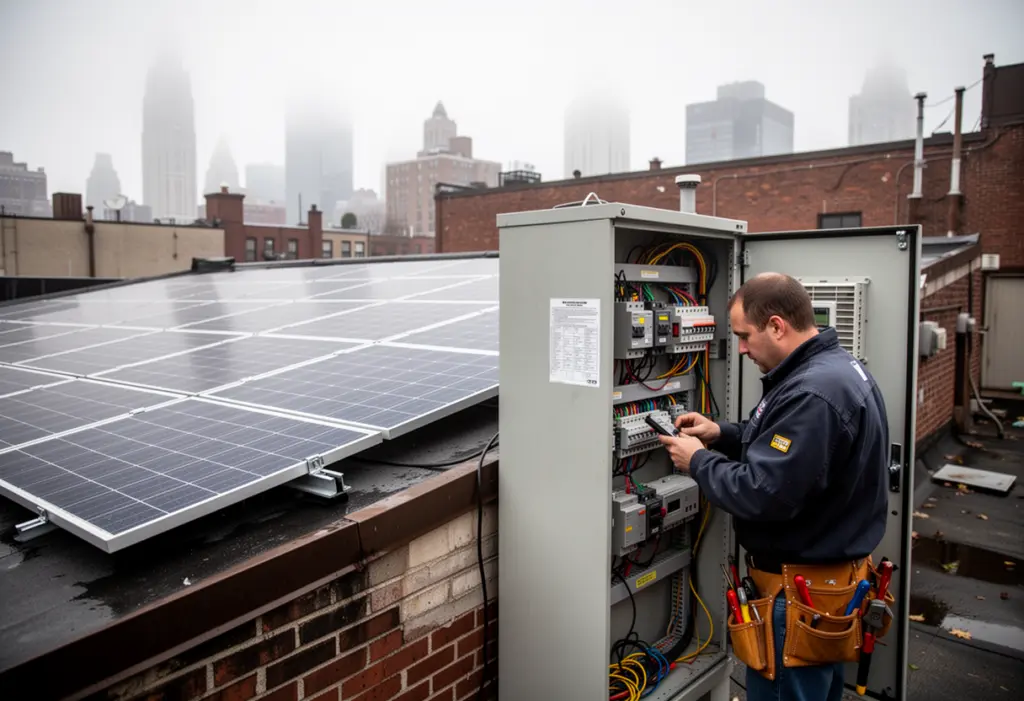
The single question that decides a commercial solar project in New York is how the exported power will be compensated, and for most non-residential projects the answer is not full retail net metering. Phase One net metering, which credits exports at the full retail rate and holds that structure for twenty years from interconnection, is what most mass-market residential rooftop customers are on. The Value Stack, also called VDER, is the framework built for community distributed generation and for larger and commercial projects. Establish which one your project falls under before anyone prices the array, because it changes the value of every exported kilowatt-hour in the model.
Ask these four things before design
- Which utility actually serves the meter. Read the bill rather than assuming from the county. Territory boundaries do not follow county lines, and if the building sits in a municipal electric utility’s service area it is outside Public Service Commission jurisdiction altogether: no state interconnection process, no Public Service Commission net metering, no Customer Benefit Contribution, and terms set by the municipality directly.
- Which service account and which rate class. A demand-billed account and a small commercial account are treated differently, and the difference has money in it.
- What capacity the circuit can take. Hosting capacity is finite and it is consumed by whoever applies first.
- Whether the project is behind the meter or front of the meter. That single choice changes the compensation, the charges and the study track.
Why the study stage is where schedules break
A residential rooftop is a standardised application. A commercial project of any size enters a study process where the utility examines what the circuit can absorb and what upgrades the project would trigger. Those upgrades are not the utility’s cost to swallow; they land in the project budget, and they can be discovered late enough to change whether the project happens at all. Two practical consequences follow.
First, the interconnection application should go in as early as the design allows, because position in the queue is real and capacity ahead of you is capacity you cannot have. Second, no equipment should be ordered against a schedule that assumes the study will come back clean. Ask your developer, in writing, what the study has actually returned and what the upgrade exposure looks like, rather than accepting a projected commissioning date.
Permission to operate is the date that counts
An array that is mechanically finished and electrically inspected is still not allowed to export. Permission to operate from the utility is the milestone that starts production, starts any twenty-year compensation term, and starts the clock on the payback the proposal promised. When a proposal quotes a completion date, ask whether it means panels on the roof or permission to operate in hand. Those two dates are frequently months apart, and only one of them earns anything.
The monthly charge, and the account type that avoids it
The Customer Benefit Contribution is billed monthly on the DC size of the system rather than on production, for systems interconnected on or after 1 January 2022, and the rates are recalculated annually rather than locked at interconnection. On Con Edison’s 2026 small commercial rate of $1.47 per kW-month, a 50 kW rooftop pays 50 x $1.47 = $73.50 a month, or $882 a year, before it has generated anything.
Two details are worth checking against your own account. Commercial accounts with a demand charge are not subject to the contribution at all, so the rate class question above is not academic. And the small commercial rate is not automatically higher than the residential one: for 2026, RG&E’s small commercial rate is $0.96 against a residential $1.31, NYSEG’s is $1.14 against $1.19, and Orange & Rockland’s is $0.88 against $1.00. Three utilities, not two, run that way.
Where the incentives actually sit for a business
Nothing on the residential side carries over. The 30% federal residential credit under section 25D is gone, terminated for expenditures made after 31 December 2025 with the expenditure treated as made when the original installation is completed. New York’s 25% credit on Form IT-255 is capped at $5,000 and requires the taxpayer’s principal residence, so it does not apply to a commercial building either. Business projects fall under a separate provision with its own conditions, and the right person to price that into a model is your accountant, working from the actual ownership structure.
What does apply on the state side is NY-Sun, paid through the contractor as a price reduction and stepping down as each regional megawatt block fills, and RPTL 487’s fifteen-year property tax exemption on added value where the municipality, the county and the school district have each not opted out, for systems constructed before 1 January 2030. All of this moves. Confirm the current position with NYSERDA and with the utility before it goes into a business case.
Frequently Asked Questions
Is commercial solar net metered in New York?
Usually not in the full retail sense. Phase One net metering at the full retail rate is what most mass-market residential rooftop customers are on. The Value Stack, or VDER, is the framework for community distributed generation and for larger and commercial projects. Confirm which applies before the array is priced.
How long does a commercial interconnection take in New York?
It depends on the study stage rather than on the installation. The utility examines what the circuit can absorb and what upgrades the project would trigger, and those findings can change both the budget and the schedule. Apply early and do not order equipment against an assumed clean result.
Does my business pay the Customer Benefit Contribution?
Commercial accounts with a demand charge are not subject to it. Where it applies, it is billed monthly on DC size: 50 kW on Con Edison's 2026 small commercial rate of $1.47 per kW-month is $73.50 a month, or $882 a year, regardless of production.
Can a business claim the 30% federal solar credit?
Not the residential one. Section 25D was terminated for expenditures made after 31 December 2025 and never applied to business property anyway. Business projects fall under a separate provision with its own conditions, which your accountant should price from the actual ownership structure.
This article is general information, not tax, legal or financial advice. Incentive amounts, eligibility rules and deadlines change and depend on your utility, your tax situation and your property. Confirm current terms with NYSERDA, your utility and a qualified tax professional before making a decision.
NY Solar Incentives
Independent New York solar research. We summarise NYSERDA, NY-Sun and federal programme rules from published sources and state plainly when a figure is an estimate. We are not a government agency and do not sell equipment.
Run the arithmetic on your own system
Check the dated program table and your arrangement before counting an incentive. Standard residential NY-Sun blocks are closed; Long Island Affordable Solar has a conditional income-verification route. The NY credit depends on qualified costs and tax liability, while the NYC abatement reduces future property-tax bills. The estimator keeps those timings separate.