Solar and a New Roof in New York: Getting the Timing Right
The sequence is decided by one number: how many years the roof has left. Get that from a roofer, in writing, before a solar contract is anywhere near the table.
On this page 8 sections
- 01Get the roof assessed by a roofer
- 02What a later removal and reinstall actually costs
- 03The warranty question, which is the one that bites
- 04One trip or two
- 05The federal deadline that used to force the timing no longer exists
- 06The New York clocks that do still run
- 07A short sequence to follow
- 08Frequently Asked Questions
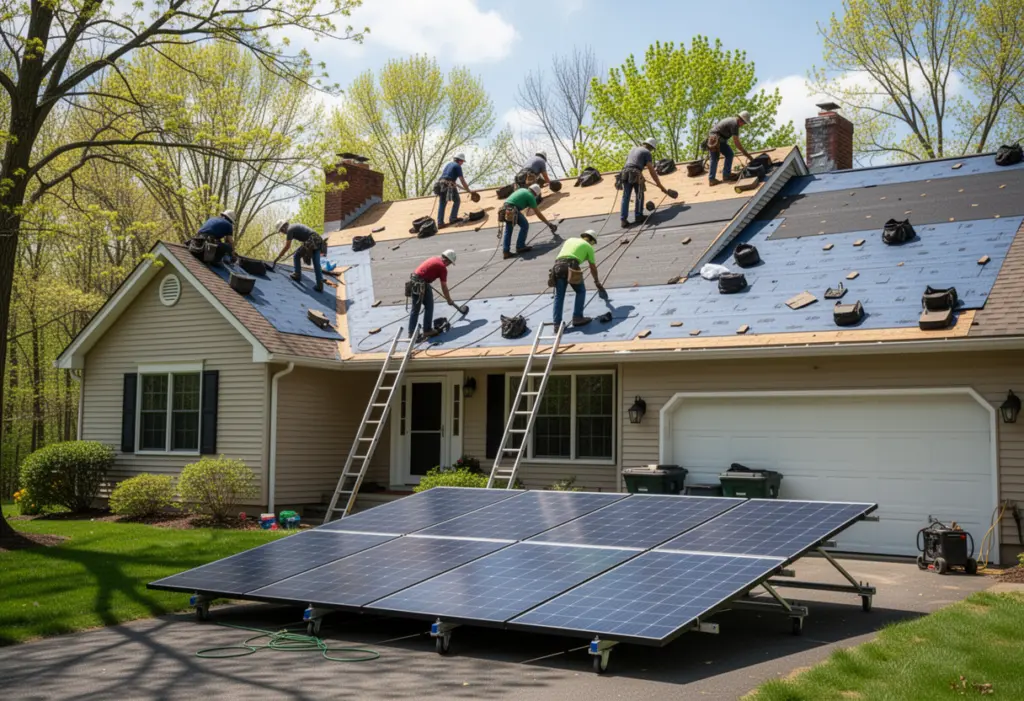
The sequence is decided by one number: how many years the roof has left. If that number is smaller than the working life of a solar array, the roof goes first. Doing it the other way round means paying a crew to remove the array and put it back, with the system off and producing nothing in between, and it puts two warranties into an argument with each other.
Get the roof assessed by a roofer
Not by the solar salesperson, and not from a photograph. A roofer will tell you the covering type, its age, the condition of the decking, whether there has been previous layering, and how the flashing and ventilation are performing. Ask for the remaining life in writing. An installer with an incentive to close this month is the wrong source for the one number the whole sequence depends on.
What a later removal and reinstall actually costs
- A second mobilisation: crew, lift or scaffold, and site setup paid twice.
- Labour to detach and re-attach every module, plus new flashings and often new attachment hardware, because the old penetrations are not being reused.
- Weeks of lost production while the array is off the roof, which lands squarely in whatever season the roof failed in.
- Storage and handling risk for the modules, and the possibility that a discontinued module cannot be matched if one is damaged.
The warranty question, which is the one that bites
If a leak appears after solar goes on, you want a single party responsible. That is easiest when the roof is new and the installer has warranted their own penetrations in writing, in the contract, with a term attached. Ask three questions before signing: what is the flashing method at each attachment, how long is the workmanship warranty on those penetrations specifically, and does the roofing manufacturer’s warranty survive a third party penetrating the roof. The third answer is frequently no unless a specific procedure is followed, and it is far cheaper to establish that before the holes are drilled.
One trip or two
Where the roof is being replaced anyway, the cleanest arrangement is a re-roof immediately followed by the array, coordinated so the solar layout is known before the roofers finish. It avoids paying twice for access and it lets the roofer position vents, pipes and any new penetrations clear of where panels will sit. It also means one conversation about who is responsible for the roof, rather than two.
The federal deadline that used to force the timing no longer exists
The 30 percent residential credit at section 25D was terminated for expenditures made after 31 December 2025, and the operative test is when the original installation is completed rather than when the system is switched on. There is a separate rule for work done in connection with constructing or reconstructing a structure, where the test is when the taxpayer’s original use of that structure begins. Either way, a 2026 quote that still shows a 30 percent federal line is materially wrong and there is no longer a federal reason to compress the schedule. Sequence the work for cost and for the roof, which is what should have driven it in the first place.
The New York clocks that do still run
RPTL 487 gives a 15-year exemption from real property tax on the value the system adds, but it requires construction before 1 January 2030 and it survives only where the municipality, the county and the school district have each declined to opt out — three separate checks with your assessor, not one.
Interconnection is its own clock. Phase One net metering credits exports at the full retail rate for 20 years from interconnection, and the Customer Benefit Contribution applies to systems interconnected on or after 1 January 2022, charged monthly on DC capacity regardless of production. On RG&E at $1.31 per kW-month for 2026, a 7 kW array is about $9.17 a month, near $110 a year. Delaying an installation across a year boundary does not change that charge in your favour, because the rates are recalculated annually rather than locked at interconnection.
A short sequence to follow
- Roofer inspects and states remaining life in writing.
- If the roof is going, replace it first and share the intended solar layout with the roofer.
- Solar contract specifies flashing method, penetration warranty term, and who answers a leak call.
- Permit, install, electrical inspection, then permission to operate — record the interconnection date.
- File RP-487 with your assessor and keep the paperwork with your tax records.
Incentive programmes move, so confirm the current position yourself: NYSERDA publishes the NY-Sun block position by region, and the per-watt incentive steps down as each block fills, which is a real cost of drift when a project slips by a season.
Frequently Asked Questions
Should I replace the roof before installing solar?
If the remaining life of the roof is shorter than the life of the array, yes. Removing and reinstalling later means a second mobilisation, new flashings and hardware, and weeks with the system off the roof producing nothing.
Who is responsible if the roof leaks after solar is installed?
Whoever your contract says, which is why the flashing method, the workmanship warranty term on the penetrations and the effect on the roofing manufacturer's warranty should all be written down before any holes are drilled.
Is there still a federal deadline pushing the timing?
No. The 30% residential credit at section 25D was terminated for expenditures made after 31 December 2025, with an expenditure treated as made when the original installation is completed. Sequence the work for cost and for the roof instead.
Does any New York deadline apply?
RPTL 487, the 15-year property tax exemption on added value, requires construction before 1 January 2030 and survives only where the municipality, county and school district have each not opted out.
This article is general information, not tax, legal or financial advice. Incentive amounts, eligibility rules and deadlines change and depend on your utility, your tax situation and your property. Confirm current terms with NYSERDA, your utility and a qualified tax professional before making a decision.
NY Solar Incentives
Independent New York solar research. We summarise NYSERDA, NY-Sun and federal programme rules from published sources and state plainly when a figure is an estimate. We are not a government agency and do not sell equipment.
Run the arithmetic on your own system
Check the dated program table and your arrangement before counting an incentive. Standard residential NY-Sun blocks are closed; Long Island Affordable Solar has a conditional income-verification route. The NY credit depends on qualified costs and tax liability, while the NYC abatement reduces future property-tax bills. The estimator keeps those timings separate.