Solar for a New York School District: Where to Start
A school district owes no income tax, and its buildings empty across the months when production is at its highest. Both facts change the case before a single panel is priced.
On this page 8 sections
- 01The load runs opposite to the sun
- 02Value has to arrive as cash or as a price
- 03The procurement question comes before the engineering one
- 04Your district is one of the three RPTL 487 authorities
- 05Permitting and interconnection are not the residential path
- 06What to establish before the first proposal
- 07Incentives, and the one to strike out
- 08Frequently Asked Questions
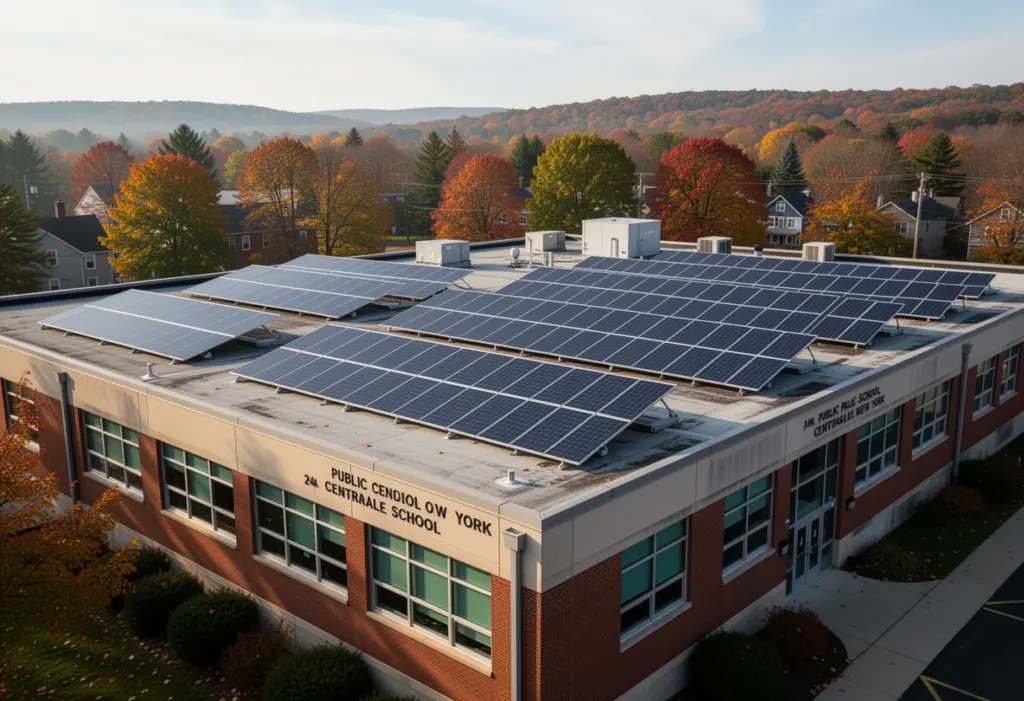
Two facts about a school district decide most of a solar proposal before anyone measures a roof. It owes no income tax, so a tax credit has nothing to offset and value has to arrive some other way. And its load collapses in July and August, while production is at or near its annual peak. Neither is a reason not to build. Both are reasons to insist that what reaches your board is modelled on your district rather than on a generic commercial building.
The load runs opposite to the sun
School buildings are busy from September to June and largely empty through the summer, and solar production is the reverse of that. What bridges the gap is the export compensation mechanism, and which one applies is the most consequential line in the whole proposal.
Most residential rooftop customers in New York are on Phase One net metering, where exports are credited at the full retail rate and the structure holds for 20 years from interconnection. The Value Stack is the mechanism for community distributed generation and for larger and commercial projects. A district-scale array is not a house, so a residential net metering assumption must not be carried across silently. Ask in writing which compensation applies to a project of this size on this account, and require that the financial model be rebuilt if the answer changes.
Value has to arrive as cash or as a price
Because the district is tax exempt, a credit against income tax is worth nothing to it directly. There are two broad routes and they belong to different advisers.
Elective pay, sometimes called direct pay, is the mechanism by which a tax-exempt entity can be paid the value of certain federal energy credits in cash rather than offsetting tax it does not owe. Whether it reaches your project, on what terms and under which current rules is a question for the district’s counsel and auditor, not for a vendor’s slide and not for this page.
Third-party ownership is the other route: somebody else owns the system and the district buys the power or leases the equipment. There the tax benefits belong to the owner and what the district receives is a price, so the comparison is that price against what you pay the utility now, across the full term, with the escalator included and with the end-of-term position written down.
The procurement question comes before the engineering one
A district is a public body and its purchasing is governed accordingly. Which routes are open to you at all, and what process each requires, is a question for the district’s counsel and business office at the very start rather than a detail to be tidied up once a preferred vendor is in the room. A vendor who tells you which procurement route to use is answering a question they do not own.
Your district is one of the three RPTL 487 authorities
This is the part unique to a school district, and it cuts both ways. RPTL 487 gives a fifteen-year exemption from real property tax on the value a solar system adds, and the exemption can be opted out of separately by the county, by the city, town or village, and by the school district itself. Your district may therefore already hold a position on solar exemptions inside its own boundaries, and if it does, the district office knows where that resolution is filed.
In New York City, Buffalo, Rochester, Syracuse and Yonkers the school district is fiscally dependent and levies no separate property tax at all, so there is no separate school check to make in those five. Section 487 also requires construction before 1 January 2030, which is a real constraint on a project that has to clear a board, a procurement process and an interconnection queue.
Permitting and interconnection are not the residential path
The New York State Unified Solar Permit standardises permitting for systems of 25 kW DC and under and has been adopted by over 300 authorities having jurisdiction. A district-scale array sits above that threshold, so it goes through ordinary building permitting, and in the five boroughs through the New York City Department of Buildings. Ask early what interconnection process applies to a project of this size on this account, who submits the application, and what the queue looks like now. The timeline of a large project lives there rather than in the installation itself.
What to establish before the first proposal
- Twelve months of interval data for every meter, not annual totals.
- The utility serving each building, read from the bill. A municipal electric utility is outside the Public Service Commission entirely.
- Roof age and remaining warranty on every building under consideration, and the cost of removing and reinstalling an array if a roof is replaced.
- A stamped structural review including design snow load for your actual location.
- Whether other electrification is planned: buses, heat pumps, kitchen equipment. Each lands on the same meters.
Incentives, and the one to strike out
If a proposal shows a 30 percent federal residential credit line, it is materially wrong and the arithmetic behind it should be rejected. Section 25D was terminated for expenditures made after 31 December 2025, an expenditure is treated as made when the original installation is completed, and it was a residential provision that never reached a district. New York State’s 25 percent credit capped at 5,000 dollars on Form IT-255 requires a principal residence and does not apply either.
NY-Sun is applied by a participating contractor as a reduction in price and steps down in blocks as capacity fills, so ask which block and what the per-watt figure is on the day of the quote. The Customer Benefit Contribution is charged monthly on DC system size for systems interconnected on or after 1 January 2022, and accounts with a demand charge do not pay it. Where it does apply, at the 2026 net-metered small commercial rate of 1.38 dollars per kW-month on National Grid, a 40 kW array on a smaller building is 55.20 dollars a month, about 662 a year, whatever it produces; a project compensated under the Value Stack sits on a separate and lower CBC schedule, so confirm which rate table the account falls under before the figure is used. Confirm each of these with NYSERDA and your utility before a number reaches the board packet.
Frequently Asked Questions
How does a school district benefit from a tax credit it cannot use?
Not directly. Either through elective pay, the mechanism by which a tax-exempt entity can be paid the value of certain federal energy credits in cash, or through third-party ownership, where the owner takes the tax benefits and the district simply buys power at a price. Which is available and on what terms is a question for the district's counsel and auditor.
Does the summer break ruin the case for school solar?
No, but it moves the case onto the export compensation mechanism, since production peaks when the buildings are empty. Ask in writing whether the project is compensated under net metering or the Value Stack, and require the model to be rebuilt if the answer changes.
Does the school district property tax exemption matter here?
It matters twice. RPTL 487's fifteen-year exemption can be opted out of separately by the county, the municipality and the school district, so your own district may already have taken a position. In New York City, Buffalo, Rochester, Syracuse and Yonkers there is no separate school levy, so that check does not arise.
Does the Unified Solar Permit cover a school array?
Usually not. It standardises permitting for systems of 25 kW DC and under and has been adopted by over 300 authorities having jurisdiction. A district-scale system goes through ordinary building permitting, and through the New York City Department of Buildings in the five boroughs.
This article is general information, not tax, legal or financial advice. Incentive amounts, eligibility rules and deadlines change and depend on your utility, your tax situation and your property. Confirm current terms with NYSERDA, your utility and a qualified tax professional before making a decision.
NY Solar Incentives
Independent New York solar research. We summarise NYSERDA, NY-Sun and federal programme rules from published sources and state plainly when a figure is an estimate. We are not a government agency and do not sell equipment.
Run the arithmetic on your own system
Check the dated program table and your arrangement before counting an incentive. Standard residential NY-Sun blocks are closed; Long Island Affordable Solar has a conditional income-verification route. The NY credit depends on qualified costs and tax liability, while the NYC abatement reduces future property-tax bills. The estimator keeps those timings separate.