Prevailing Wage and Solar Projects in New York
Prevailing wage is decided by who is paying and under what contract, not by the technology. Establish the answer before bids go out, because bids written under different assumptions cannot be compared.
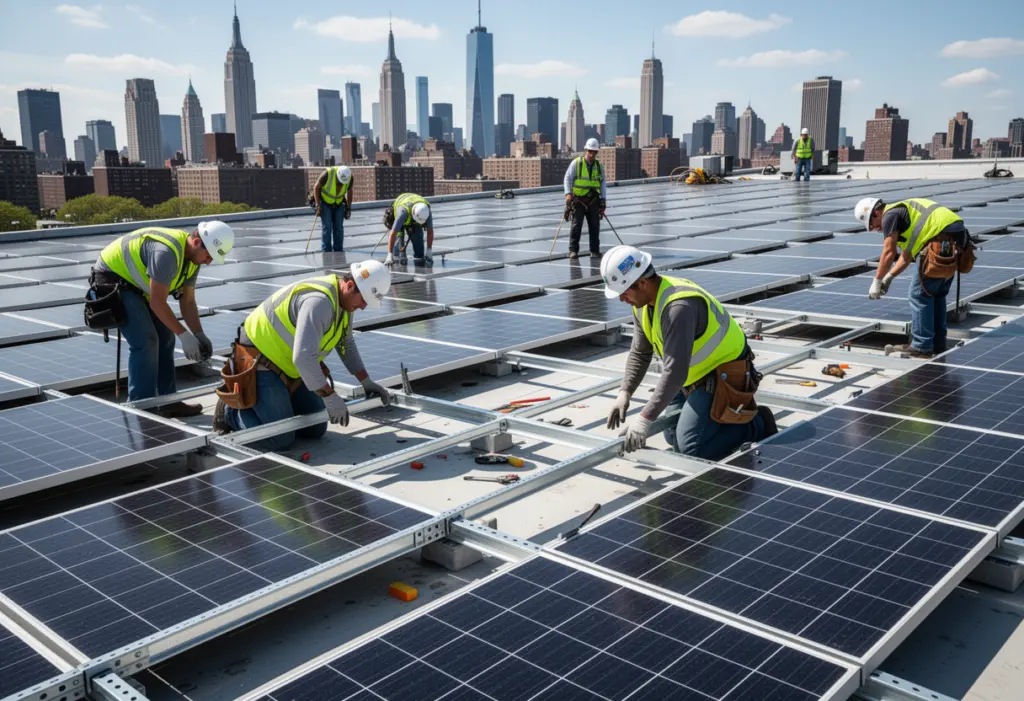
Whether prevailing wage applies to a solar project in New York is not a question about solar. It is a question about who is paying, under what contract, and with what funding conditions attached. The technology is irrelevant to the test. That is why the answer cannot be found on a page like this one, and why it has to be established in writing before bids go out.
Get the answer from the two places that can give it
The New York State Department of Labor administers prevailing wage in this state and issues the applicable schedules. The other authoritative source is the contract itself, together with whoever is funding the work: a public entity, a public authority, or a programme whose award conditions impose wage obligations. Ask both. A contractor’s opinion, however confident, is not a determination, and it is not what protects you if the determination goes the other way later.
Where the question actually arises
- Work contracted by a public entity, such as a municipality, a school district or a public authority.
- Projects carrying funding whose conditions impose wage requirements. The obligation travels with the money and the award documents, so read them.
- Projects on public property, or on private property under an arrangement with a public body.
If you are a homeowner paying privately for a rooftop system on your own house, this is very unlikely to be your question. But because the test is the contract and the funding rather than the size of the job, the safe move whenever any public money or public entity is anywhere in the arrangement is to ask rather than assume.
Why it matters even if you never read a wage schedule
Here is the practical consequence for anyone comparing bids. Two bids written under different wage assumptions are not comparable, and the cheaper one may simply be the one that assumed the obligation does not apply. If the determination later says it does, the difference does not evaporate; it turns into a change order, a shortfall or a dispute, and the entity that owns the project is the one holding it.
So put the answer into the bid documents rather than leaving it to each bidder. State the determination, or state that bidders must price on the basis of a stated schedule, and require every bid to be built the same way. That single step converts an argument after award into an apples-to-apples comparison before it.
What to put in the contract
- An explicit statement of which wage regime applies, with the source of that determination named.
- Certified payroll submission as a condition of payment, at agreed intervals, rather than on request.
- Flow-down to subcontractors. Solar work is routinely subcontracted, and a compliance clause that binds only the prime contractor is a clause with a hole in it.
- Responsibility for classification. Worker classification disputes are a common source of exposure, and the contract should say who carries that risk.
- Records retention and audit rights, in a form the funder will accept.
Federal conditions are a separate question
Some federal clean energy tax provisions carry their own wage and apprenticeship conditions, administered federally and entirely separate from New York State prevailing wage law. Satisfying one does not automatically satisfy the other, and the documentation each expects is not the same. Whether any of them apply to your project, and what records they require from day one of construction, is a question for your tax adviser before work starts, because retroactive record-keeping is not possible.
What none of this changes
Wage rules affect what a project costs to build. They do not change what it earns afterwards. The Customer Benefit Contribution is billed monthly on the DC size of the system, regardless of production, on systems interconnected on or after 1 January 2022, and it is recalculated annually. On Central Hudson’s 2026 small commercial rate of $1.83 per kW-month, the highest in the state, a 90 kW project pays 90 x $1.83 = $164.70 a month, about $1,976 a year. Commercial accounts with a demand charge are not subject to it, so check your rate class rather than assuming.
Nor do wage rules touch the incentive picture. The 30% federal residential credit is gone, terminated for expenditures made after 31 December 2025 and treated as made when the original installation is completed, and it never applied to public or business projects in any case. New York’s 25% credit capped at $5,000 on Form IT-255 requires a principal residence. What does reach a non-residential project is NY-Sun, applied by the contractor as a price reduction and stepping down as each regional megawatt block fills, and RPTL 487’s fifteen-year property tax exemption where the municipality, the county and the school district have each not opted out, for systems constructed before 1 January 2030. Confirm all of it at source before it enters a budget.
Frequently Asked Questions
Does prevailing wage apply to residential solar in New York?
For a homeowner paying privately for a system on their own house it is very unlikely to be the question. The test is the contract and the funding rather than the technology or the size, so where any public money or public entity is involved you should ask rather than assume.
Who decides whether prevailing wage applies to my project?
The New York State Department of Labor administers prevailing wage and issues the applicable schedules, and the contract documents and funding conditions govern the specific job. A contractor's opinion is not a determination and will not protect you later.
Why does this affect my bid comparison?
Two bids written under different wage assumptions are not comparable, and the cheaper one may simply be the one that assumed the obligation does not apply. State the determination in the bid documents so every bidder prices the same way.
Are federal wage and apprenticeship conditions the same thing?
No. Some federal clean energy tax provisions carry their own wage and apprenticeship conditions, administered federally and separate from New York State law. Satisfying one does not satisfy the other, and the records each expects must be kept from the start of construction.
This article is general information, not tax, legal or financial advice. Incentive amounts, eligibility rules and deadlines change and depend on your utility, your tax situation and your property. Confirm current terms with NYSERDA, your utility and a qualified tax professional before making a decision.
NY Solar Incentives
Independent New York solar research. We summarise NYSERDA, NY-Sun and federal programme rules from published sources and state plainly when a figure is an estimate. We are not a government agency and do not sell equipment.
Run the arithmetic on your own system
Check the dated program table and your arrangement before counting an incentive. Standard residential NY-Sun blocks are closed; Long Island Affordable Solar has a conditional income-verification route. The NY credit depends on qualified costs and tax liability, while the NYC abatement reduces future property-tax bills. The estimator keeps those timings separate.