Solar Panel Cost in Batavia, NY: How to Read the Quote
A Batavia solar quote is a list of things that are easy to price and a few that are easy to leave out. The ones left out are what decide whether the price was good.
On this page 7 sections
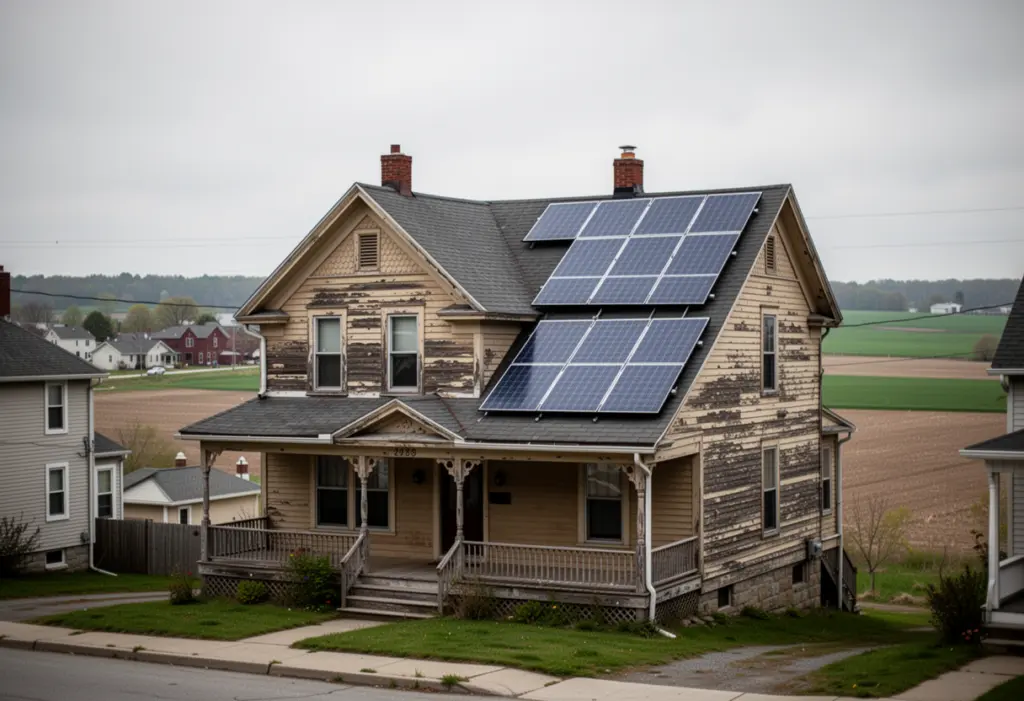
Most of a Batavia solar price is straightforward: modules, inverters, racking, wire, labour and a permit. The part that decides whether the price was actually good is the part that is easy to leave off the page — the service upgrade, the re-roof, the tree, the interconnection fee and an incentive quoted from a NY-Sun block that has since closed. This is how to take a Genesee County proposal apart.
Dollars per watt, then the exclusions
Ask each installer for the gross price before any incentive, and divide it by the DC watts of the proposed array. Dollars per watt is the only figure two proposals can be compared on, because it is unaffected by whichever incentives each company chose to assume. A 7.5 kW system is 7,500 DC watts; do the division yourself rather than accepting a monthly payment as the comparison.
Then line the exclusions up next to each other. The questions worth asking in writing are narrow ones: is the electrical permit included, is the interconnection application included, is monitoring hardware included and for how long, and is anything about the roof, the trees or the service panel listed as excluded or as an allowance. An allowance is a placeholder, not a price.
The federal line that is now simply wrong
If a Batavia proposal still carries a 30 percent federal credit, stop reading the numbers under it. Section 25D was terminated for expenditures made after 31 December 2025, with an expenditure treated as made when the original installation is completed. A buyer in 2026 gets nothing federally. There is a separate provision for business and farm projects — Genesee County has plenty of both — but it is a different section of the code and a different filing, and the answer for a barn roof belongs with your accountant rather than with a sales sheet.
Two authorities with the same name
The City of Batavia and the Town of Batavia are separate municipal corporations with separate code offices. A 14020 address on one side of the city line answers to a different desk than a 14020 address on the other. Ask which one your parcel is in, because the fee schedule and the inspection queue are not the same, and because the answer also matters later for the property tax exemption.
Two further local items belong in the price rather than in a change order:
- Older city housing and 100 amp service. A great deal of the housing inside the city predates the war. Where the service is 100 amps, adding a solar breaker can mean an upgrade or a line-side tap, and that is a real four-figure line. Ask what the service is rated at and whether the busbar has room before the design is finalised.
- Tonawanda Creek. The creek runs through the city and there is mapped flood plain along it. Where a property is in a mapped zone, inverters, disconnects and any battery have to be mounted above a specified elevation, which adds labour and takes the basement off the table for storage. Confirm the mapping before the design, not after the inspection.
The charge that never appears on a quote
Batavia is National Grid territory. The Customer Benefit Contribution is a monthly charge on the DC size of the array, billed on capacity whether the panels produce or not. The 2026 residential rate is $0.97 per kW-month. On a 7.5 kW system that is $7.28 a month, roughly $87 a year — modest, but it is a cost of ownership that most proposals never mention, and it is recalculated annually rather than fixed at the moment you interconnect. It applies only to systems interconnected on or after 1 January 2022.
It also has a direct consequence for sizing. Under Phase One net metering, exports are credited at the full retail rate for 20 years, which is generous — but an array built larger than your consumption banks credits you never draw down while still paying the capacity charge every month on the extra kilowatts. Size to the load you actually have, including any load you are about to add.
If your address is on a municipal electric system
This corner of Western New York has villages that run their own electric utilities — Holley in Orleans County and Arcade in Wyoming County among them. A municipal electric customer sits outside Public Service Commission jurisdiction entirely: no state net metering rules, no Customer Benefit Contribution and no state interconnection process. Terms are set by the utility itself and have to be asked for directly. Read the utility name printed on your own bill rather than assuming from the town you live in.
Where the incentives actually land in the price
The property tax exemption is the one to work through in Batavia, because it takes three separate checks and the answers are independent. RPTL 487 exempts the added value of the system from real property tax for 15 years, but a county, city, town or village may opt out by local law and a school district may opt out by resolution. So you check the city or the town, you check Genesee County, and you check the school district — and any one of them opting out removes that portion. The system must also be constructed before 1 January 2030.
Alongside it, New York’s 25 percent credit capped at $5,000 on Form IT-255 is available for your principal residence, and the state sales tax exemption applies to residential solar equipment. NY-Sun, a contractor-applied reduction rather than anything you file, is not available to a house now: as of September 2026 NYSERDA has no open NY-Sun block for homes in any utility territory; check NYSERDA’s NY-Sun dashboard for a new one. Incentive programmes are revised regularly — verify the current position with NYSERDA, the Tax Department and your assessor before signing, rather than relying on a figure printed in a proposal.
Frequently Asked Questions
What is the single most useful number in a Batavia solar quote?
Gross price before incentives divided by DC watts. Dollars per watt is unaffected by whichever incentives each installer assumed, so it is the only figure that lets two proposals be compared directly.
Does the City of Batavia or the Town of Batavia issue my solar permit?
They are separate municipal corporations with separate code offices, and a 14020 address can sit in either. Confirm which one covers your parcel, because fee schedules, inspection queues and the property tax opt-out position are all decided at that level.
Can I still claim the federal solar tax credit in 2026?
Not as a homeowner buying a system. Section 25D ended for expenditures made after 31 December 2025, and an expenditure counts as made when installation is completed. Business and farm projects fall under a different provision — ask your accountant rather than an installer.
Is a bigger array always better value in Batavia?
No. Net metering credits exports at the full retail rate, but an array larger than your consumption banks credits you never use while still paying the Customer Benefit Contribution every month on the extra DC kilowatts. Size to real load, including load you plan to add.
This article is general information, not tax, legal or financial advice. Incentive amounts, eligibility rules and deadlines change and depend on your utility, your tax situation and your property. Confirm current terms with NYSERDA, your utility and a qualified tax professional before making a decision.
NY Solar Incentives
Independent New York solar research. We summarise NYSERDA, NY-Sun and federal programme rules from published sources and state plainly when a figure is an estimate. We are not a government agency and do not sell equipment.
Run the arithmetic on your own system
Check the dated program table and your arrangement before counting an incentive. Standard residential NY-Sun blocks are closed; Long Island Affordable Solar has a conditional income-verification route. The NY credit depends on qualified costs and tax liability, while the NYC abatement reduces future property-tax bills. The estimator keeps those timings separate.