PSEG Long Island Battery Storage: What It Really Buys
A battery on a Long Island solar system is bought for outages, not for arbitrage. Full retail-rate net metering already does the job people expect storage to do.
On this page 8 sections
- 01What the battery actually buys
- 02Decide the circuits before you decide the battery
- 03Permits, siting and inspection
- 04The monthly charge, and what it is billed on
- 05Questions that separate a real quote from a brochure
- 06What the 2026 incentive picture supports
- 07The honest summary
- 08Frequently Asked Questions
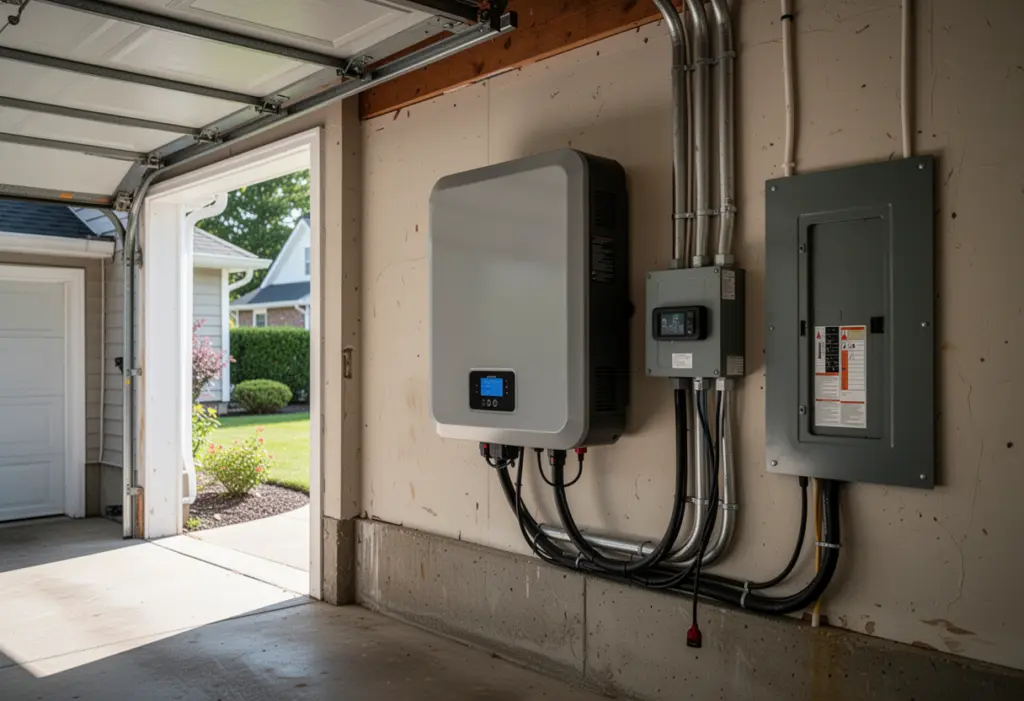
Start with the uncomfortable part. On Long Island, where residential solar is credited under Phase One net metering at the full retail rate, a battery is a resilience purchase and not an economic one. Storing a kilowatt-hour to use tonight saves you the retail rate. Exporting the same kilowatt-hour earns a credit at the retail rate. There is no spread to harvest, so the case for storage has to be made on outages, not on savings.
What the battery actually buys
It buys the ability to keep chosen circuits running when the grid is down. That is a real benefit in a coastal region where storms take lines out, and it is worth paying for if you know what you want backed up. Solar alone does not do it: a grid-tied array shuts down in an outage for line-worker safety unless there is storage or islanding equipment to support it. Homeowners are regularly surprised by this after the fact, and it is the single most common misunderstanding about rooftop solar in a storm zone.
Decide the circuits before you decide the battery
- List what must run: refrigeration, heat or the furnace fan, a sump pump, a well pump if you have one, internet and phone charging, and any medical equipment.
- Ask about the critical loads panel. Backing up selected circuits usually means a separate subpanel and rewiring, which is labour, not hardware, and it belongs in the quote.
- Ask what the battery will not carry. Well pumps, air conditioning compressors and electric ranges have large starting or continuous draws. Get the specific answer for your equipment rather than a general reassurance.
- Ask how long, at what load. A duration figure is meaningless without the load it assumes. Make them state both.
Permits, siting and inspection
A battery is part of the interconnection application to PSEG Long Island and part of the municipal permit, and it brings its own siting rules. Where the unit may be mounted, whether it can be inside living space, garage placement, clearances and fire code requirements are decided by your town or incorporated village, and requirements differ across Long Island jurisdictions. Ask which authority is reviewing yours and what it requires before the equipment is ordered. On the south shore, ask about flood zone elevation for the battery and its disconnects as well, since electrical equipment placement is frequently the constraint rather than wall space.
The monthly charge, and what it is billed on
The Customer Benefit Contribution is billed on DC capacity for systems interconnected on or after 1 January 2022, and the published 2026 residential rates are for photovoltaic systems. On the LIPA and PSEG Long Island schedule that is $1.13 per kW-month, so a 7 kW array pays 7 x $1.13 = $7.91 a month, about $94.92 a year. Ask PSEG Long Island directly how a paired storage system is treated on your account rather than assuming it is either included or exempt, and get the answer before you sign. Note as well that mass-market LIPA projects cannot opt into the Value Stack, so there is no alternative compensation mechanism here that would change the arithmetic in a battery’s favour.
Questions that separate a real quote from a brochure
- What is the usable capacity, not the nameplate capacity?
- What is the warranty term, what throughput or cycle limit does it carry, and who performs a warranty replacement?
- Is the inverter shared with the solar array or separate, and what happens to the whole system if it fails?
- What does the system do automatically in an outage, and what has to be done by hand?
- What does the monitoring cost after the first period, and does the battery keep working without it?
What the 2026 incentive picture supports
Do not assume the solar incentives extend to storage. New York’s 25% credit capped at $5,000 on Form IT-255 is written for solar energy system equipment at a principal residence, and whether a particular storage installation falls inside it is a question for whoever prepares your return rather than for a salesperson. Ask separately whether any storage-specific incentive is available through NYSERDA or through PSEG Long Island on the day you are quoting, and require it to appear as a line on the contract if it is claimed. NY-Sun no longer reduces the solar side either: NYSERDA’s last residential block for PSEG Long Island territory closed on 17 April 2016. As of September 2026 NYSERDA has no open NY-Sun block for homes in any utility territory; check NYSERDA’s NY-Sun dashboard for a new one. And there is no federal residential credit to fall back on: section 25D was terminated for expenditures made after 31 December 2025, an expenditure being treated as made when the original installation is completed, so any 2026 proposal that prices storage net of a 30% federal credit is wrong on its face.
The honest summary
If you want the lights on when the grid is down, a battery does that and nothing else does. If you want a shorter payback, it will not deliver one under full retail-rate net metering, and a quote that claims otherwise is worth reading closely for the assumption doing the work. Customers of the Freeport, Rockville Centre, Greenport or Fishers Island municipal systems sit outside the PSC framework entirely and should ask their own utility what it credits and what it permits. Programme terms and rates are revised annually, so verify with NYSERDA and PSEG Long Island before committing.
Frequently Asked Questions
Does a battery save money on Long Island?
Not meaningfully. Phase One net metering credits exports at the full retail rate, which is the same rate storing a kilowatt-hour saves you, so there is no spread to capture. Buy storage for outage coverage instead.
Will my solar panels work in a blackout without a battery?
No. A grid-tied array shuts down during an outage for line-worker safety unless storage or islanding equipment is installed to support it. This surprises many homeowners after the first storm.
How long will a home battery run my house?
That depends entirely on the load. A duration figure means nothing without the assumed load behind it, so ask the installer to state both, and ask specifically about well pumps, air conditioning and electric ranges.
Are there incentives for storage?
Do not assume the solar incentives cover it. Ask whether a storage-specific programme applies through NYSERDA or PSEG Long Island on the day you are quoting, and require it as a line on the contract. The federal residential credit no longer exists.
This article is general information, not tax, legal or financial advice. Incentive amounts, eligibility rules and deadlines change and depend on your utility, your tax situation and your property. Confirm current terms with NYSERDA, your utility and a qualified tax professional before making a decision.
NY Solar Incentives
Independent New York solar research. We summarise NYSERDA, NY-Sun and federal programme rules from published sources and state plainly when a figure is an estimate. We are not a government agency and do not sell equipment.
Run the arithmetic on your own system
Check the dated program table and your arrangement before counting an incentive. Standard residential NY-Sun blocks are closed; Long Island Affordable Solar has a conditional income-verification route. The NY credit depends on qualified costs and tax liability, while the NYC abatement reduces future property-tax bills. The estimator keeps those timings separate.