Ice Storm Power Outage: Why Rooftop Solar Shuts Down Too
Freezing rain damages transmission, feeders and service drops at the same time, which is why the outages it causes are long. A grid-tied array disconnects the moment the utility reference disappears, so the question is what else the house has.
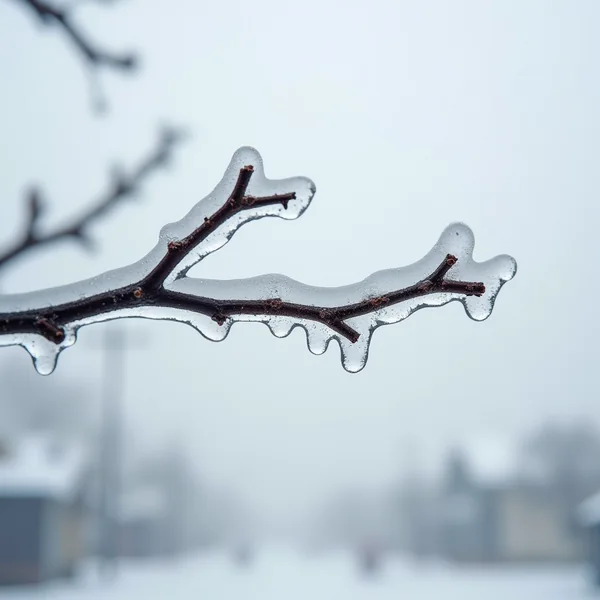
Why a grid-tied array produces nothing while the feeder is down, and what a New York house actually needs in place before the ice arrives.
What an Ice Storm Power Outage Does to a New York House
An ice storm is not a wind event that happens to be cold. Freezing rain
lands as liquid and sets as a glaze on every surface it touches, and the load
it adds is cumulative: a conductor span, a limb over a service drop and a
crossarm all gain weight at the same time, in the same hour, across an entire
county. That is why the outages it causes have a different shape from summer
ones. They are wide, they are simultaneous, and the damage sits in thousands of
small places rather than one large one.
The practical consequence for a homeowner is duration. A blown fuse on a
single tap is a short job. An ice event puts damage on the transmission lines,
the substations, the feeders, the taps and the individual service drops at
once, and crews have to work that order — you cannot re-energise a house whose
feeder is still on the ground. It is also the reason neighbours come back at
staggered times and it does not mean anyone was forgotten.
Everything below is about the hours between those two events: the moment the
lights go out, and the moment a crew reaches your street.
A grid-tied array stops producing the moment the grid does
This is the single most surprising thing about an ice storm power outage for
a household with solar on the roof. The sun can come out the next morning onto
a clear sky, the array can be swept clean, and the house still has nothing.
The inverter has disconnected on purpose.
A standard grid-following inverter takes its voltage and frequency reference
from the utility. When that reference disappears it is required to stop
exporting and to disconnect within a defined window, so that a de-energised
line cannot be back-fed while a lineworker is on it. Anti-islanding is a safety
requirement written into the interconnection standards every inverter sold for
grid connection is certified against. It is not a fault, and there is no
setting an owner can change.
So a plain grid-tied system with no storage and no islanding-capable
equipment produces exactly nothing during an outage, regardless of the weather
that follows. Some inverters offer a small daytime-only outlet that runs off
the array while the sun is up and dies at dusk; that is a genuinely different
feature from whole-home backup, and it is worth asking which one a quote is
describing.
The three ways a house keeps running when the feeder is down
Each of these is a different electrical system, not a different brand of the
same thing. They differ in what has to be installed, what starts them, and what
limits how long they last.
| Approach | What it can carry | How it starts | What ends the run | Cold-weather note |
|---|---|---|---|---|
| Battery with an islanding-capable inverter | A defined backup subpanel, or the whole service if the equipment and the loads allow it |
Automatically, usually within a fraction of a second | Stored energy runs out; solar can extend it during daylight if the system is configured to recharge while islanded |
Usable capacity falls in the cold, and battery cabinets have their own temperature limits — an unconditioned garage is a different environment from a basement |
| Permanently installed standby generator | Whatever the automatic transfer switch is wired to serve | Automatically, after a short delay while it confirms the outage | Fuel supply, or a service interval it reaches during a long event | Starts under load in the cold; the battery that cranks it is the usual failure point, and it is the part nobody tests |
| Portable generator through an inlet box and interlock | The circuits the interlocked breaker feeds, within the generator’s rating |
Manually — someone goes outside and starts it | Fuel on hand, and the run interval the machine needs | Has to live outdoors, well away from the house and any opening, in the weather that caused the outage |
The one that is never on this table is an extension cord run from a
generator into the house through a window, or a cord fitted with a plug on both
ends. The second energises the panel through an outlet with no separation from
the utility, which is exactly the condition anti-islanding exists to prevent.
The inlet box and interlock arrangement exists
because it is the deliberate, inspectable version of the same idea.
Cold makes the outage a load problem, not a lighting problem
In a summer outage the demand list is short: a refrigerator, some lights, a
few chargers. A January event in New York adds space heating to that list, and
space heating is a different order of magnitude entirely.
This matters most for a house that has already electrified. A cold-climate
heat pump draws steadily and moderately while it is running in its normal
range; the electric resistance element that backs it up in deep cold does not.
Resistance heat is the largest single load most electrified houses have, and a
battery sized around evening peak shaving will not carry it for long. If the
backup plan is a battery, the resistance element usually has to be excluded
from the backed-up circuits, which means accepting that the heat pump alone
carries the house at the coldest hour of the year — a decision to make on paper
in advance, not in the dark.
Deciding in advance which circuits matter
The traditional answer is a backup subpanel: an electrician moves the
circuits you want backed up onto their own panel at installation time, and that
list is then fixed. The newer answer is circuit-level control, where relays
decide at runtime what stays energised —
what that can and cannot shed is worth understanding
before it is quoted, because shedding is binary and it reaches only what passes
through the panel.
Either way the work starts from the same document: an honest inventory of
what the house actually draws, which is the same
load calculation that governs any other electrification
decision.
The things that fail before the lights do
People plan for darkness and are caught out by everything else. In a New
York house, most of these need electricity even when their fuel is not
electric:
- Heat from a gas or oil system. The burner, the controls
and the circulator pump or blower all run on house power. A full oil tank heats
nothing without it. - Water from a private well. No power, no pump, no water —
and that includes the water needed to flush. - The sump pump. Freezing rain becomes runoff the moment it
thaws, which is often the same day the outage ends. - Plumbing in an unheated run. Pipes in an exterior wall, a
crawlspace or an unconditioned bay start losing heat the moment the house
does. - Anything medical. Oxygen concentrators, CPAP machines and
powered mobility equipment need a plan that does not assume a short
interruption. Most New York utilities keep a life-support customer register;
being on it does not restore power faster, but it changes how you are
contacted.
The freezer, answered by thermal mass rather than a number
A closed freezer is a well-insulated box full of thermal mass, and frozen
food is the mass. A full freezer therefore holds a safe temperature
substantially longer than a half-empty one, which is why filling the empty
space with containers of water before a forecast event does more good than any
other single preparation. The dominant variable after that is the door: every
opening replaces cold dense air with warm room air, and it does not come back.
The USDA publishes the standing guidance for how long a full and a half-full
freezer hold with the door shut, and it is worth reading before you need it
rather than during. Judge the food on temperature, not on how long the power
was out.
Roof and array during and after the event
Solar modules are tested to shed a static load, and the glaze from freezing
rain is a load the racking and the roof carry together rather than the modules
alone. The risk that actually shows up in New York is not usually the ice on
the array; it is a limb that the ice brought down onto it, and the meltwater
that refreezes at the eave once the sun returns.
The instinct to clear the array is the one to resist. A glazed roof is a
fall hazard, and scraping ice off a module face is how the glass and the
backsheet get damaged. The same reasoning applies here as with
snow on a New York array: production lost over a few
days is small against the value of the equipment, and against the value of not
being on the roof. Photograph anything that looks like damage from the ground
once it is safe, and let the insurer and the installer see it before anyone
touches it.
What to settle before a storm, not during one
Adding backup to an existing system is a permitting and interconnection
project, not an appliance purchase, and the lead times are what they are. Three
things are worth establishing early.
Which code path the work falls under. New York State’s
Uniform Code and New York City’s own Electrical Code are two distinct regimes,
and which edition is in force is a question for the authority having
jurisdiction rather than something to assume from a previous job or from a
neighbour’s install. No one can tell you a particular installation is compliant
from a description of it; the inspector who signs it off is the one who
decides.
What the utility has to approve. Adding storage to an array
that is already interconnected is a change to the interconnection, not a
private matter between you and an installer. It touches how the system behaves
on the utility’s side and therefore how it is metered, which is the same
paperwork trail that governs net metering credits.
What is currently on offer. New York runs its storage
support through NYSERDA and the utilities rather than as a single fixed figure,
and the terms move. Quoting a number here would be out of date before the next
storm; the way to price it is to read the
current battery storage incentive terms and then get
the installer to write, on the quote, which programmes they are applying for on
your behalf and what happens if one does not come through.
The honest summary is that an ice storm power outage is a duration problem,
and duration is decided by choices made months earlier: what is on the backup
list, what the backup source is, and whether the house was ever asked to run on
it before the night it had to.
Frequently Asked Questions
Will my solar panels power the house during an ice storm outage?
Not on their own. A standard grid-tied inverter takes its voltage and frequency reference from the utility and is required to disconnect when that reference disappears, so that a downed line cannot be back-fed while crews are working on it. The array stops even in bright sun. Powering the house through an outage needs equipment that can form its own grid and separate cleanly from the utility, which in practice means a battery with an islanding-capable inverter, or a generator through a transfer arrangement.
Can I add a battery to an array I already have?
Often, but it is a project rather than an accessory. Whether the existing inverter can work with storage at all, whether the battery needs its own inverter alongside it, and where the backup subpanel goes are all site questions. It is also a change to the utility interconnection and usually a permit, so ask an installer to quote the electrical work, the interconnection application and the inspection as separate lines rather than as one number.
How long will a home battery run a house in a winter outage?
It depends almost entirely on whether space heating is on the backup list. Lights, a refrigerator, a modem and charging draw little enough that stored energy stretches a long way. Electric resistance heat is the largest load most electrified houses have and will empty a battery quickly, which is why resistance backup is normally excluded from backed-up circuits. Ask the installer to model your own backup list rather than quoting a runtime in the abstract, and remember usable capacity drops in the cold.
Is a portable generator safe to use during an outage?
Outdoors, well clear of the house and of any window, door or vent, and connected through an inlet box with a breaker interlock or a transfer switch rather than through a cord into an outlet. Carbon monoxide is the hazard that kills people in these events, and back-feeding through an outlet energises the utility side of the service with no separation, which is the condition inverter anti-islanding exists to prevent. The inlet arrangement is the inspectable version of the same intent.
Should I clear ice off my solar panels after the storm?
No. A glazed roof is a fall hazard and scraping a module face damages glass and backsheet, which costs far more than the production lost over a few days of a New York winter. Ice sheds on its own as temperatures rise. If a limb has come down on the array or the racking looks disturbed, photograph it from the ground once conditions allow and let the installer and the insurer look before anything is touched or repaired.
Why did my neighbour get power back before I did?
Restoration follows the electrical hierarchy, not the street. Transmission and substations come first, then the feeders that serve whole neighbourhoods, then the taps, then individual service drops. Two houses on the same road can sit on different feeders, and a damaged service drop or weatherhead on your own property is repaired last and is sometimes the homeowner’s responsibility rather than the utility’s. Reporting your outage separately is worth doing even when the whole street is dark.
What should I do about heat if the outage lasts days?
Close off the rooms you are not using, let the house get cooler than is comfortable rather than trying to hold a normal setpoint, and watch the plumbing in exterior walls and unheated spaces before you worry about comfort. Any combustion appliance run indoors for heat, including a grill or a generator, is a carbon monoxide risk. If the house cannot be kept above freezing, leaving for a warming centre and draining the system is a better outcome than a burst pipe discovered on return.
NY Solar Incentives
Independent New York solar research. We summarise NYSERDA, NY-Sun and federal programme rules from published sources and state plainly when a figure is an estimate. We are not a government agency and do not sell equipment.
Run the arithmetic on your own system
Check the dated program table and your arrangement before counting an incentive. Standard residential NY-Sun blocks are closed; Long Island Affordable Solar has a conditional income-verification route. The NY credit depends on qualified costs and tax liability, while the NYC abatement reduces future property-tax bills. The estimator keeps those timings separate.