National Grid CBC Charge: 97 Cents a Kilowatt a Month
National Grid has the cheapest capacity charge of any New York utility. The number behind it that catches people out is on the commercial side.
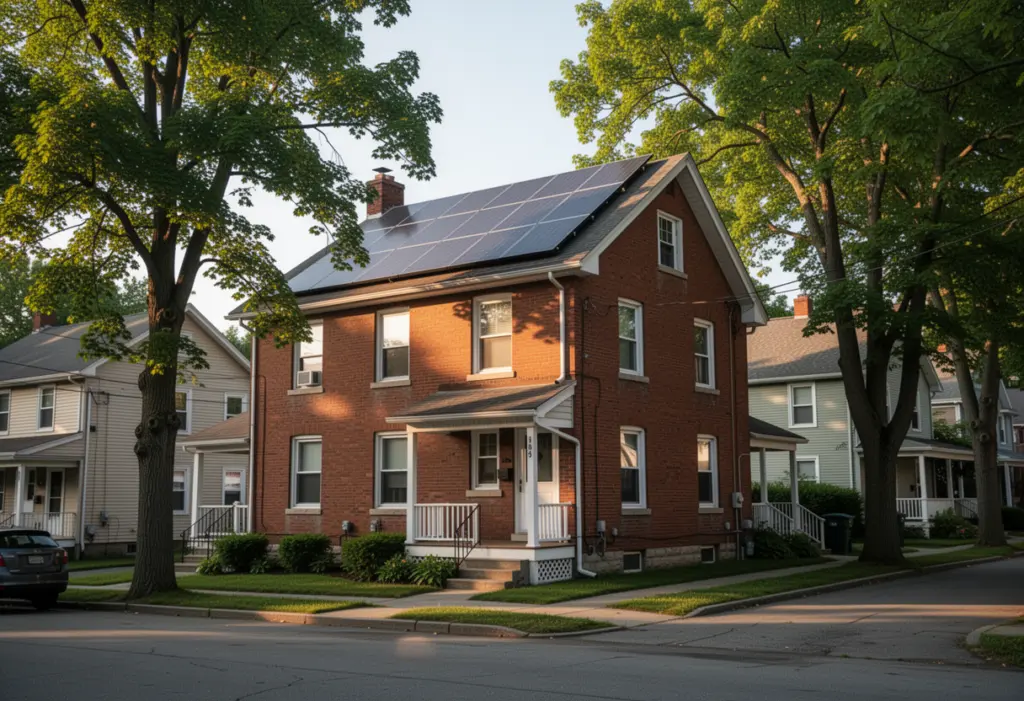
National Grid’s 2026 residential Customer Benefit Contribution is $0.97 per kW-month of DC system size — the lowest residential figure of any New York utility. Under 97 cents a kilowatt it is genuinely a small line, but it is charged on capacity rather than on output, so it appears in full during a Syracuse January when the array is buried and again in July when it is running flat out.
What 97 cents a kilowatt is actually worth
- 6 kW — $5.82 a month, about $69.84 a year
- 9.5 kW — $9.22 a month, about $110.58 a year
- 12.4 kW — $12.03 a month, about $144.34 a year
The interesting comparison is what the identical roof would cost elsewhere. That 9.5 kW array pays about $110.58 a year here. Under Central Hudson, at $1.67, it would be roughly $190 a year; under RG&E at $1.31, about $149; under Con Edison at $1.29, about $147. Held at 2026 rates, twenty years of net metering puts the gap between the least and most expensive territory on that one array in the region of $1,600, for equipment that is otherwise identical. Those rates are reset every year, so read that as the shape of the difference rather than a forecast. It is not a reason to choose where to live, but it is worth having in the model rather than out of it.
The trap is on the commercial side
National Grid’s 2026 small commercial rate is $1.38 per kW-month — more than 40% above its residential figure, and one of the higher small commercial rates in the state. That inversion of the intuition matters here more than in most territories, because National Grid country contains a great many properties where a house and a business or a farm operation share a parcel but sit on separate accounts. A 15 kW array on a shop account is about $20.70 a month, roughly $248 a year, against $174.60 if the same capacity were residential. Establish which account the array is going on before the design is finished, not after.
For completeness, the Value Stack column shows $0.49 residential and $0.97 small commercial for National Grid. That framework, VDER, is for community distributed generation and larger or commercial projects rather than mass-market residential rooftop, which sits on Phase One net metering. If a residential quote uses the Value Stack figures, ask what compensation framework it is assuming and why.
Who owes nothing
The charge reaches systems interconnected on or after 1 January 2022 and no earlier ones. Community solar subscribers pay nothing at all, because those are front-of-the-meter projects. Commercial accounts with a demand charge are outside it too. On expansions of a pre-2022 system the current NYSERDA fact sheet keeps the whole system outside the charge, but an earlier version of the same document said the reverse and that superseded text is still repeated in plenty of places — check the current fact sheet rather than an article about it.
And the rates are recalculated annually. Nothing about the figure you are quoted is locked in at interconnection, so plan around the mechanism rather than around 97 cents.
Upstate specifics worth knowing
National Grid serves Buffalo, Syracuse, the Albany and Capital District area and much of upstate, but the footprint is not continuous. A number of municipal electric utilities sit inside it: Solvay and Skaneateles in Onondaga County, Akron and Springville in Erie, Green Island in Albany County, Sherrill in Oneida, Boonville a little further north. Those customers are outside Public Service Commission jurisdiction — no capacity charge, no PSC net metering, no state interconnection process — and have to ask their own utility for terms.
One warning that has caught people out. Running a municipal water or sewer department is not evidence that a village runs its own electric utility. The village of Herkimer does not, although its immediate neighbours Frankfort, Ilion and Mohawk each do. Read the utility name printed on the bill and take nothing from what the village next door does.
A property tax point specific to this territory
RPTL 487 gives a 15-year exemption on the added value of the system. It is not open ended — the system has to be constructed before 1 January 2030 — and it requires three separate authorities not to have opted out: the municipality, the county and the school district. In most of the state that is three checks. In Buffalo and Syracuse, both inside National Grid territory, it is two — those are Big Five city school districts, fiscally dependent and levying no separate property tax, so there is no separate school district check to make. It is a small simplification and it is genuinely different from what a statewide guide will tell you.
Alongside it, the live 2026 list is the state sales tax exemption and the 25% credit capped at $5,000 on Form IT-255 for a principal residence. NY-Sun is not on it: as of September 2026 NYSERDA has no open NY-Sun block for homes in any utility territory; check NYSERDA’s NY-Sun dashboard for a new one. There is no federal residential credit for a 2026 buyer — section 25D ended for expenditures made after 31 December 2025 — so nothing federal offsets this charge. Confirm the current capacity rate in NYSERDA’s published sheet and the credit position with the New York State Department of Taxation and Finance before relying on either.
Frequently Asked Questions
How much is National Grid's CBC in 2026?
$0.97 per kW-month of DC system size for residential net metered solar, the lowest residential rate of any New York utility. A 9.5 kW array pays about $9.22 a month, roughly $110.58 a year.
Is the small commercial rate lower too?
No, the opposite. National Grid's 2026 small commercial rate is $1.38 per kW-month, more than 40% above its residential figure. If a house and a business share a parcel on separate accounts, which account the array sits on changes the bill.
Does the charge apply to an older system?
Only to systems interconnected on or after 1 January 2022. Community solar subscribers and commercial accounts with a demand charge are also outside it, and the rates are recalculated annually rather than fixed at interconnection.
Do Buffalo and Syracuse homeowners check the school district for RPTL 487?
No. Both are Big Five city school districts, fiscally dependent and levying no separate property tax, so there is no separate school check. Elsewhere in National Grid territory the municipality, the county and the school district must each not have opted out.
This article is general information, not tax, legal or financial advice. Incentive amounts, eligibility rules and deadlines change and depend on your utility, your tax situation and your property. Confirm current terms with NYSERDA, your utility and a qualified tax professional before making a decision.
NY Solar Incentives
Independent New York solar research. We summarise NYSERDA, NY-Sun and federal programme rules from published sources and state plainly when a figure is an estimate. We are not a government agency and do not sell equipment.
Run the arithmetic on your own system
Check the dated program table and your arrangement before counting an incentive. Standard residential NY-Sun blocks are closed; Long Island Affordable Solar has a conditional income-verification route. The NY credit depends on qualified costs and tax liability, while the NYC abatement reduces future property-tax bills. The estimator keeps those timings separate.