Solar Panel Cost in Camillus, NY: Fixed Costs and Choices
Half of a Camillus solar price is set by your roof and your utility before an installer arrives. The other half is a set of choices, and two of them are expensive.
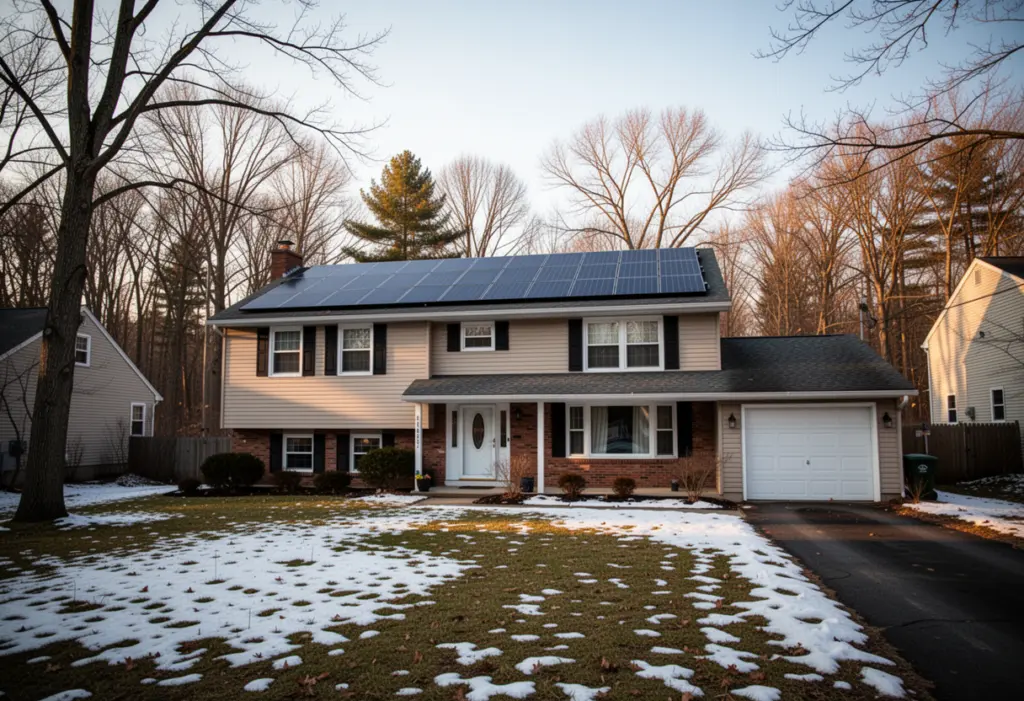
It helps to split a Camillus solar price into what is fixed and what is chosen. The fixed part is decided before an installer arrives: the pitch and orientation of your roof, the trees on the southern side, the service panel in the basement and the utility that serves the address. The chosen part is where the money is either spent well or wasted — system size, storage, financing and the quality of the estimate the whole plan rests on.
What is fixed
Roof geometry sets how many modules fit on the good planes and how many end up somewhere mediocre. Vent stacks, dormers and a chimney break a plane into pieces and raise the labour per module. Shading is the other fixed factor, and in this part of Onondaga County it is decided by mature street trees and by the ground rising away from Nine Mile Creek rather than by anything on the roof itself.
Ask for an on-site shading assessment rather than a satellite estimate, and ask what the model assumes for December and January specifically. Those are the months the net metering credit bank is being drawn down, and a tree that costs you nothing in July costs you a great deal then. Where two installers disagree sharply on annual production for the same roof, one of them has usually not visited.
What is chosen, and the two expensive choices
Storage. A battery in New York is a resilience purchase, not an economic one. Under Phase One net metering your exports are credited at the full retail rate for 20 years from interconnection, so the grid is already doing the storing at par. A battery buys you power during an outage, which is a real thing to want on a rural-edge feeder, but it does not pay for itself out of arbitrage under this tariff. Price it as insurance and decide accordingly.
Size. Every extra kilowatt of DC capacity costs money once at purchase and then again every month for as long as you own it, whether or not you consume what it makes. Build for the load you have plus the load you are genuinely about to add — a heat pump, an electric vehicle — and not for the roof area available.
The monthly cost of capacity
Camillus is National Grid territory, and the Customer Benefit Contribution is charged on DC system size rather than on production. For 2026 the residential rate is $0.97 per kW-month. An 11 kW array therefore carries $10.67 a month, about $128 a year, before the first kilowatt-hour is counted. The charge applies to systems interconnected on or after 1 January 2022 and is recalculated each year, so it is not locked in when you connect. Subscribers to community solar pay none of it, which is one of the few genuine cost differences between subscribing and owning.
Two authorities, and one boundary that changes everything
The Town of Camillus and the Village of Camillus are separate authorities with separate building departments. A 13031 address can be in either, and the permit fee and inspection queue differ. Settle it before an application is drafted.
The boundary that matters more is the utility one. The Village of Solvay runs its own municipal electric department, and Skaneateles does the same further south in the county. A municipal electric customer is outside Public Service Commission jurisdiction: there is no state net metering entitlement, no Customer Benefit Contribution and no state interconnection process, and the terms for exporting power are whatever that utility sets. If your address is anywhere near a municipal boundary, read the utility name on your own bill before you accept any production or savings figure built on National Grid rules.
Line items worth pricing separately
- Service upgrade. Ask for it as its own number rather than folded into the system price, so you can see what you are paying for electrical work you would eventually have needed anyway.
- Roof work. If the shingles have under roughly ten years left, price the re-roof now. Taking an array off and putting it back later is the most avoidable cost in residential solar.
- Snow management. Racking specified for the local load is not optional, and snow guards may be needed where an array sheds onto a walk or a driveway.
- Maintenance contracts. A pitched array in this climate is washed by rain and shed by gravity. Paying annually to have panels cleaned is rarely worth it here, and a monitoring subscription should be a small number or none at all.
The incentives, and the one that is easiest to miss
The 30 percent federal residential credit no longer exists — section 25D was terminated for expenditures made after 31 December 2025, with the expenditure treated as made when the original installation is completed. Anything quoting it in 2026 is quoting a dead provision.
What survives is state and local. The easiest to lose is the sales tax exemption: New York exempts residential solar energy systems equipment from state sales tax, and localities may separately elect to exempt their own share, so the total varies by county and city. Read the quote to see whether any tax is being charged and ask why if it is. Beyond that, the 25 percent state credit capped at $5,000 on Form IT-255 applies to a principal residence, and RPTL 487 exempts the added value from property tax for 15 years where the town or village, the county and the school district have each not opted out. NY-Sun, which comes off the price through the contractor when a block is open, does not apply now: as of September 2026 NYSERDA has no open NY-Sun block for homes in any utility territory; check NYSERDA’s NY-Sun dashboard for a new one. Check each of these against the current published rules before signing — they are revised, and a proposal is not a source.
Frequently Asked Questions
Is a battery worth the cost in Camillus?
As economics, generally no. Phase One net metering credits exports at the full retail rate for 20 years, so the grid already stores your surplus at par. A battery is a resilience purchase for outages — price it as insurance rather than as a payback item.
How much does an 11 kW system cost to keep on National Grid?
The Customer Benefit Contribution is $0.97 per kW-month of DC size for 2026, so an 11 kW array pays about $10.67 a month, roughly $128 a year, regardless of what it produces. The rate is recalculated annually.
What if my Camillus address is served by Solvay Electric?
Then almost none of the state framework applies. Municipal electric utilities sit outside Public Service Commission jurisdiction, so there is no state net metering, no Customer Benefit Contribution and no state interconnection process. Ask the utility directly and confirm from your bill.
Should I pay for a solar panel cleaning plan?
Rarely, on a pitched roof in central New York. Rain washes the glass and snow sheds off the slope. Spend the money on a proper on-site shading assessment and correct snow-rated racking instead, which change production far more than cleaning does.
This article is general information, not tax, legal or financial advice. Incentive amounts, eligibility rules and deadlines change and depend on your utility, your tax situation and your property. Confirm current terms with NYSERDA, your utility and a qualified tax professional before making a decision.
NY Solar Incentives
Independent New York solar research. We summarise NYSERDA, NY-Sun and federal programme rules from published sources and state plainly when a figure is an estimate. We are not a government agency and do not sell equipment.
Run the arithmetic on your own system
Check the dated program table and your arrangement before counting an incentive. Standard residential NY-Sun blocks are closed; Long Island Affordable Solar has a conditional income-verification route. The NY credit depends on qualified costs and tax liability, while the NYC abatement reduces future property-tax bills. The estimator keeps those timings separate.