Is a Heat Pump Dryer Worth It on New York Electric Rates?
The case for a heat pump dryer in New York rests on what you are replacing and which utility bills you. How to compute the saving from your own all-in rate, and why 120 volts matters.
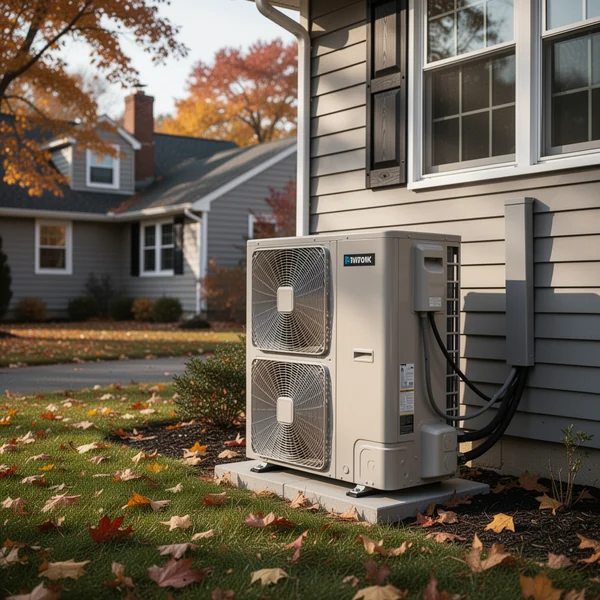
Whether a heat pump dryer is worth it in New York depends far less on the sticker price than on two things: what you are replacing, and which utility bills you. Against an electric resistance dryer on a Con Edison or PSEG Long Island rate, the running-cost gap is the largest in the country; against a gas dryer on a National Fuel Gas line in Buffalo, the case is mostly about venting, not money.
The machine is worth understanding before you price one, because it is not a normal dryer with a better badge.
What a heat pump dryer actually does
A conventional electric dryer heats fresh air with a resistance element, blows it through the clothes, and throws it out of the house through a duct. A heat pump dryer runs a closed loop: a small refrigeration circuit heats the air going into the drum, then cools the moist air coming out so the water condenses, then reheats the same air and sends it round again. The water goes to a drain or a pull-out tray. There is no exhaust duct.
Three consequences follow, and they matter differently in a New York house than they do in Georgia.
- It uses substantially less electricity per load than resistance drying, because it is moving heat rather than making it — the same reason a heat pump beats baseboard for space heating.
- It stops evicting your heated air. A vented dryer running in January pulls warm indoor air out of the house, and that air is replaced by outdoor air drawn in through every gap in the envelope. In a leaky older house on a cold Syracuse night, you are paying your furnace or heat pump to reheat that make-up air. Nobody puts this on a spreadsheet, and it is real.
- Cycles take longer. The drum air is cooler, so a load takes noticeably more time than a resistance dryer. Households that do laundry in a queue on Sunday feel this; households that run one load an evening do not.
The 120-volt point, which matters more than people expect
Many heat pump dryers run on a standard 120-volt outlet rather than the 240-volt, 30-amp circuit a resistance dryer needs. In a Brooklyn apartment or a 100-amp-service house in Yonkers, that is not a convenience — it is the difference between installing the appliance and calling an electrician. If you are already planning a heat pump, an EV charger or an induction range, a dryer that does not claim a 240-volt slot in a full panel is worth real money in avoided electrical work. Check the specification for the model you are actually buying; not every heat pump dryer is a 120-volt machine, and some are hybrids with a resistance boost.
Working out the number on New York electric rates
There is no honest single answer to “how much will it save me,” because New York electricity prices differ by utility, by service class, and by month, and because your laundry volume is your own. But the calculation is short, and you can do it from documents you already have.
- Get the estimated annual energy use from the yellow EnergyGuide label on each machine you are comparing — the label states an estimated yearly kilowatt-hour figure based on a standard number of loads.
- Scale it to your household. If you run half the loads the label assumes, halve it; if you have three teenagers, do not.
- Find your real all-in price per kilowatt-hour. This is the number most people get wrong. Take a recent bill, add the supply charges and the delivery charges together, and divide by the kilowatt-hours used that month. Delivery is often the larger half, and quoting only the supply rate — the number an ESCO markets to you — will understate your savings badly. If you are not sure how the two halves of a New York bill separate, the walkthrough in reading a Con Edison bill applies to the structure even if Con Ed is not your utility.
- Multiply. Annual kWh difference between the two machines, times your all-in rate, is your annual saving. Compare that against the price difference on the machines.
Do that arithmetic yourself rather than trusting a retailer’s payback claim. Downstate customers on Con Edison or PSEG Long Island will find the savings side of the equation considerably larger than a customer in the National Grid upstate territory, purely because the price per kilowatt-hour is higher — which is why the same appliance genuinely is a better deal in Queens than in Rochester.
If you are replacing a gas dryer
Then the comparison changes shape. Natural gas is cheaper per unit of heat than electricity almost everywhere in New York, so a heat pump dryer is unlikely to beat a gas dryer on running cost alone. The reasons to switch are different: you remove a combustion appliance and its vent from the house, you free up the gas connection if you are working toward an all-electric home, and you stop the winter make-up air problem described above. For households on propane or in a house being electrified end-to-end, that is often decisive. For a household with cheap piped gas and no intention of leaving it, it usually is not.
Incentives: be careful what you are told
The federal credits are gone. Section 25C and Section 25D both ended for property placed in service after 31 December 2025. A New York household buying an appliance in 2026 gets nothing federal. If a showroom sheet still shows a federal credit, it is stale.
On the state side, NYS Clean Heat — NYSERDA with Central Hudson, Con Edison, National Fuel Gas, National Grid, NYSEG, Orange & Rockland and RG&E — is a space-heating and water-heating programme. Clothes dryers are not its core equipment category, and rebate offerings on appliances change and vary by utility, so the only reliable check is your own address in the finder at cleanheat.ny.gov/find-available-rebates plus your utility’s own appliance rebate page. PSEG Long Island is not a Clean Heat sponsor and runs separate programmes, so Nassau and Suffolk readers should look there. Do not assume a rebate exists because a retailer says it does; ask which programme, and find the programme’s own page.
The practical drawbacks, stated plainly
- Two filters, not one. There is a lint filter and a condenser or evaporator filter that has to be rinsed periodically. Skip it and the machine slows down and the drying times people complain about online become real.
- Condensate has to go somewhere. A drain hose to the laundry standpipe is far better than emptying a tray, and in an unheated basement or garage a condensate line can freeze — the same failure that plagues heat pump condensate lines in a New York winter.
- Cold rooms slow it down. The machine pulls heat from the room air. In an unheated Buffalo garage in February it will work poorly. A conditioned basement or a laundry closet inside the envelope is the right home for one.
- Repairability. It contains a sealed refrigeration circuit. Ask what the compressor warranty covers and who services the brand near you before you buy — that answer is much better upstate for some brands than others.
What to do next
- Pull one recent electric bill and compute your all-in rate: (supply + delivery) ÷ kWh. Write it on the fridge; you will use it for every electrification decision you make.
- Check the model’s voltage requirement before anything else. If it runs on 120 volts and your panel is tight, that alone may decide it.
- Confirm you can run a condensate hose to a drain, and that the laundry space stays above freezing all winter.
- Search your own address in the Clean Heat finder and your utility’s appliance rebate page rather than accepting a retailer’s figure. Delete any federal credit line from your mental maths — it does not exist for 2026.
- If this purchase is part of a wider plan to electrify the house, sequence it with the panel work rather than separately; the site’s overview of New York incentives beyond solar is the place to start on what the state still pays for.
NY Solar Incentives
Independent New York solar research. We summarise NYSERDA, NY-Sun and federal programme rules from published sources and state plainly when a figure is an estimate. We are not a government agency and do not sell equipment.
Run the arithmetic on your own system
Check the dated program table and your arrangement before counting an incentive. Standard residential NY-Sun blocks are closed; Long Island Affordable Solar has a conditional income-verification route. The NY credit depends on qualified costs and tax liability, while the NYC abatement reduces future property-tax bills. The estimator keeps those timings separate.