Solar Incentives in Putnam County, NY
Putnam is wooded, hilly and sits partly in New York City's watershed. All three matter before a panel goes up.
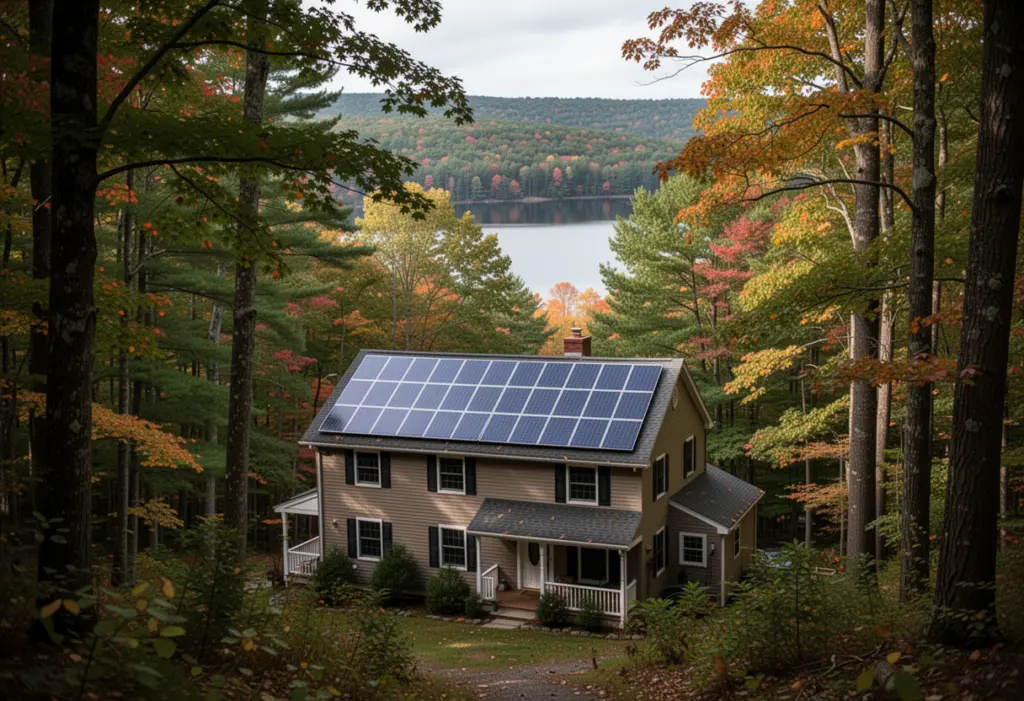
Putnam County sits between Westchester and Dutchess — Carmel, Brewster, Mahopac, Cold Spring, Patterson, Putnam Valley, Garrison. ZIP codes here begin 105 and 125. It is one of the most heavily wooded counties in the lower Hudson Valley, and a substantial part of it lies in New York City’s drinking water watershed.
Check your utility first
Putnam sits near a service boundary and the county is not uniformly served by one company. Read the name printed on your own bill rather than accepting an installer’s assumption, because the monthly solar charge differs materially:
- Central Hudson — 2026 residential Customer Benefit Contribution of $1.67 per kW-month, the highest in New York. An 8 kW system pays about $160 a year.
- NYSEG — $1.19 per kW-month. The same system pays about $114 a year.
- Con Edison — $1.29 per kW-month, about $124 a year.
All are billed on DC system size regardless of production and recalculated annually rather than fixed at interconnection.
Trees are the binding constraint
Putnam is wooded and hilly, and the low winter sun means a ridge or a stand of mature hardwoods to the south removes hours of December production that a July assessment would never reveal.
Insist on an on-site shading assessment and ask specifically what the model assumes about winter. Where the roof genuinely will not work, many Putnam properties have land for a ground mount, which solves orientation, roof age and shading at once — and community solar needs no roof at all.
If tree removal is proposed, treat it as a decision rather than an assumption folded into a production estimate. It carries real cost, sometimes a municipal permit, and on a wooded property the trees are frequently part of the value.
The watershed question
Much of Putnam lies within the New York City watershed, and land disturbance in watershed areas can carry additional review — particularly for anything involving excavation or increased impervious surface.
For a rooftop array this rarely arises. For a ground mount, which means foundations and a trench, it is worth asking about early: which authority reviews it, and does the watershed status add a step. Discovering that after signing turns a schedule into a problem.
Roofs and permits
Carmel, Brewster, Kent, Patterson, Philipstown, Putnam Valley and Southeast each run their own permitting, and Cold Spring and Nelsonville carry historic character where review may apply. Ask which authority covers your address and what it is currently running at.
Roof age is the usual gate: under roughly ten years of shingle life left means re-roof first, because removing and reinstalling an array later costs considerably more than mounting on a bare roof.
2026 incentives
The 30% federal residential credit is gone. Section 25D was terminated for expenditures made after 31 December 2025, with an expenditure treated as made when the original installation is completed.
Still available: New York’s 25% credit capped at $5,000 on Form IT-255, which reaches leases and PPAs of ten years or more as well as purchases; the state sales tax exemption; and RPTL 487’s 15-year property tax exemption where your town, the county and your school district have not opted out — each decides for its own levy. The RPTL 487 exemption is not automatic: file form RP-487 with your assessor by the taxable status date (March 1 in most towns; January 2 in Nassau towns; May 1 or June 1 in Westchester towns; set by charter in cities; usually January 1 in villages), and the system must be built before January 1, 2030 (RP-487 instructions).
Not available now: NY-Sun. As of September 2026 NYSERDA has no open NY-Sun block for homes in any utility territory; check NYSERDA’s NY-Sun dashboard for a new one. If a quote still subtracts a NY-Sun incentive, ask which open block it relies on.
Frequently Asked Questions
Which utility serves Putnam County for solar?
The county is near a service boundary and is not uniformly served by one company — Central Hudson, NYSEG and Con Edison all appear. Read the name on your own bill, because the monthly solar charge ranges from $1.19 to $1.67 per kW-month between them.
Does the New York City watershed affect solar in Putnam County?
Rarely for a rooftop array. For a ground mount, which means foundations and a trench, land disturbance in watershed areas can carry additional review — ask early which authority reviews it and whether the watershed status adds a step.
Is tree cover a problem for solar in Putnam County?
Frequently. The county is heavily wooded and hilly, and the low winter sun means southern obstructions remove December production a summer assessment will not show. An on-site shading assessment is essential.
Should I cut trees down for solar in Putnam County?
It is a decision with real cost, sometimes a municipal permit, and a permanent effect on a wooded property where the trees are often part of the value. It should be presented to you as a choice rather than assumed into a production estimate.
This article is general information, not tax, legal or financial advice. Incentive amounts, eligibility rules and deadlines change and depend on your utility, your tax situation and your property. Confirm current terms with NYSERDA, your utility and a qualified tax professional before making a decision.
NY Solar Incentives
Independent New York solar research. We summarise NYSERDA, NY-Sun and federal programme rules from published sources and state plainly when a figure is an estimate. We are not a government agency and do not sell equipment.
Run the arithmetic on your own system
Check the dated program table and your arrangement before counting an incentive. Standard residential NY-Sun blocks are closed; Long Island Affordable Solar has a conditional income-verification route. The NY credit depends on qualified costs and tax liability, while the NYC abatement reduces future property-tax bills. The estimator keeps those timings separate.