The New York Solar Permit Process, Step by Step
Two approvals decide when your system may switch on, and they run in parallel. The slower one governs your start date, and it is not always the one people expect.
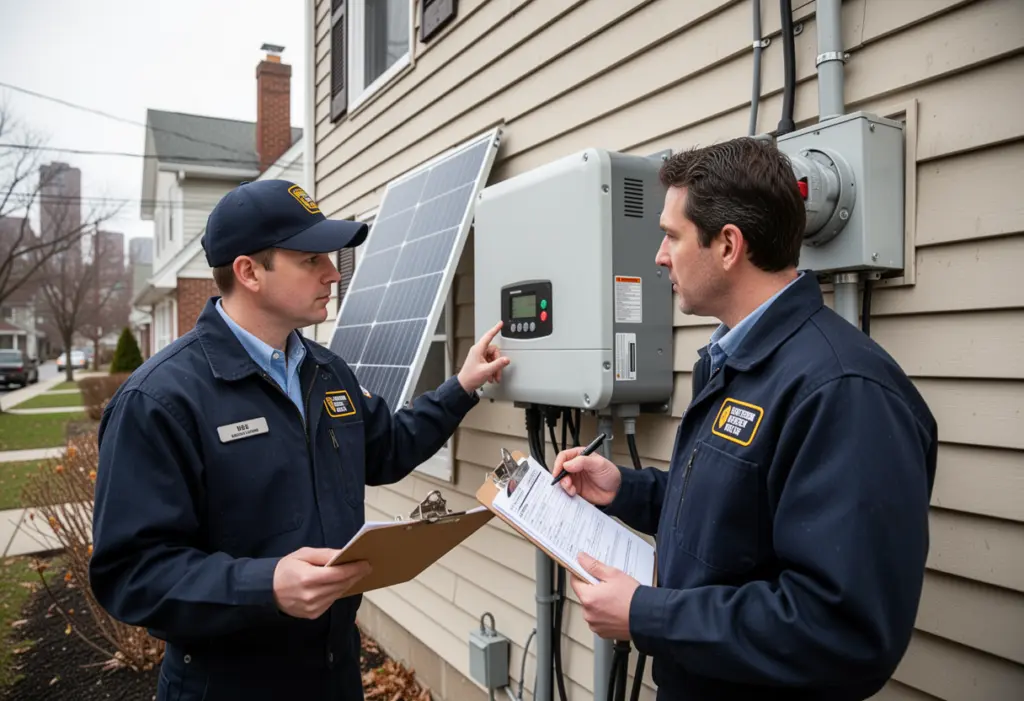
Two approvals decide when your system is allowed to switch on, and they run in parallel rather than one after the other. One is the building permit from your local authority having jurisdiction. The other is Permission to Operate from your utility. The slower of the two governs your start date, and it is not always the one people expect.
The sequence
- Site assessment. Roof measurement, shading analysis, service panel capacity, and a look at the roof covering and its remaining life. This is the stage where a roof replacement gets identified, and it is far better identified here than after the racking is on.
- Structural review. A letter or stamped drawings from an engineer licensed in New York, confirming the roof will carry the array plus snow loading for your location.
- Design and documentation. Layout, string design, electrical single line diagram, equipment specification sheets.
- Utility interconnection application. Filed with your utility. Start it as early as the design allows, because it is frequently the long pole in the whole schedule.
- Permit submission to the authority having jurisdiction — your town, village or city building department, or the New York City Department of Buildings in the five boroughs.
- Permit issued. Nothing gets installed before this point.
- Installation. Usually the shortest step on this list, which is why judging an installer by install days is misleading.
- Inspections. Final building inspection, plus electrical sign-off which in many New York jurisdictions comes from an approved third-party electrical inspection agency.
- Documentation to the utility — the certificate of compliance or completion and the inspection sign-off.
- Meter exchange where the existing meter cannot measure export.
- Permission to Operate. The utility authorises the system to energise.
- Switch on. Not before.
Why you must not energise early
Running the system before Permission to Operate is a genuine problem rather than a technicality. It puts power onto a network that has not authorised it, it can jeopardise the interconnection, and it complicates the net metering account that is meant to be crediting you. If an installer suggests it to save a fortnight, that tells you something about how they will handle the next problem too.
The Unified Solar Permit
The New York State Unified Solar Permit, developed by NYSERDA and the Department of State, standardises residential and small commercial solar permitting for systems of 25 kW DC and under. Over 300 authorities having jurisdiction have adopted it. Where it is in force the application and review are predictable, which is a real benefit even though the fee itself remains local. It does not apply in the five boroughs, which use the New York City Department of Buildings process instead.
Ask your installer whether your specific authority has adopted it. That single question tells you whether the paperwork stage is a known quantity or a bespoke one.
What you sign, and what you should keep
The installer normally prepares and files everything, but you sign as the property owner, and both the permit and the interconnection agreement are in your name. Ask for a copy of every submission and every approval as it happens, and keep them in one place:
- The permit application and the issued permit.
- The structural letter or the stamped drawings.
- The final inspection sign-off and the electrical inspection certificate.
- The certificate of compliance or completion.
- The interconnection agreement and the Permission to Operate notice.
- The itemised final invoice showing what was paid for what.
You need those twice: when you claim the state credit on Form IT-255, and when you sell the house and a cautious buyer or their attorney asks whether the array was permitted and inspected. Assembling them years later from an installer who may no longer be trading is considerably harder than asking for them as they arrive.
Timelines, honestly
Anybody quoting a fixed number of weeks for a New York permit is quoting an average that may have nothing to do with your municipality. Ask a better question: what has your recent median been in this specific town or village, and who is the reviewer you deal with there. An installer who works your area constantly can answer that. One who cannot is telling you something.
Ask also what happens if the authority rejects the submission. Rejections are ordinary — a missing detail, an outdated form, a fire access setback — and the real question is who absorbs the delay and whether your deposit schedule has already advanced past that point. Many contracts front-load payments before permitting is complete, and a rejection then becomes your problem while the money has already gone.
The utility side, and who is not on it
Interconnection and Permission to Operate come from your utility, and the process is a state one only for the investor-owned utilities under Public Service Commission jurisdiction. A municipal electric utility customer is outside it entirely — no state interconnection process, no Commission net metering and no Customer Benefit Contribution — and the terms are set by the municipal utility directly. Confirm the utility from your own bill, not from a map and not from a proposal.
Once interconnected, Phase One net metering credits exports at the full retail rate and holds for 20 years from interconnection. Where the system is interconnected on or after 1 January 2022 the Customer Benefit Contribution applies, billed monthly on DC size: a 7 kW system pays 7 multiplied by $1.31, about $9.17 a month, under RG&E, and 7 multiplied by $1.13, about $7.91, under PSEG Long Island.
The incentive that depends on this paperwork
NY-Sun never touched your tax return: it was applied by the contractor as a reduction in the price, its value depended on system size and region, and it was structured as a megawatt block that stepped down as each regional block filled. As of September 2026 NYSERDA has no open NY-Sun block for homes in any utility territory; check NYSERDA’s NY-Sun dashboard for a new one. The income-qualified Affordable Solar blocks, which were also contractor-applied, have closed as well. That leaves the 25% state credit on Form IT-255, capped at $5,000 for a principal residence, which is claimed later using exactly the documents listed above. The 30% federal residential credit is not part of the picture: it ended for expenditures made after 31 December 2025, with an expenditure treated as made when the original installation is completed.
Frequently Asked Questions
How long does the solar permit process take in New York?
It varies by municipality and averages are not useful. Ask the installer for their recent median in your specific town or village and which authority they file with. The utility interconnection track often takes longer than the building permit.
Can I turn the system on before Permission to Operate?
No. Energising before the utility authorises it can jeopardise the interconnection and complicates the net metering account. An installer who suggests otherwise is worth reconsidering.
Who files the solar permit, me or the installer?
The installer normally prepares and files, but you sign as the property owner and both the permit and the interconnection agreement are in your name. Ask for copies of every submission and approval as they happen.
What is the New York Unified Solar Permit?
A standardised residential and small commercial solar permit developed by NYSERDA and the Department of State for systems of 25 kW DC and under, adopted by over 300 authorities having jurisdiction. It does not apply in the five boroughs.
This article is general information, not tax, legal or financial advice. Incentive amounts, eligibility rules and deadlines change and depend on your utility, your tax situation and your property. Confirm current terms with NYSERDA, your utility and a qualified tax professional before making a decision.
NY Solar Incentives
Independent New York solar research. We summarise NYSERDA, NY-Sun and federal programme rules from published sources and state plainly when a figure is an estimate. We are not a government agency and do not sell equipment.
Run the arithmetic on your own system
Check the dated program table and your arrangement before counting an incentive. Standard residential NY-Sun blocks are closed; Long Island Affordable Solar has a conditional income-verification route. The NY credit depends on qualified costs and tax liability, while the NYC abatement reduces future property-tax bills. The estimator keeps those timings separate.