Solar Panel Cost in Canton, NY
In the North Country a solar quote carries costs that downstate quotes do not, and travel is the one nobody itemises. Here is what actually moves the number in Canton.
On this page 7 sections
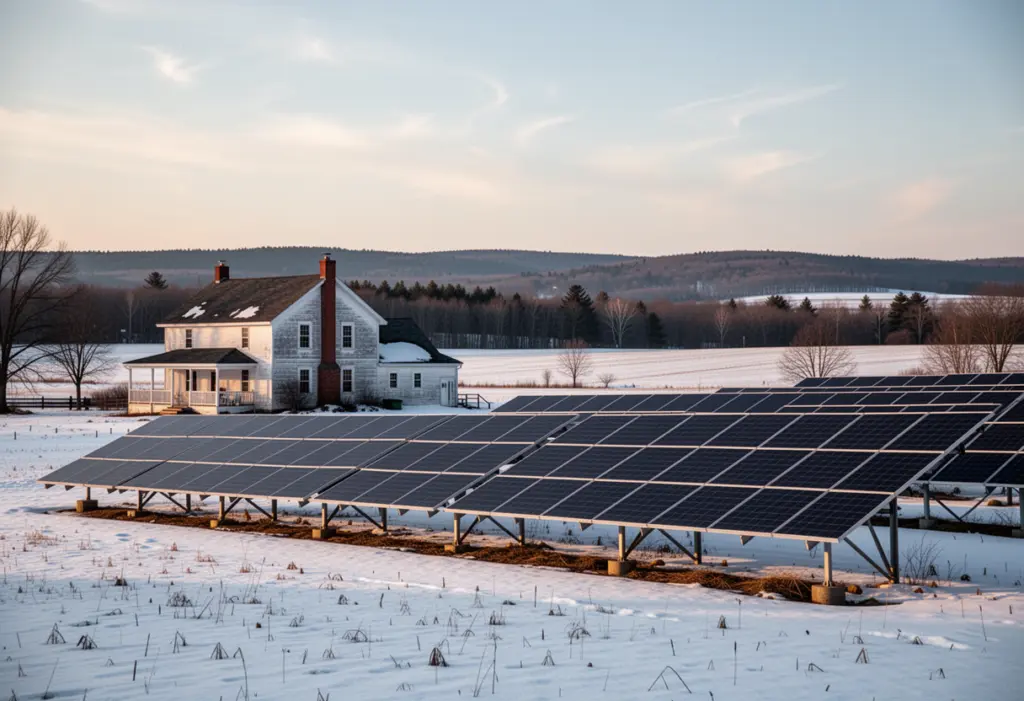
Canton is a village inside the Town of Canton, the county seat of St Lawrence County, on the Grasse River. ZIP code 13617. St Lawrence University and SUNY Canton are both here, the village is small and old, and the nearest large city is a long drive away. Each of those turns up somewhere inside a solar price.
Distance is a real line item
Fewer companies work the North Country than work western or downstate New York, and the drive from Syracuse, Watertown or Plattsburgh is long. That cost is in the price whether or not anybody itemises it. Three questions get at it:
- Where does the crew start its day? The answer prices the installation and also tells you what a warranty call in January will actually involve.
- How many separate visits does the schedule assume? Site survey, installation, electrical inspection, utility meter change — each is a journey, and a company that batches work in this region can quote below one making a special trip.
- Who takes a service call, and from where? A cheaper number from four hours away stops being cheaper the first time a failed inverter sits for a fortnight.
Collecting three quotes matters more here than in a dense market, precisely because fewer firms are competing for the work.
Snow specification costs money, legitimately
St Lawrence County takes heavy snow, and a design that genuinely meets it is not the cheapest design available. Racking and attachments rated for the local ground snow load sit above the entry-level product. A structural engineer’s letter is required more often here than in most of New York. Snow guards, wherever the array would release over a door, a walkway or a driveway, are both a safety item and a line item.
Ask, too, what the production estimate does about the weeks when the array is under snow. If nobody can tell you, the output figure is a guess dressed as a forecast — and every payback number in the proposal is derived from it.
The $5,000 ceiling, and what the 2026 arithmetic really looks like
The 30% federal residential credit is gone. Section 25D stopped at expenditures made after 31 December 2025, and the statute dates an expenditure to the day the original installation was finished. That removes the largest single line from every cost comparison written before 2026, so a proposal still showing it is not merely optimistic — its net figure does not exist.
What remains for a principal residence is New York’s 25% credit capped at $5,000 on Form IT-255, and the cap is the part that governs the sum. Below the point where a quarter of the price reaches $5,000 the credit behaves like a straight percentage; above it, every additional dollar of system cost earns nothing further, so the credit covers a steadily smaller share of a larger array. It is bounded by your actual New York State tax liability too, which makes the usable amount a question about your return rather than about the invoice, although unused credit carries forward for up to five years. Ask whether the proposal assumes you can absorb all of it in the first year.
The utility charge, and which utility
Most of this area is on National Grid, but confirm it from your own bill — Massena, in the same county, runs a municipal electric utility, and a municipal customer is outside state net metering, outside the Customer Benefit Contribution and outside the standardised state interconnection process.
On National Grid the 2026 residential CBC is $0.97 per kW-month of DC capacity, and no New York utility publishes a lower residential figure. A 5.5 kW roof array costs $5.34 a month, about $64 a year; an 11 kW ground array costs $10.67 a month, about $128. Because the charge follows capacity rather than production, a larger system pays more every month whether or not the extra kilowatts earn their keep — which is a straightforward argument for sizing to your consumption rather than to the space available.
Land changes the sum
Beyond the village this is open agricultural country and many parcels have room for a ground mount. Treat it as a genuine alternative rather than a fallback: tilt and orientation become design choices instead of inherited constraints, roof age drops out of the calculation entirely, and both clearing and maintenance happen at standing height, which in this climate is worth more than it sounds on paper.
The costs to ask about are the trenching distance back to the house, foundation depth below the frost line, site plan review and setbacks, and the clearance under the lowest row — an array set too close to the ground spends weeks at a time under a drift.
Older housing, and the incentive that has closed
Village housing here is old. Roof age is the gate — under roughly ten years of shingle life left means re-roof first — and 100 amp service is common, where fitting a solar breaker can require a panel upgrade or a line-side tap. Both belong in the written quote rather than in a change order.
On the incentive side, the one that has changed most is NY-Sun. It was paid through your contractor as a reduction on the price, the amount depended on system size and on region, and it was administered as megawatt blocks: each region had capacity blocks, and the per-watt value stepped down as each block filled, because the programme was built to phase out as the market matured. For homes it has now phased out. As of September 2026 NYSERDA has no open NY-Sun block for homes in any utility territory; check NYSERDA’s NY-Sun dashboard for a new one. The last standard upstate residential block (Block 14, $0.15/W, NYSEG, RG&E and National Grid territories) closed on 17 December 2025, and the income-tested Affordable Solar block closed on 9 March 2026. So the figure a neighbour received last year is not available to you at all, and a quote that still shows a NY-Sun line needs explaining in writing.
Also live: the state sales tax exemption on residential solar equipment, and RPTL 487, a 15-year exemption on added property value where the village, the town, St Lawrence County and your school district have each separately declined to opt out, for systems constructed before 1 January 2030. Confirm the current position with NYSERDA and the New York State Department of Taxation and Finance before signing.
Frequently Asked Questions
Why do Canton quotes differ from downstate ones?
Two real costs. Fewer companies work the North Country, so travel to and from the site is inside the price, and the structure has to be specified for heavy snow, which means better racking, engineer's letters more often, and snow guards where the array releases.
Is the state credit worth a quarter of my system cost?
Only up to $5,000. Below that point it behaves like a straight 25%; above it, additional system cost earns nothing further. It is also bounded by your New York State tax liability, with unused amounts carrying forward for up to five years.
Is a ground mount cheaper here?
Not necessarily cheaper, but often better value on a parcel with land, because tilt and orientation become choices, roof age drops out, and clearing happens at standing height. Ask about trenching distance, frost-line foundations, site plan review and clearance under the lowest row.
How do I find out what NY-Sun will pay on my system?
Nothing on a home at present. As of September 2026 NYSERDA has no open NY-Sun block for homes in any utility territory; check NYSERDA's NY-Sun dashboard for a new one. While residential blocks were open, NY-Sun was delivered as a price reduction through the contractor and its per-watt value stepped down as each block filled, so a neighbour's figure from last year does not carry over.
This article is general information, not tax, legal or financial advice. Incentive amounts, eligibility rules and deadlines change and depend on your utility, your tax situation and your property. Confirm current terms with NYSERDA, your utility and a qualified tax professional before making a decision.
NY Solar Incentives
Independent New York solar research. We summarise NYSERDA, NY-Sun and federal programme rules from published sources and state plainly when a figure is an estimate. We are not a government agency and do not sell equipment.
Run the arithmetic on your own system
Check the dated program table and your arrangement before counting an incentive. Standard residential NY-Sun blocks are closed; Long Island Affordable Solar has a conditional income-verification route. The NY credit depends on qualified costs and tax liability, while the NYC abatement reduces future property-tax bills. The estimator keeps those timings separate.