Solar Panel Installation in Watertown, NY
Watertown sits below the Tug Hill Plateau, in one of the snowiest corners of the eastern United States. Structural specification here is a safety item rather than a formality.
On this page 9 sections
- 01Snow load is the first line of the specification
- 02The city is not inside the town
- 03The Black River
- 04Not everyone in this county is on National Grid
- 05The 2026 Customer Benefit Contribution
- 06Nineteenth-century streets
- 07Ask where the crew is based
- 082026: the cap is what decides the arithmetic
- 09Frequently Asked Questions
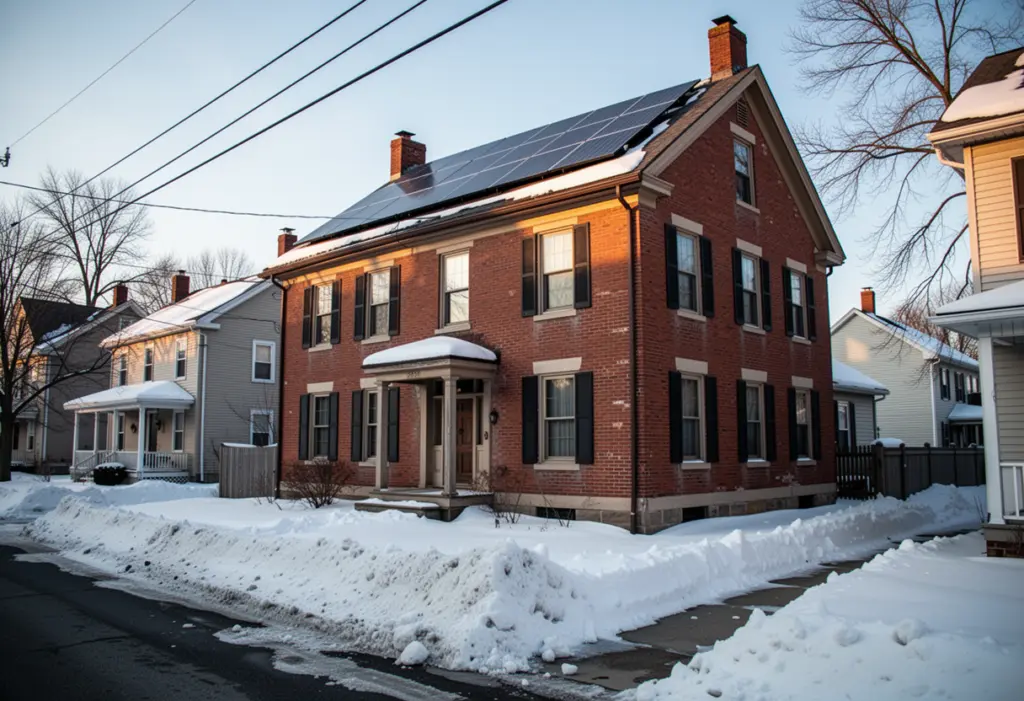
Watertown is a city in Jefferson County, on the Black River east of Lake Ontario. ZIP codes 13601 and 13603. It stands at the western foot of the Tug Hill Plateau, which collects some of the heaviest snowfall in the eastern United States, and that single fact reorganises a solar quote here more thoroughly than anything else on it.
Snow load is the first line of the specification
Four questions, in this order, and each of them wants an answer you can write down.
- What ground snow load are the racking, the attachments and the roof structure rated for? Racking is rated in pounds per square foot. The figure either covers your address or it does not, and hardware chosen for a downstate job may simply not reach it.
- Is a structural engineer’s letter needed? It is called for far more often at the foot of Tug Hill than in most of New York. Put it in the budget rather than meeting it after contract.
- Where does a loaded array discharge? Modules are slicker than shingle and a full array releases as a slab. Above a door, a walkway or a driveway, snow guards are a safety item and not an upsell.
- What snow-cover assumption sits inside the production estimate? A model built on a downstate profile overstates a Watertown winter substantially, and an inflated output figure quietly inflates the payback the whole proposal rests on.
One thing deep snow does not justify: tilting a roof array steeply so that it sheds faster. That raises wind load, complicates the mounting and usually costs more annual production than the snow it clears.
The city is not inside the town
The City of Watertown and the Town of Watertown are separate authorities with their own building departments, and unlike the village-inside-a-town pattern common elsewhere in the North Country, neither contains the other. Confirm which one holds your address before an installer files. A permit lodged in the wrong office costs weeks, and in a region where crews travel a long way to reach you, a missed inspection window costs a return journey.
The Black River
The river runs through the middle of the city, and low-lying property along it sits in mapped flood plain. What the mapping governs is elevation: the inverter, the AC and DC disconnects, the production meter and any battery generally have to be mounted above a specified height, which on many of these houses takes the basement off the table as a battery location even though it is the cheapest and tidiest place available. Establish whether your parcel is inside a mapped zone before the design is drawn, because relocating equipment after an inspection is not a cheap correction.
Not everyone in this county is on National Grid
Most of Jefferson County is, but the villages of Philadelphia and Theresa each operate a municipal electric utility. Municipal systems fall outside Public Service Commission jurisdiction, and their customers therefore get no state net metering, no Customer Benefit Contribution and no standardised state interconnection process — the terms are the village’s and have to be requested from it. Read the supplier name on your own bill before you read anything else about incentives.
The 2026 Customer Benefit Contribution
On a National Grid account this monthly charge applies to any system interconnected on or after 1 January 2022 and is calculated on DC capacity. The 2026 residential figure is $0.97 per kW-month, and no other New York utility publishes a lower residential rate. A 7 kW array pays $6.79 a month, about $81 a year; a 10 kW array pays $9.70, about $116. It is billed against capacity rather than what the system actually produces, and it is republished annually rather than fixed at the moment you interconnect. Set against it, Phase One net metering values your exports at the full retail rate and holds that treatment for 20 years from interconnection.
Nineteenth-century streets
Watertown carries a large stock of nineteenth and early twentieth century housing, and roof age is the usual gate: with under roughly ten years of shingle life remaining, replace the covering before the array goes on, because lifting a system off and re-fitting it later costs considerably more than mounting on bare deck. 100 amp service is common in that housing, and adding a solar breaker can force a panel upgrade or a line-side tap, which belongs in the quote rather than in a change order. On the older streets near Public Square, ask whether architectural review runs ahead of the building permit — where it does, a rear roof plane, all-black modules and concealed conduit are what clears it, and arguing after a refusal costs a meeting cycle.
Ask where the crew is based
The North Country supports fewer installers than western or downstate New York. Travel is a genuine cost inside a price rather than padding, and the answer to that one question also describes what a warranty call in February is going to look like.
2026: the cap is what decides the arithmetic
A properly snow-rated system in this county is not the cheapest system on the market, which makes the ceiling on New York’s credit the number to understand first. The solar energy system equipment credit is 25% of qualified expenditure but stops at $5,000, claimed on Form IT-255 for equipment at your principal residence in the state. Once the heavier racking, the engineer’s letter and the snow guards have pushed the price past the point where 25% reaches $5,000, every further dollar attracts no further credit at all. The credit is limited by your actual New York State tax liability as well; it is not refundable, though unused amounts carry forward for up to five years. Ask whether the proposal in front of you has assumed you can absorb the whole of it in year one.
Also live: the state sales tax exemption on residential solar equipment, and RPTL 487, a 15-year exemption on added property value where the city or town, Jefferson County and your school district have each separately declined to opt out, for systems constructed before 1 January 2030. Not live for a home: NY-Sun and its Affordable Solar incentive, which used to come off the contractor’s price. As of September 2026 NYSERDA has no open NY-Sun block for homes in any utility territory; check NYSERDA’s NY-Sun dashboard for a new one. The last standard upstate residential block (Block 14, $0.15/W, NYSEG, RG&E and National Grid territories) closed on 17 December 2025, and the upstate Affordable Solar block for income-qualified households closed on 9 March 2026.
The 30% federal residential credit is gone. Section 25D was terminated for expenditures made after 31 December 2025, and an expenditure is treated as made when the original installation is completed. Any 2026 proposal still showing a federal line is materially wrong, and it is the first thing to check on any quote you are handed. Programmes move, so confirm the current position with NYSERDA and the New York State Department of Taxation and Finance before you sign.
Frequently Asked Questions
How much snow load does a Watertown array have to carry?
More than a generic New York specification assumes, because the city sits at the foot of the Tug Hill Plateau. Ask for the ground snow load rating of the racking, attachments and roof structure in pounds per square foot, and expect a structural engineer's letter more often than elsewhere.
Who issues my solar permit here?
Either the City of Watertown or the Town of Watertown. They are separate authorities with their own building departments and neither contains the other, so confirm which one holds your address before an installer files anything.
Is everyone near Watertown on National Grid?
No. Most of Jefferson County is, but the villages of Philadelphia and Theresa each run a municipal electric utility outside Public Service Commission jurisdiction, so their customers get no state net metering, no CBC and no standardised interconnection.
Why does the $5,000 ceiling matter so much in this county?
Because a properly snow-rated system costs more to build. Heavier racking, engineer's letters and snow guards push the price past the point where 25% of it reaches $5,000, and beyond that point additional cost earns no additional credit.
This article is general information, not tax, legal or financial advice. Incentive amounts, eligibility rules and deadlines change and depend on your utility, your tax situation and your property. Confirm current terms with NYSERDA, your utility and a qualified tax professional before making a decision.
NY Solar Incentives
Independent New York solar research. We summarise NYSERDA, NY-Sun and federal programme rules from published sources and state plainly when a figure is an estimate. We are not a government agency and do not sell equipment.
Run the arithmetic on your own system
Check the dated program table and your arrangement before counting an incentive. Standard residential NY-Sun blocks are closed; Long Island Affordable Solar has a conditional income-verification route. The NY credit depends on qualified costs and tax liability, while the NYC abatement reduces future property-tax bills. The estimator keeps those timings separate.