Solar Panel Installation in Ogdensburg, NY
Ogdensburg is the only city in St Lawrence County and its housing runs old, which makes the income-eligible incentive the first question rather than the last.
On this page 8 sections
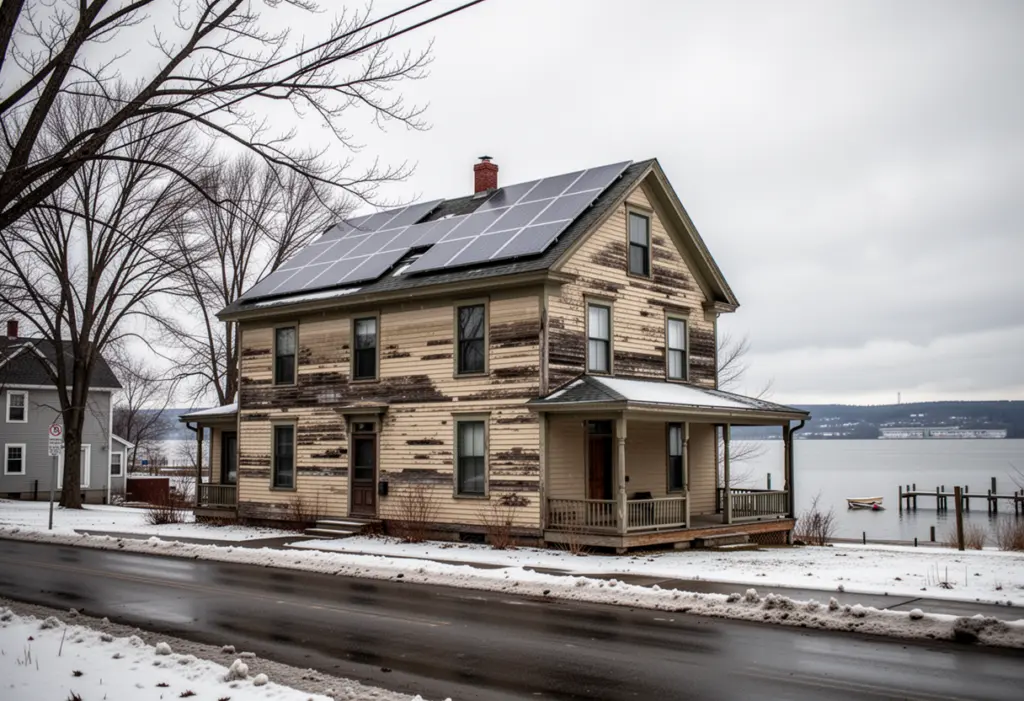
Ogdensburg is the only city in St Lawrence County, at the point where the Oswegatchie River meets the St Lawrence, directly across the water from Canada. ZIP code 13669. Much of the housing dates from the nineteenth and early twentieth centuries, and the income-tested help that used to come off a solar price here is closed for now. Both facts change where a sensible conversation starts.
Affordable Solar is closed for now
NYSERDA’s Affordable Solar incentive increased the NY-Sun incentive for households under 80% of area median income, and the contractor took it off the price on the day you signed. It is not available now. The upstate Affordable Solar block closed on 9 March 2026, and as of September 2026 NYSERDA has no open NY-Sun block for homes in any utility territory; check NYSERDA’s NY-Sun dashboard for a new one. Two things follow for a household budget:
- A quote should not show it. If a proposal still carries an Affordable Solar or NY-Sun line for your home, ask the contractor in writing which open block it comes from.
- What is left depends on your tax bill. New York’s credit is limited by the state tax you actually owe, so on a modest income part of it may have to be carried forward; the 2026 section below has the detail.
With the federal credit gone as well, what still reaches an installation in this city is the state credit, the state sales tax exemption and RPTL 487, set out under the 2026 heading below.
One authority, which is simpler than most of the region
Ogdensburg is a city, so it runs its own building department and there is no village-inside-a-town layer to disentangle — a genuine advantage over most North Country addresses. Ask about the electrical inspection as a separate step and ask what the turnaround is, because up here a delayed inspection can mean a crew making a second long journey rather than waiting an afternoon. On the older streets near the waterfront, ask whether architectural review sits ahead of the building permit; where it does, keeping the array off the street elevation, using black-framed modules and mounting flush to the plane is what clears it.
Two rivers, and where the equipment ends up
Low-lying property along the St Lawrence and the Oswegatchie can fall inside mapped flood plain, and the mapping is about height rather than about panels. The inverter, the AC and DC disconnects, the production meter and any battery normally have to sit above a specified elevation, which can mean a different wall, a greater height or an interior room instead of the default position beside the meter — and on these parcels it very often means a battery cannot go in the basement even though the basement is the cheapest place for one. Find out whether your parcel is inside a mapped zone before a design is drawn, because moving equipment after an inspection is expensive.
Older housing: three checks
Roof age
With under roughly ten years of shingle life remaining, replace the covering first. Taking an array off and putting it back later costs considerably more than mounting on bare deck, and it is an entirely avoidable expense.
Structure
Older wood-frame roofs draw a structural engineer’s letter more often than newer construction, and the snow this climate delivers makes that more likely again. Budget for it rather than meeting it after contract.
Service panel
100 amp service is common in this housing stock, and fitting a solar breaker can require a panel upgrade or a line-side tap. Ask what your service is and whether the busbar has room, then get the answer priced inside the quote.
Wind as well as snow
Ask for the ground snow load the racking, attachments and roof structure are specified for, as a number. Ask where a loaded array would release, since panels shed as a slab and a doorway or walkway underneath needs snow guards. Ask what snow-cover assumption is inside the production estimate. And because this city sits on open water, ask about the wind load rating of the racking and the attachments as well — that question is easy to forget inland and hard to fix afterwards. Then ask where the crew is based, because travel is a genuine cost in a North Country quote and the answer also describes a February service call.
Renting, and the meter
Rented and two-family housing is common here, and one rule governs it: a system reduces the consumption on the meter it is wired behind. A landlord-side array offsets the landlord’s usage rather than a tenant’s apartment, even when the panels sit directly above it. Where the bill payer is not the roof owner, community solar reaches them instead — no roof, no up-front cost, and no Customer Benefit Contribution for subscribers.
National Grid, and what 2026 leaves
Most of this area is on National Grid; confirm it from your own bill, since Massena in the same county is municipal and its customers are outside state net metering, the Customer Benefit Contribution and the state interconnection process. On National Grid the 2026 residential CBC is $0.97 per kW-month of DC capacity, the lowest residential rate published in New York for the year — $3.88 a month on a 4 kW array, about $47 across a year, or $6.31 on 6.5 kW, about $76. It is billed on capacity rather than production. Phase One net metering credits exports at the full retail rate and holds for 20 years from interconnection.
Take the incentives in the order that suits a household budget. The contractor-applied money that used to come first, Affordable Solar and NY-Sun, has no open block for homes as of September 2026. That leaves New York’s 25% credit capped at $5,000 on Form IT-255 for a principal residence in the state, which is limited by your actual state tax liability and so may not be fully usable on a modest income — it is not refundable, but unused amounts carry forward for up to five years, which is worth putting to an accountant before a proposal is built around the full figure. Then the state sales tax exemption on residential solar equipment, and RPTL 487, a 15-year exemption on added property value where the city, St Lawrence County and your school district have each separately declined to opt out, for systems constructed before 1 January 2030.
A federal line has no business appearing on a 2026 quote at all. Section 25D ended for expenditures made after 31 December 2025, measured from the completion of the original installation, so a proposal still carrying 30% is describing a benefit nobody can collect. Check the current position with NYSERDA and the New York State Department of Taxation and Finance before you sign.
Frequently Asked Questions
What is available to a lower-income household in Ogdensburg?
Less than it was before March 2026. NYSERDA's Affordable Solar incentive, which increased the NY-Sun incentive for income-qualified households, closed in the upstate region on 9 March 2026. As of September 2026 NYSERDA has no open NY-Sun block for homes in any utility territory; check NYSERDA's NY-Sun dashboard for a new one. The state credit still applies, limited by the tax you owe, with unused amounts carried forward for up to five years.
Can I use the whole New York credit on a modest income?
Not necessarily. The credit is capped at $5,000 and bounded by your actual New York State tax liability, so the full amount may not be usable in the year of installation. It is not refundable, although unused amounts carry forward for up to five years.
Does the flood plain affect solar here?
On low-lying property along the St Lawrence and the Oswegatchie it does. The inverter, both disconnects, the meter and any battery normally have to clear a specified elevation, which usually rules out a basement battery. Establish it before a design is drawn.
Is there anything extra to ask about because of the open water?
Yes — the wind load rating of the racking and the attachments, alongside the snow load figure. It is an easy question to forget on an inland job and an expensive one to correct after the array is up.
This article is general information, not tax, legal or financial advice. Incentive amounts, eligibility rules and deadlines change and depend on your utility, your tax situation and your property. Confirm current terms with NYSERDA, your utility and a qualified tax professional before making a decision.
NY Solar Incentives
Independent New York solar research. We summarise NYSERDA, NY-Sun and federal programme rules from published sources and state plainly when a figure is an estimate. We are not a government agency and do not sell equipment.
Run the arithmetic on your own system
Check the dated program table and your arrangement before counting an incentive. Standard residential NY-Sun blocks are closed; Long Island Affordable Solar has a conditional income-verification route. The NY credit depends on qualified costs and tax liability, while the NYC abatement reduces future property-tax bills. The estimator keeps those timings separate.