Solar Panel Installation in Cheektowaga, NY
Cheektowaga's post-war housing means usable roof area, not consumption, usually decides how big a system can be.
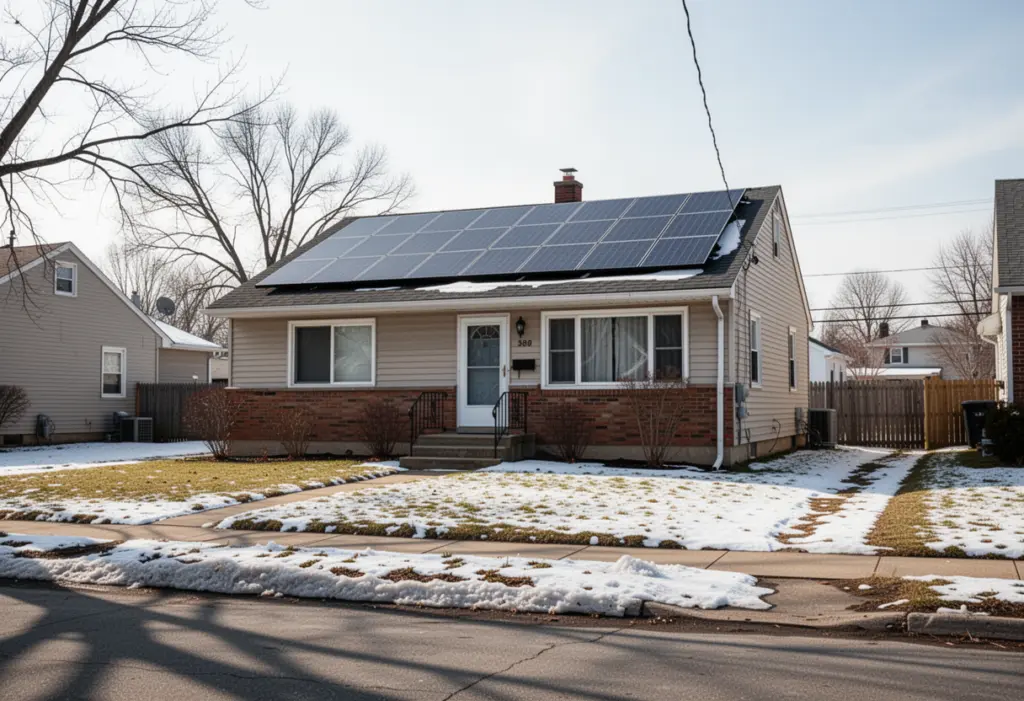
Cheektowaga sits immediately east of Buffalo, wrapped around the airport. ZIP codes here begin 142 and 140. Its housing is overwhelmingly post-war — Capes, ranches and small colonials on modest lots — and that is the single fact that shapes a solar project here.
Roof area, not consumption, is usually the limit
On a small post-war roof, what caps the array is frequently how much unshaded, unobstructed area exists rather than how much electricity the household uses. A household that would justify a 10 kW system may only fit six or seven.
Ask your installer directly what is limiting the array. If the answer is roof area rather than budget, that changes what to expect — and it is where a community solar subscription covering the remainder becomes worth considering, since community solar needs no roof and its subscribers pay no Customer Benefit Contribution.
Fire-access clearances eat proportionally more of a small roof than a large one, which is part of the same story. Ask how much capacity went to clearances, in kW.
Shading between houses
Lots are modest and houses sit close together, so a neighbour’s roofline or a street tree matters at the low winter sun angle in a way it would not on a larger plot. Insist on an on-site shading assessment.
The sequence
- Twelve months of National Grid usage, an on-site shading assessment, roof condition and structure.
- Interconnection application to National Grid, before installation.
- Town of Cheektowaga building permit.
- Installation, typically one to three days.
- Electrical inspection, then certificate to National Grid, meter exchange, and permission to operate. The system may not run before PTO.
If a project goes quiet after installation, ask for the inspection certificate and the date it was submitted — many stalls turn out to be certificates that passed and were never sent.
Snow
Erie County design loads are high. Ask what load the racking is specified for and who verified the roof can carry it, whether snow guards are needed, and what snow-cover assumption is in the production estimate.
National Grid
The Customer Benefit Contribution is $0.97 per kW-month of DC system size for 2026, the lowest of the major New York utilities: about $5.82 a month on a 6 kW system, roughly $70 a year. Billed on capacity regardless of production and recalculated annually.
2026 incentives
The 30% federal residential credit is gone — section 25D was terminated for expenditures made after 31 December 2025, with an expenditure treated as made when the original installation is completed. On a modest budget a quote still showing it overstates the net cost by thousands.
Still available:
- New York’s 25% credit, capped at $5,000, on Form IT-255 — non-refundable but carried forward five years, which matters where tax liability is modest.
- The state sales tax exemption on residential solar equipment.
- RPTL 487, the 15-year property tax exemption, claimed on form RP-487 filed with your assessor by the taxable status date, where the town, Erie County and your school district have not opted out.
NY-Sun and its Affordable Solar track for low- to moderate-income households are not on this list: as of September 2026 NYSERDA has no open NY-Sun block for homes in any utility territory; check NYSERDA’s NY-Sun dashboard for a new one. A quote that still shows a NY-Sun price reduction should name the open block it is counting on.
Frequently Asked Questions
Why is my Cheektowaga solar system smaller than my usage?
On a small post-war roof, usable area rather than consumption usually caps the array, and fire-access clearances eat proportionally more of a small roof. Ask your installer directly what is limiting it and how much capacity went to clearances.
Can I combine rooftop solar with community solar?
It is worth asking about where a small roof cannot cover the household. Community solar needs no roof or up-front cost, and its subscribers pay no Customer Benefit Contribution at all.
What does National Grid charge a Cheektowaga solar customer?
The Customer Benefit Contribution at $0.97 per kW-month of DC system size for 2026, the lowest of the major New York utilities — about $70 a year on a 6 kW system.
What extra help exists for lower-income households here?
Not from NY-Sun right now. NYSERDA's Upstate Affordable Solar track for low- to moderate-income households closed on 9 March 2026, and as of September 2026 NYSERDA has no open NY-Sun block for homes in any utility territory; check NYSERDA’s NY-Sun dashboard for a new one. The state credit still carries forward for up to five years, which matters where tax liability is modest. What NYSERDA does offer now is Statewide Solar for All: households enrolled in their utility's Energy Assistance Program (EAP) get a monthly community-solar credit on their electric bill, with no upfront cost or fees, and enrolment in EAP enrolls you automatically.
This article is general information, not tax, legal or financial advice. Incentive amounts, eligibility rules and deadlines change and depend on your utility, your tax situation and your property. Confirm current terms with NYSERDA, your utility and a qualified tax professional before making a decision.
NY Solar Incentives
Independent New York solar research. We summarise NYSERDA, NY-Sun and federal programme rules from published sources and state plainly when a figure is an estimate. We are not a government agency and do not sell equipment.
Run the arithmetic on your own system
Check the dated program table and your arrangement before counting an incentive. Standard residential NY-Sun blocks are closed; Long Island Affordable Solar has a conditional income-verification route. The NY credit depends on qualified costs and tax liability, while the NYC abatement reduces future property-tax bills. The estimator keeps those timings separate.