Solar Panel Installation in Syracuse, New York
Syracuse gets more snow than almost any city in the country, and that shapes the whole installation. Here is what it changes, and what it does not.
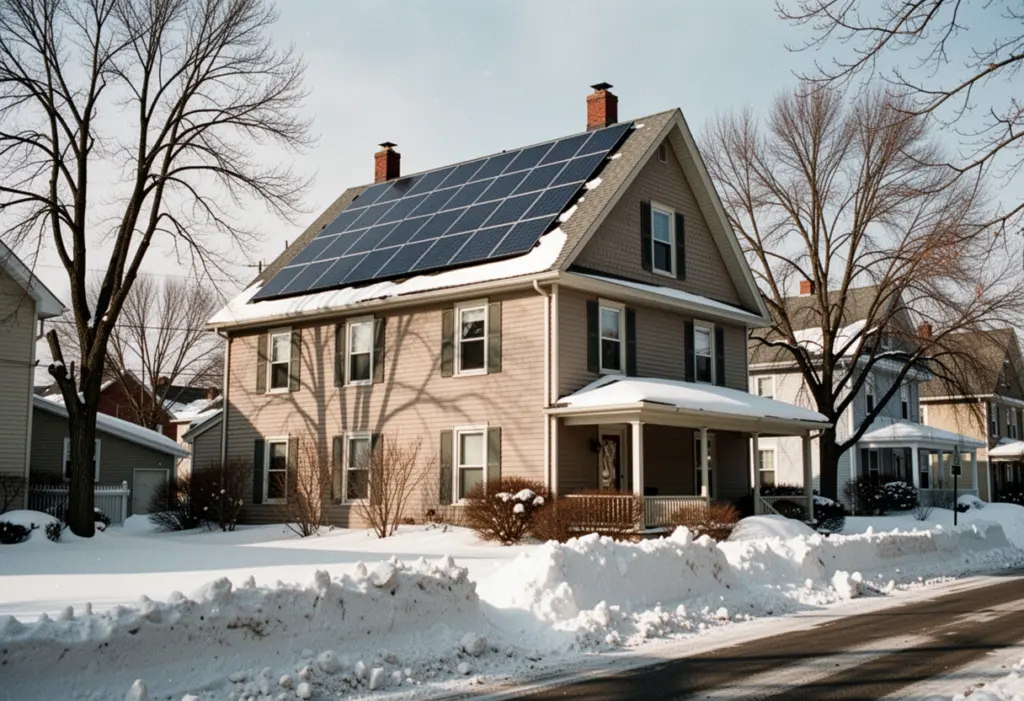
Syracuse receives more snow than almost any other city of its size in the United States, and that single fact colours every conversation about solar here. It matters — but far less than most people assume, and not in the way they expect.
What snow actually does to a Syracuse system
Panels shed snow better than the roof around them. The glass is smooth, the surface is dark, and a module under snow still absorbs enough light to warm and start the slide. A pitched array in Syracuse typically clears itself while the shingles beside it are still covered.
The days genuinely lost fall in December and January, which are already the weakest production months of the year. Across a full Syracuse winter, snow cover normally accounts for a modest single-digit percentage of annual production. It is a real loss and it should be in the production estimate — a proposal that models Syracuse output with no snow assumption is overstating the annual number.
What snow does change is engineering. Racking must be specified for the local snow load, which in Onondaga County is substantially higher than downstate. A steeper pitch helps. And where an array sits above a doorway, a driveway or a walkway, snow guards are not a luxury — a full sheet of snow releasing at once from a solar array is a genuine hazard.
The installation sequence
- Site assessment and design. Twelve months of National Grid usage, a shading assessment, roof condition and structure.
- Interconnection application filed with National Grid, ideally before anything is mounted.
- Building permit from the City of Syracuse or your town — Clay, Cicero, Camillus, Manlius, DeWitt, Salina and Liverpool each run their own process.
- Installation. One to three days for a typical residential array.
- Electrical inspection by the municipality.
- Meter exchange and permission to operate from National Grid. The system may not run before this.
The gap between installation and permission to operate is where the frustration lives, and it is mostly municipal rather than utility. Ask your installer for a current range for each step, based on their recent projects in your specific town.
Roof and structure in Syracuse
Syracuse housing stock skews old, and old wood-frame roofs designed for heavy snow are not automatically able to carry an array on top of the load. A structural engineer’s letter is more common here than in most of the state, and it is a real cost when a building department asks for one.
Roof age is the other budget item people miss. If the shingles have under roughly ten years left, replace the roof first. Taking an array off and putting it back later costs considerably more than installing on a bare roof.
National Grid, and the number nobody quotes
Syracuse is National Grid territory. Beyond interconnection and permission to operate, that sets your Customer Benefit Contribution: a monthly charge on the DC size of your system for anyone interconnecting on or after 1 January 2022.
National Grid’s final 2026 residential rate is $0.97 per kW-month — the lowest in the state. An 8 kW system pays $7.76 a month, roughly $93 a year. Compare Central Hudson at $1.67 for the same system, and it is clear how much territory alone is worth.
Incentives in 2026
The 30% federal residential credit is gone. Section 25D ended for expenditures made after 31 December 2025, and the operative test is when the original installation was completed — not when the system was placed in service. A Syracuse install finished in December 2025 still qualifies even if National Grid granted PTO in 2026.
Still live: New York’s 25% credit capped at $5,000 on Form IT-255; the state sales tax exemption on residential solar equipment; and the RPTL 487 property tax exemption for 15 years where your municipality has not opted out. The RPTL 487 exemption is not automatic: file form RP-487 with your assessor by the taxable status date (March 1 in most towns; January 2 in Nassau towns; May 1 or June 1 in Westchester towns; set by charter in cities; usually January 1 in villages), and the system must be built before January 1, 2030 (RP-487 instructions). Onondaga County’s towns have each made that decision separately, so check yours. As of September 2026 NYSERDA has no open NY-Sun block for homes in any utility territory; check NYSERDA’s NY-Sun dashboard for a new one.
Questions to ask a Syracuse installer
- What snow load is the racking specified for, and who confirmed the roof can carry it?
- Does the production estimate include a snow-cover assumption? What is it?
- Where will snow discharge from this array, and does it need snow guards?
- Which municipality issues my permit and what is its current turnaround?
- Is any part of the payment schedule tied to permission to operate rather than to the panels being bolted down?
Frequently Asked Questions
Does snow make solar pointless in Syracuse?
No. Panels shed snow faster than the roof around them, and the days lost fall in December and January when production is lowest anyway. Snow cover typically costs a modest single-digit percentage of annual production, which should be reflected in the estimate.
Do Syracuse roofs need extra engineering for solar?
Often. Onondaga County snow loads are substantially higher than downstate, racking must be specified accordingly, and a structural engineer's letter is requested more frequently here than in most of the state.
Which utility connects solar in Syracuse?
National Grid. It handles the interconnection application and permission to operate, and its 2026 residential Customer Benefit Contribution rate is $0.97 per kW-month — the lowest of the major New York utilities.
How long does solar installation take in Syracuse?
The physical installation is usually one to three days. The full sequence from application to permission to operate takes considerably longer, and most of that time is municipal permitting and inspection rather than utility work.
This article is general information, not tax, legal or financial advice. Incentive amounts, eligibility rules and deadlines change and depend on your utility, your tax situation and your property. Confirm current terms with NYSERDA, your utility and a qualified tax professional before making a decision.
NY Solar Incentives
Independent New York solar research. We summarise NYSERDA, NY-Sun and federal programme rules from published sources and state plainly when a figure is an estimate. We are not a government agency and do not sell equipment.
Run the arithmetic on your own system
Check the dated program table and your arrangement before counting an incentive. Standard residential NY-Sun blocks are closed; Long Island Affordable Solar has a conditional income-verification route. The NY credit depends on qualified costs and tax liability, while the NYC abatement reduces future property-tax bills. The estimator keeps those timings separate.