Solar Companies in NYC: What to Check Before Signing
Six structurally different businesses sell rooftop solar in New York City. How to tell them apart, which credentials you can verify yourself, and what to press on.
On this page 9 sections
- 01Six kinds of company, and how to tell them apart
- 02What each kind tends to get wrong
- 03The credentials you can check yourself, before you meet anyone
- 04The building type decides the shortlist before price does
- 05Who files what, and who is the applicant of record
- 06The scope boundaries that only bite in a dense city
- 07Landmarks, historic districts and what is visible from the street
- 08What survives if the company does not
- 09Frequently asked questions
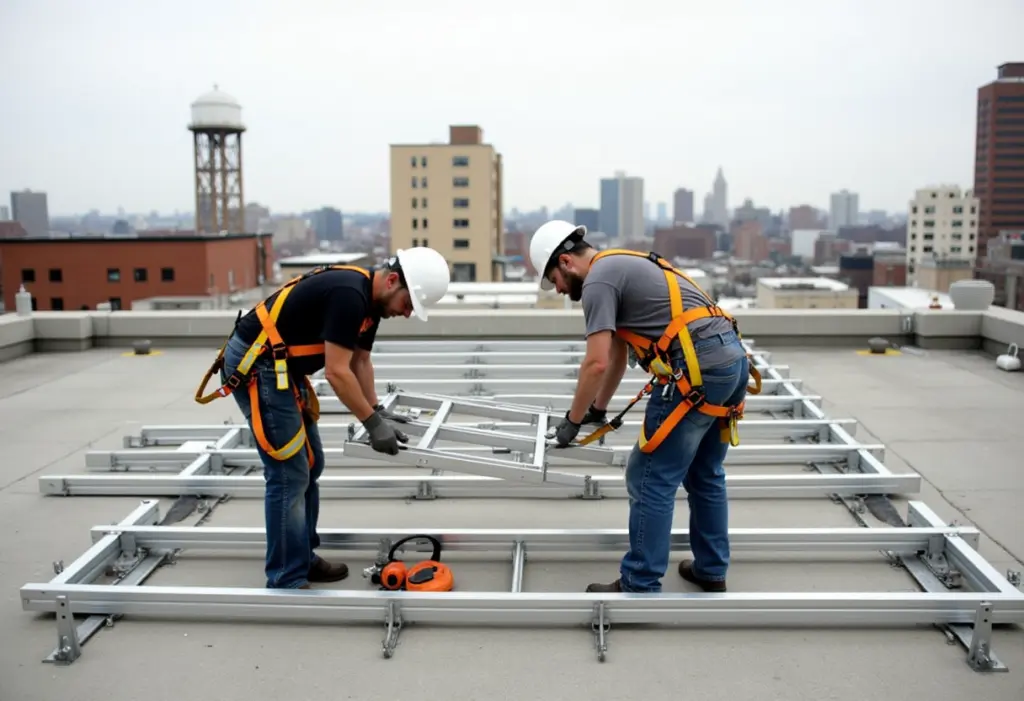
The companies selling rooftop solar in New York City are not variations on one business. They are at least six structurally different operations, and the differences decide who designs the system, who is legally responsible for the filings, and who is still reachable in year six.
Identifying which kind you are talking to is worth doing before comparing prices, because the same quoted figure means different things depending on who is standing behind it. This site is independent, sells nothing and names no company; what follows is how to read the ones that contact you.
Six kinds of company, and how to tell them apart
A design-build solar contractor employs its own designers and crews and files its own work. A national sales organisation markets and finances at scale and subcontracts the installation to a local crew you have not met. A roofing company that has added solar leads with the roof and treats the array as an attachment. An electrical contractor that has added solar comes at it from the service panel. A co-op and condominium specialist is set up for board approvals, alteration agreements and shared roofs. A community solar broker installs nothing at all and is selling a subscription to a remote array.
All six are legitimate businesses. They are simply good at different things, and the failure modes are predictable: the sales organisation is furthest from the roof, the roofer is furthest from the interconnection, the electrician is furthest from the waterproofing, and the broker is not selling what most callers think they are buying.
One question that sorts them quickly
Ask who will physically be on the roof, whether they are employees of the company you are signing with, and who holds the workmanship warranty. The answer places the company in one of the six categories within about a minute, and it is a fair question that a competent firm answers without hesitation.
What each kind tends to get wrong
| Kind of company | Usual strength | Question worth pressing |
|---|---|---|
| Design-build solar contractor | Owns the whole process | Capacity: how far out is the schedule, and who covers permit delays |
| National sales organisation | Financing options and process scale | Which local firm installs, and whose warranty covers the labour |
| Roofing company with solar | Roof condition and waterproofing | Who handles interconnection and the electrical scope |
| Electrical contractor with solar | Service panel and code compliance | Who is responsible if a penetration leaks |
| Co-op and condo specialist | Board approvals and shared roofs | How the benefit is allocated between units |
| Community solar broker | No equipment, no installation | Whether you were looking for a subscription at all |
The credentials you can check yourself, before you meet anyone
Most claims a salesperson makes about their company’s standing are checkable against a public register in about fifteen minutes. Treat all of them as filters on eligibility rather than recommendations: registration says a company is permitted to do the work, not that it does it well.
Home improvement work on residential property in New York City generally requires a Home Improvement Contractor licence from the Department of Consumer and Worker Protection, which publishes a licence lookup. Ask which licence number the company trades under and check it yourself rather than accepting a claim on a brochure. If a firm says the requirement does not apply to its scope, ask it to put that in writing.
The Department of Buildings side is public too. Filings, permits and any violations attached to an address appear in the department’s public systems, so a company that has worked on your block has left a record. The electrical work needs a New York City licensed master electrician, which is a separate credential from whoever sells you the system.
If your price relies on the state incentive, the company must appear on NYSERDA’s list of participating NY-Sun contractors — an incentive quoted by a firm that is not on it is not a real deduction. At the individual level, NABCEP certification is a voluntary industry credential held by a person rather than a business, so ask whether the certified individual will be on your project or only on the letterhead.
The building type decides the shortlist before price does
In a one or two-family house the owner can normally authorise the work directly. In a co-op or condominium the roof is usually common property, board approval and an alteration agreement come first, and the question is not whether a company can install solar but whether it has worked through that approval before.
Renters cannot authorise a rooftop installation at all, which is one reason community solar exists as a separate route. A company still pitching a rooftop system after learning you rent is telling you something about how it qualifies leads.
Who files what, and who is the applicant of record
New York City work runs through the Department of Buildings, and the filings are made by a registered design professional or licensed contractor acting as the applicant of record, not by the homeowner. That person is also the practical route to the city’s solar property tax abatement, whose application is a Department of Buildings filing rather than something attached to a tax return.
Ask directly whether the company employs or retains the professional who will file, and whether the abatement application is inside the contract price. The process is set out step by step in the guide to applying for the abatement, and the wider approval sequence in solar panel installation in NYC.
The scope boundaries that only bite in a dense city
Quotes that look identical often differ on who pays for the parts of the job peculiar to the five boroughs. Roof access is one: whether material goes up an interior stair, a hoist or a crane, and who arranges street permits if it does. A sidewalk shed or protective netting is another, and it is a real line item on a street with pedestrian traffic below.
The electrical side has its own boundary. If the main service panel needs upgrading, that can be a substantial separate cost, and quotes vary in whether they include it, exclude it or defer it to a survey. The same applies to utility-side interconnection work. Get each written as included or excluded rather than as an assumption; a quote that is silent on them is not cheaper, it is less finished.
Check the tax claim, not just the price
The 30% federal residential credit under section 25D ended for expenditures made after 31 December 2025, with the test being completion of the original installation. A New York City homeowner buying a system now claims nothing federally. Any company still showing 30% coming back on a purchase is working from expired rules, and that is a straightforward competence test.
Landmarks, historic districts and what is visible from the street
A large share of the city’s rowhouse and brownstone stock sits in historic districts or is individually landmarked. Those installations need Landmarks Preservation Commission approval as well as the usual permits, and the commission’s central question is visibility from the public way: arrays set back behind parapets are handled far more simply than anything that reads from the street.
This is specialist work rather than an obstacle, but it is not every company’s work. Ask whether the firm has taken a project through that review, and how the timeline was built into the schedule.
What survives if the company does not
Three warranties matter and they come from three different places: the panel manufacturer, the inverter manufacturer, and the installer for workmanship. Only the third depends on the company still existing, which is why the age of the business and whether the installing entity is the contracting entity are worth establishing.
Solar businesses do close, and an orphaned system is a practical problem rather than a catastrophe: manufacturer warranties survive but must be claimed directly, and another firm will service the array, usually for a fee. Ask what monitoring costs after the first years, who is called for a leak, and whether the workmanship warranty is backed by anyone other than the company itself.
The broader checklist for reading a company’s paperwork is in the guide to vetting a solar installer in New York, and the patterns worth walking away from are collected in contract red flags.
Frequently asked questions
How do I check that a solar company in NYC is qualified?
Use the public registers rather than the brochure. Check the Home Improvement Contractor licence with the Department of Consumer and Worker Protection, look up the company’s filing and violation history in the Department of Buildings systems, and confirm it appears on NYSERDA’s participating NY-Sun contractor list if the state incentive is part of your price. Confirm separately who the licensed master electrician and the applicant of record will be.
Does a bigger solar company mean a safer installation in NYC?
Not reliably. Scale tends to indicate marketing and financing reach rather than roof-level skill, and larger national operations often subcontract the physical work to local crews. What matters more is who will be on your roof, whether they are employees of the company you are contracting with, and who holds the workmanship warranty.
Can a solar company install on a co-op or condominium roof?
Only with the building’s authorisation, because the roof is normally common property rather than the unit owner’s. That means board approval and usually an alteration agreement before any filing happens. Firms experienced in those buildings will expect the process; ones that are not will underestimate the timeline.
Confirm requirements before you rely on them
Licensing rules, filing procedures, incentive levels and landmark review criteria all change. Confirm the current requirements with the New York City Department of Buildings, the Department of Consumer and Worker Protection, the Landmarks Preservation Commission where it applies, your utility and NYSERDA before treating anything here as settled for your building.
This article is general information, not tax, legal or financial advice. Incentive amounts, eligibility rules and deadlines change and depend on your utility, your tax situation and your property. Confirm current terms with NYSERDA, your utility and a qualified tax professional before making a decision.
NY Solar Incentives
Independent New York solar research. We summarise NYSERDA, NY-Sun and federal programme rules from published sources and state plainly when a figure is an estimate. We are not a government agency and do not sell equipment.
Run the arithmetic on your own system
Check the dated program table and your arrangement before counting an incentive. Standard residential NY-Sun blocks are closed; Long Island Affordable Solar has a conditional income-verification route. The NY credit depends on qualified costs and tax liability, while the NYC abatement reduces future property-tax bills. The estimator keeps those timings separate.