Electricity Rate Increases in New York and Solar
Rising rates are the strongest honest argument for solar in New York, and the most abused number in a sales model. Here is which part of the bill it really hedges.
On this page 8 sections
- 01Why full retail crediting is the real hedge
- 02The escalator assumption inside the payback figure
- 03The part of your bill that can rise against you
- 04Where a lease or PPA points the other way
- 05Two things a rate rise does not make true
- 06If you cannot put panels up
- 07What to verify, and where
- 08Frequently Asked Questions
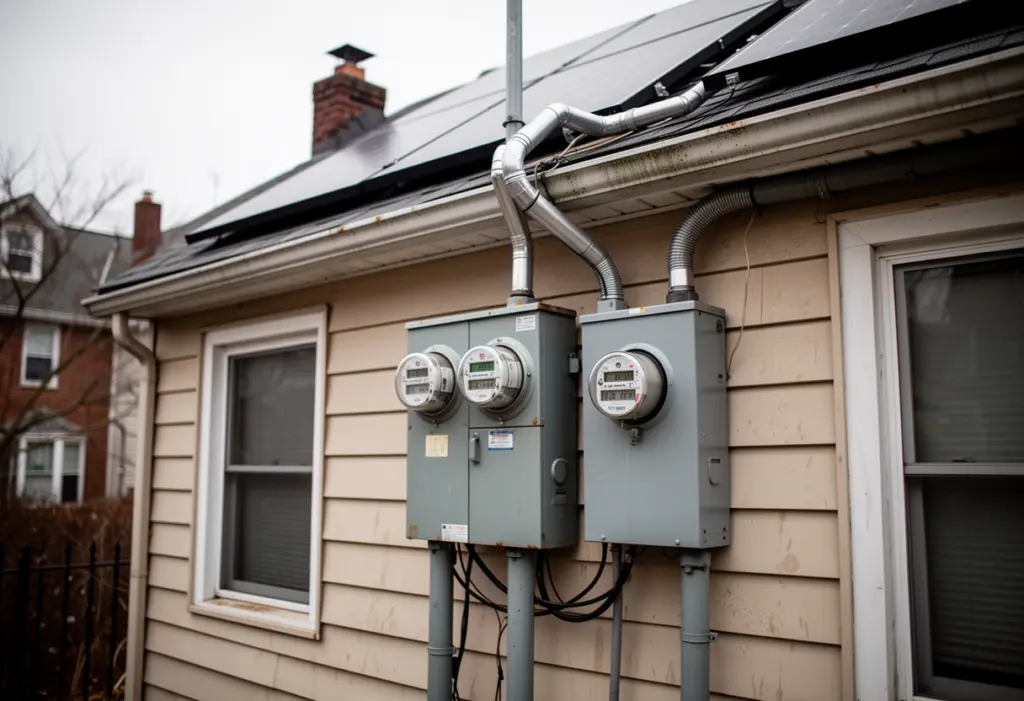
Rising electricity rates are the strongest honest argument for solar in New York, and the most abused number in a sales model. Both things are true at once, and separating them is the whole job. What an owned array hedges is the volumetric part of the bill, the cents-per-kilowatt-hour you would otherwise keep paying for the next twenty years. What it does not hedge is the fixed monthly customer charge, and what it actively exposes you to is a capacity charge that is recalculated every year and can move against you.
Why full retail crediting is the real hedge
Phase One net metering credits exported kilowatt-hours at the full retail rate, and a system interconnected today holds that structure for 20 years from interconnection. That is the mechanism that turns a rate rise into a benefit rather than a loss: if the retail rate goes up, the value of every exported kilowatt-hour goes up with it. You are not locked into an old price for your exports, and you are not exposed to a future rate for your consumption. That is a genuine hedge, and it is the argument worth making rather than the dramatic one.
The Value Stack, or VDER, is a different crediting structure aimed at community distributed generation and larger or commercial projects. It is not the mass-market residential arrangement, and a residential proposal that describes your credits in Value Stack terms is either an unusual project or a confused document. Ask which one you are being interconnected under and get the answer in writing.
The escalator assumption inside the payback figure
Every payback model contains an assumed annual rate of electricity price growth, and it is almost never printed on the summary page. It should be. Ask two questions and compare the answers.
- What annual escalation rate does this model use, and where does that figure come from?
- Show me the same payback with the escalation set to zero.
A system that pays back sensibly at zero escalation is a calculation. A system that only works at an aggressive assumed rise is a forecast dressed as one, and forecasts do not fund panels. The gap between the two versions tells you how much of the pitch rests on something nobody can promise.
The part of your bill that can rise against you
The Customer Benefit Contribution is billed monthly on the DC size of the array, and the fact sheet is explicit that rates change annually and are not locked in at interconnection. For 2026 the residential rates run from $0.97 per kW-month on National Grid to $1.67 on Central Hudson, with Con Edison at $1.29, NYSEG at $1.19 and LIPA at $1.13. On a 10 kW array that is $9.70 a month under one utility and $16.70 under another, and neither figure is fixed for the life of the system. It applies to systems interconnected on or after 1 January 2022.
Delivery rates themselves change through rate cases filed with the Public Service Commission, which are public documents. If a rise is being used to justify a signature this week, the filings are the place to check the claim rather than the brochure.
Where a lease or PPA points the other way
A third-party agreement can carry an escalator of its own, meaning the price you pay for the power rises by a contracted percentage every year. That reverses the logic: instead of fixing your energy cost, you have agreed to a rising one and simply moved which company sends the increase. Ask for the escalator as a number, then work out the year-fifteen and year-twenty payment before comparing anything. Also confirm the term, because New York’s 25 percent credit reaches leases and PPAs only where the agreement runs ten years or more, and for those agreements the $5,000 is a lifetime ceiling on the agreement rather than an annual figure.
Two things a rate rise does not make true
It does not make a battery pay for itself. Under full retail-rate net metering the grid already banks your surplus at full value, so a battery in New York remains a resilience purchase rather than an economic one, however the headline rate moves.
And it does not justify an oversized array. Production beyond your annual consumption builds credits you never draw down, while the capacity charge on that extra DC size arrives every month regardless. Size to twelve months of your own metered usage, plus any electrification you have actually decided on, and no further.
If you cannot put panels up
Community solar responds to rate rises too, since the credit is tied to the value of the electricity it displaces, and subscribers pay no Customer Benefit Contribution at all. The variables to check are the discount rate, the cancellation notice period and what happens if your usage falls. It is the route that works for renters, shaded roofs and apartment buildings where the roof is not yours to use.
What to verify, and where
Programmes move, and so do the numbers in this article. The capacity charge is reset annually by NYSERDA, NY-Sun incentives step down as regional blocks fill, and delivery rates change through PSC proceedings. New York’s 25 percent credit capped at $5,000 on Form IT-255 remains for a principal residence, alongside the state sales tax exemption and RPTL 487’s fifteen-year exemption where the municipality, the county and the school district have each not opted out and the system is constructed before 1 January 2030. What has gone is the 30 percent federal residential credit: section 25D was terminated for expenditures made after 31 December 2025, with an expenditure treated as made when the original installation is completed, so any 2026 model still escalating savings against a federal credit is wrong twice over.
Frequently Asked Questions
Does solar protect me from electricity rate increases?
It hedges the per-kilowatt-hour part of the bill. Phase One net metering credits exports at the full retail rate for 20 years from interconnection, so a rising rate raises the value of what you export. The fixed customer charge is unaffected.
What escalation rate should a quote assume?
Ask what it assumes and where the figure came from, then ask to see the same payback at zero escalation. A system that only works on an aggressive assumed rise is a forecast rather than a calculation.
Can the solar capacity charge go up?
Yes. The Customer Benefit Contribution is recalculated annually and is not locked in at interconnection. For 2026 residential rates run from $0.97 per kW-month on National Grid to $1.67 on Central Hudson.
Is a PPA a good hedge against rate rises?
Only if it has no escalator. Many agreements raise the price you pay by a contracted percentage each year, which moves the increase rather than removing it. Ask for the escalator and calculate the year-twenty payment.
This article is general information, not tax, legal or financial advice. Incentive amounts, eligibility rules and deadlines change and depend on your utility, your tax situation and your property. Confirm current terms with NYSERDA, your utility and a qualified tax professional before making a decision.
NY Solar Incentives
Independent New York solar research. We summarise NYSERDA, NY-Sun and federal programme rules from published sources and state plainly when a figure is an estimate. We are not a government agency and do not sell equipment.
Run the arithmetic on your own system
Check the dated program table and your arrangement before counting an incentive. Standard residential NY-Sun blocks are closed; Long Island Affordable Solar has a conditional income-verification route. The NY credit depends on qualified costs and tax liability, while the NYC abatement reduces future property-tax bills. The estimator keeps those timings separate.