Section 48E Investment Tax Credit, Explained for Homeowners
If you are buying panels for your own roof, section 48E is not your credit. It matters to you anyway, because it is the reason a lease or PPA offer can price in a benefit you never see.
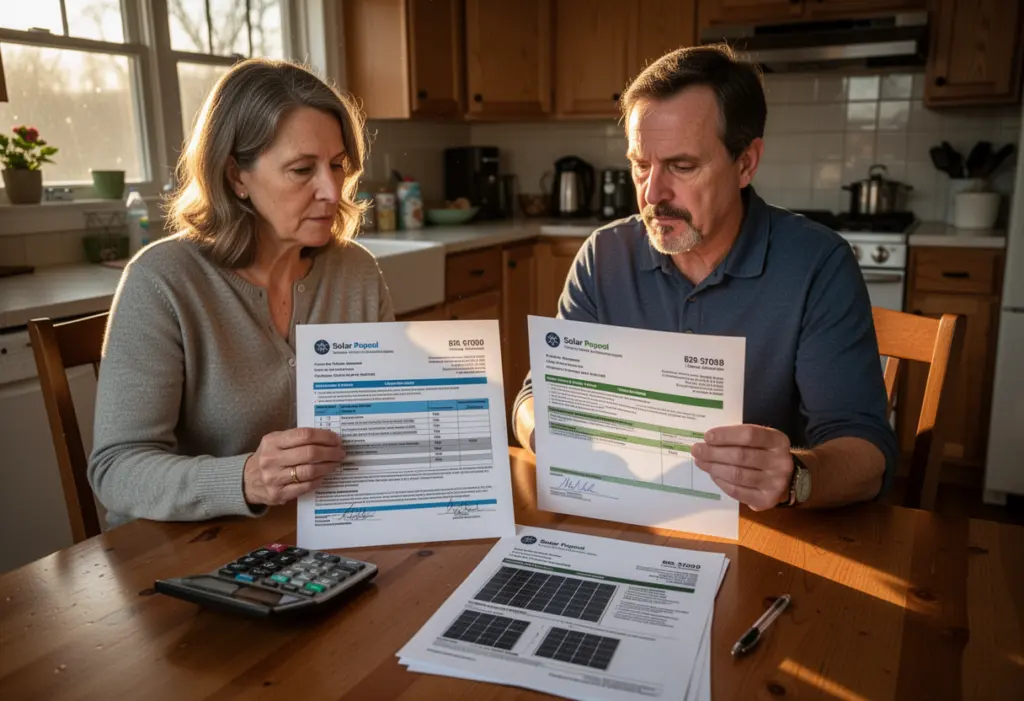
Start with the part that saves you the most time: section 48E is a business provision. It is the investment credit route for clean electricity facilities owned by a business taxpayer. If you are a homeowner buying a system for your own roof, it is not your credit, it never was, and no amount of paperwork turns it into yours.
The homeowner provision was section 25D, and section 25D is gone. It was terminated for expenditures made after 31 December 2025, and an expenditure counts as made when the original installation is completed. A homeowner who buys in 2026 claims nothing federally: no phase-down, no transition, no carryover of a credit that was never earned. Any 2026 proposal showing a 30% federal line is materially wrong and should be sent back to whoever wrote it.
So why do you keep hearing the name?
Because of who owns the equipment. In a lease or a power purchase agreement, the system on your roof belongs to a company, and that company is a business taxpayer with its own federal position. The business-side credit survives for the owner even though the residential one did not survive for you.
That single fact explains something homeowners find confusing in 2026. A third-party offer can still be priced as though an incentive exists, because for the party that owns the hardware one does. It is not being handed to you. It is being priced into an offer, and how much of it reaches you depends entirely on the terms you negotiate.
What to ask a lease or PPA salesperson
- Who owns the system, legally, for the whole term? Get the entity name, not the brand on the van.
- What is the escalator? A rate that rises every year is the mechanism by which an attractive opening figure becomes an unattractive one in year twelve.
- What is the buyout, and when? Ask how it is calculated rather than accepting a single illustrative number.
- What happens when I sell the house? Transfer terms and the buyer’s qualification requirements decide whether your agreement helps or hinders a sale.
- What is the term, exactly? This matters in New York for a specific reason set out below.
Why this page does not print a percentage
Because the value of a business credit depends on conditions, adders and eligibility rules that turn on the specifics of a project and that change with legislation. A flat figure quoted to you by someone who has not seen the project is a sales number rather than a tax answer. For the real one, the sources are the IRS and a tax professional looking at the actual ownership structure. That is not evasion; it is the difference between this site and the pages that got the 25D rule wrong.
What New York actually gives a homeowner in 2026
This is where a homeowner’s own benefit lives, and it is more generous than most people assume about third-party ownership. New York’s credit on Form IT-255 is 25% of qualified expenditure, capped at $5,000, at the taxpayer’s principal residence in New York, and it reaches purchases as well as leases and power purchase agreements of at least ten years. The ten-year minimum applies to the lease as well as to the PPA, so a five or seven year lease does not qualify. A flat 25% describes the purchase and the PPA mechanic rather than the lease one: for a PPA the credit is 25% of that year’s payments, while for a lease the annual credit is the payments you actually made that year, capped by 25% of the total contracted payments or $5,000, whichever is less. For a lease or PPA the $5,000 is a lifetime ceiling per agreement rather than an annual figure, no credit is allowed after the fifteenth year where an agreement runs longer than that, and the credit is limited by your actual New York State tax liability: it is not refundable, though unused credit carries forward for up to five years.
The cap is worth doing the arithmetic on. Twenty-five percent of a qualifying expenditure of $22,000 is $5,500, which is above the ceiling, so the credit is $5,000 and every dollar of qualifying expenditure above $20,000 adds nothing to it. That break-even is a useful thing to carry into a conversation about adding capacity or equipment.
Alongside it: the state sales tax exemption on residential solar equipment, and RPTL 487’s fifteen-year property tax exemption on added value where the municipality, the county and the school district have each not opted out, for systems constructed before 1 January 2030. NY-Sun, which your contractor applied as a price reduction rather than you claiming it, and its Affordable Solar incentive for low- to moderate-income households no longer add to that: as of September 2026 NYSERDA has no open NY-Sun block for homes in any utility territory; check NYSERDA’s NY-Sun dashboard for a new one.
The charge nobody mentions in either pitch
Ownership structure does not change the Customer Benefit Contribution, which is billed monthly on the DC size of the system regardless of production for systems interconnected on or after 1 January 2022. On Orange & Rockland’s 2026 residential rate of $1.00 per kW-month, a 5 kW array pays exactly $5 a month, $60 a year. Community solar subscribers pay none of it, which is a genuine point of difference if you are comparing a subscription against putting hardware on your roof. Check the current position with NYSERDA and the Department of Taxation and Finance before you sign anything, because every figure here is reset annually.
Frequently Asked Questions
Can a homeowner claim the section 48E credit?
No. Section 48E is the investment credit route for clean electricity facilities owned by a business taxpayer. The homeowner provision was section 25D, and it was terminated for expenditures made after 31 December 2025, treated as made when the original installation is completed.
Why does a lease still include an incentive if the homeowner credit is gone?
Because the company that owns the equipment is a business taxpayer with its own federal position, and the business-side credit survives for the owner. It is priced into the offer rather than handed to you, so how much reaches you depends on the terms you negotiate.
Does New York give me anything on a lease or PPA?
Yes. The Form IT-255 credit of 25% capped at $5,000 reaches leases and power purchase agreements of at least ten years at your principal residence. The ten-year minimum applies to the lease as well as the PPA, and the $5,000 is a lifetime ceiling per agreement.
Why does this page not state the 48E percentage?
Because the value depends on conditions, adders and eligibility rules that turn on project specifics and change with legislation. A flat figure from someone who has not seen the project is a sales number. Get the answer from the IRS and a tax professional.
This article is general information, not tax, legal or financial advice. Incentive amounts, eligibility rules and deadlines change and depend on your utility, your tax situation and your property. Confirm current terms with NYSERDA, your utility and a qualified tax professional before making a decision.
NY Solar Incentives
Independent New York solar research. We summarise NYSERDA, NY-Sun and federal programme rules from published sources and state plainly when a figure is an estimate. We are not a government agency and do not sell equipment.
Run the arithmetic on your own system
Check the dated program table and your arrangement before counting an incentive. Standard residential NY-Sun blocks are closed; Long Island Affordable Solar has a conditional income-verification route. The NY credit depends on qualified costs and tax liability, while the NYC abatement reduces future property-tax bills. The estimator keeps those timings separate.