Adding a Battery to an Existing Solar System in New York
Most existing New York arrays can take a battery. The deciding factor is rarely the battery itself, and almost always the inverter you already own and the interconnection paperwork that follows.
On this page 7 sections
- 01Your existing inverter decides the price
- 02What it does to your interconnection, and to your twenty years
- 03The monthly capacity charge is on the panels, not the battery
- 04Say the uncomfortable part out loud
- 05Six questions before you sign
- 06What the incentives actually do for a retrofit
- 07Frequently Asked Questions
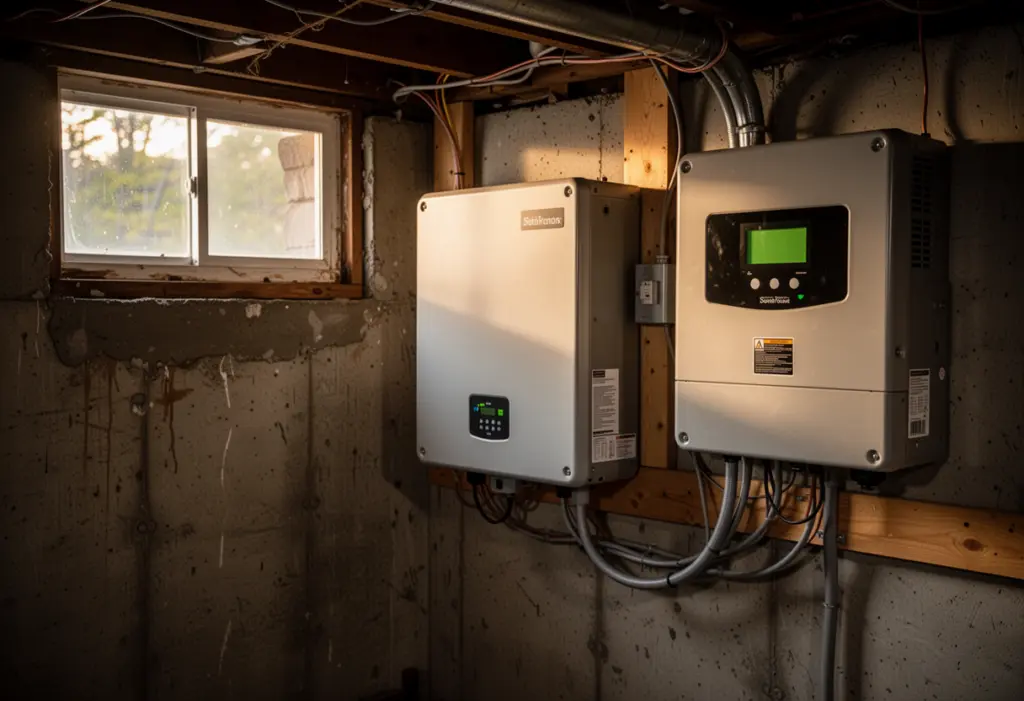
Most existing New York solar arrays can take a battery. The deciding factor is rarely the battery, and almost always two other things: the inverter already bolted to your wall, and what your utility does with the paperwork that follows.
Your existing inverter decides the price
There are two ways to add storage to an array that is already producing. One keeps the inverter you own and adds a second, battery-side inverter alongside it. The other replaces what you have with a single hybrid unit that handles panels and battery together. The first is usually less disruptive and leaves working equipment in place. The second removes a box rather than adding one, which can be tidier, but it discards hardware you have already paid for and restarts a warranty clock on somebody else’s terms.
Ask which approach is being quoted, in writing, before comparing prices. Two quotes that look far apart very often are not quoting the same job at all.
What it does to your interconnection, and to your twenty years
Phase One net metering credits your exports at the full retail rate, and the arrangement holds for 20 years from interconnection. That term is the most valuable thing your existing system owns, and a retrofit touches the agreement that carries it.
Put the question directly to the installer, then to the utility: is adding storage handled as a modification of my existing interconnection agreement, or as a new application? Get the answer before work starts rather than after. If your array sits on a municipal electric utility, none of this applies in the usual way at all. Municipal utilities are outside Public Service Commission jurisdiction, so there is no state interconnection process and no PSC net metering, and the terms are whatever that utility sets. Confirm the utility name from your own bill, not from a coverage map an installer shows you.
The monthly capacity charge is on the panels, not the battery
The Customer Benefit Contribution is billed per kW of DC system size every month, regardless of what the system produces, on systems interconnected on or after 1 January 2022. Storage is not DC panel capacity, so a battery by itself does not add to it. The 2026 residential rates are National Grid $0.97, Orange & Rockland $1.00, LIPA and PSEG Long Island $1.13, NYSEG $1.19, Con Edison $1.29, RG&E $1.31 and Central Hudson $1.67 per kW-month. A 7 kW array on NYSEG at $1.19 is about $8.33 a month, roughly $100 a year, and the battery leaves that untouched. If the retrofit also adds panels, it does not: three extra kW on that same array adds about $3.57 a month.
One wrinkle matters specifically for retrofits. The charge applies from interconnection date, so an older array may sit outside it entirely. The current version of NYSERDA’s Customer Benefit Contribution fact sheet treats systems interconnected before 1 January 2022, including later expansions to them, as outside the charge. An earlier version of that same document said the opposite, and the superseded wording is still repeated in plenty of places. Ask your utility to confirm your own position in writing rather than trusting either version of the sheet.
Say the uncomfortable part out loud
Under Phase One net metering the grid is already storing your surplus at full retail value. A battery cannot beat one hundred cents on the dollar, so a residential retrofit does not usually pay for itself out of arbitrage. What it buys is power during an outage, and quiet instead of a generator. Those are real things to want. They are not a return, and a proposal that presents them as one is doing arithmetic you should ask to see line by line.
Six questions before you sign
- Which circuits stay live during an outage, and where does the critical loads subpanel go?
- Does the array keep producing in an outage, or shut down with the grid unless the system is configured to island?
- Does the new work affect the roof warranty or the existing panel warranty?
- Who holds the monitoring account afterwards, and can you see state of charge yourself?
- What is the utility approval lead time, and who pays if inspection fails?
- Is any incentive line in the quote something you claim, or something the contractor claims?
What the incentives actually do for a retrofit
The 30% federal residential credit is gone. Section 25D was terminated for expenditures made after 31 December 2025, and an expenditure counts as made when the original installation is completed, so a 2026 retrofit earns nothing federally. A quote for this work carrying a 30% federal line is materially wrong, and worth challenging on the spot.
New York’s 25% credit on Form IT-255, capped at $5,000, remains for solar energy system equipment at your principal residence. The retrofit raises a narrow question: if you already claimed against the original installation, what a later addition can claim is a matter for the Form IT-255 instructions and your tax preparer, not for the person selling the battery. The state sales tax exemption and the 15-year RPTL 487 property tax exemption are likewise written around solar equipment. RPTL 487 requires the system to be constructed before 1 January 2030, and depends on the municipality, the county and the school district having each not opted out, so whether your assessor treats storage as part of the exempt added value is a question for the assessor before the work rather than after. All of this moves; check the current position at tax.ny.gov and with NYSERDA before you sign.
Frequently Asked Questions
Can any existing solar system take a battery?
Most can, but the route differs. Either a second battery-side inverter is added alongside your existing one, or your inverter is replaced with a hybrid unit. Ask which is being quoted before comparing prices, because the two jobs are not the same job.
Does adding a battery affect my net metering?
It touches the interconnection agreement that carries your Phase One net metering term, which runs 20 years from interconnection. Ask the utility in writing whether storage is processed as a modification of the existing agreement or a new application.
Will my monthly capacity charge go up?
Not because of the battery. The Customer Benefit Contribution is billed on DC panel capacity, so storage alone adds nothing. Adding panels does: three extra kW on NYSEG at $1.19 per kW-month is about $3.57 a month.
Is a retrofit worth it financially?
Usually not on arbitrage alone. Phase One net metering already credits exports at full retail, so the grid is storing your surplus at full value. Treat a battery as a resilience purchase and judge it on outages, not payback.
This article is general information, not tax, legal or financial advice. Incentive amounts, eligibility rules and deadlines change and depend on your utility, your tax situation and your property. Confirm current terms with NYSERDA, your utility and a qualified tax professional before making a decision.
NY Solar Incentives
Independent New York solar research. We summarise NYSERDA, NY-Sun and federal programme rules from published sources and state plainly when a figure is an estimate. We are not a government agency and do not sell equipment.
Run the arithmetic on your own system
Check the dated program table and your arrangement before counting an incentive. Standard residential NY-Sun blocks are closed; Long Island Affordable Solar has a conditional income-verification route. The NY credit depends on qualified costs and tax liability, while the NYC abatement reduces future property-tax bills. The estimator keeps those timings separate.