Orange & Rockland Permission to Operate: What PTO Means
Permission to operate is the utility authorisation that lets your array run. Until it arrives the panels stay dark, however finished they look from the street.
On this page 8 sections
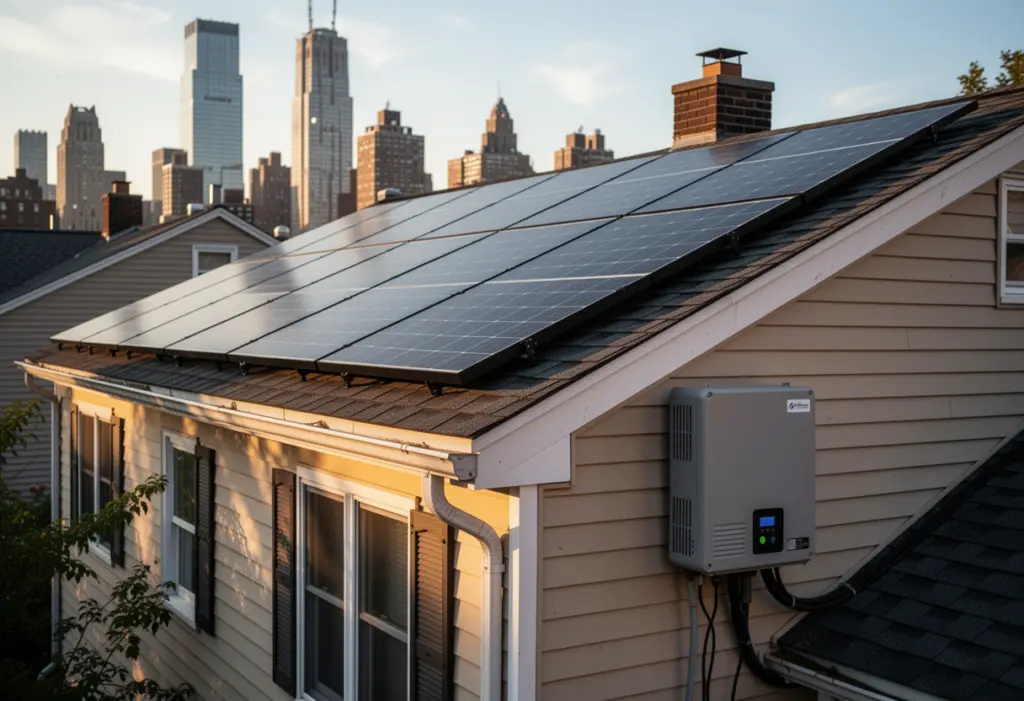
Permission to operate — PTO — is Orange & Rockland’s written authorisation to energise your system. Until it arrives, the array stays switched off, even when the panels are bolted down, the inverter is wired and the electrician has signed off. Homeowners find this maddening, and it is the single most common source of the question about why a finished-looking roof is producing nothing.
Where PTO sits in the sequence
- Contract and site assessment.
- Design, then the interconnection application to O&R and the building or electrical permit to your village or town.
- Installation.
- Electrical inspection by the authority having jurisdiction, and the inspection certificate.
- Paperwork back to the utility, including the certificate and the as-built details.
- A meter exchange, if the existing meter cannot record bidirectional flow.
- PTO. Then, and only then, the system is commissioned and switched on.
Steps four and five are where the days go. Neither is glamorous and neither is technical. They are documents moving between three organisations.
What delays it
- An as-built that does not match the application. A row of modules dropped because of an obstruction, or a substituted inverter, means the filed document and the roof disagree. That has to be reconciled before authorisation.
- The inspection certificate. The inspection is arranged by the installer with a third-party inspector; the certificate then has to reach the utility. Ask who is responsible for sending it.
- A service upgrade discovered late. If the panel could not take the solar breaker, everything stops for a separate scope of work.
- Meter availability and scheduling. Ordinary logistics, and outside your installer’s control.
Do not run it early
It is technically possible to close the breaker before authorisation. Do not. Exporting before the utility has authorised the connection means production nobody has agreed to meter under net metering rules, and it puts you outside the tariff you are about to join. There is nothing to gain: a week of unauthorised production is worth a few dollars and can cost you the goodwill you will need if something else goes wrong.
What to fix in the contract, before any of this
The useful lever is the payment schedule. Many contracts release the final payment on mechanical completion — panels on the roof — which removes the installer’s incentive to chase inspection paperwork. Ask for a meaningful final milestone tied to permission to operate instead. It is a reasonable request, it is sometimes granted, and the conversation itself tells you how the company handles the tail end of a job.
Two more questions worth asking in writing: who schedules the inspection, and who follows up with O&R if the file goes quiet for a fortnight.
Why the date is more than a formality
The interconnection date starts your 20-year Phase One net metering term, under which exports are credited at the full retail rate. It also determines the Customer Benefit Contribution, which applies to systems interconnected on or after 1 January 2022 and runs at $1.00 per kW-month of DC size on O&R for 2026 — $8.80 a month on an 8.8 kW array, $105.60 a year, whatever the weather does.
The 2025 to 2026 federal boundary, which is not about PTO
This one catches people precisely because it feels like it should follow the utility’s timeline. It does not. The federal residential credit under section 25D was terminated for expenditures made after 31 December 2025, and an expenditure is treated as made when the original installation is completed — not when the system is placed in service and not when the utility authorises it. So a system whose installation was completed in December 2025 but which was only energised in 2026 can still be inside the old rule. There is an exception that flips the answer for new construction: where the expenditure is in connection with constructing or reconstructing a structure, it is treated as made when your original use of the structure begins. This is an accountant’s question with real money in it, and it should be asked as one.
2026 incentives around the PTO date
For anyone buying now, the live New York items are the 25 percent state credit capped at $5,000 on Form IT-255 for a principal residence, the state sales tax exemption, and RPTL 487 where the municipality, the county and the school district have each not opted out, on a system constructed before 1 January 2030. NY-Sun is not among them: as of September 2026 NYSERDA has no open NY-Sun block for homes in any utility territory; check NYSERDA’s NY-Sun dashboard for a new one. If the name on your bill is a municipal electric department rather than O&R, there is no PSC interconnection process and no PTO in this sense at all — the municipal utility sets its own terms and you ask it directly. Incentive programmes change, so confirm the current position at source before you rely on it.
Frequently Asked Questions
What is permission to operate?
It is the utility's written authorisation to energise your solar array. Until Orange & Rockland issues it, the system must stay switched off even if installation and inspection are complete.
Can I turn my panels on before PTO?
No. Exporting before authorisation puts you outside the net metering tariff you are joining, and a week of unauthorised production is worth very little against the trouble it creates.
What holds up permission to operate?
Usually the electrical inspection certificate reaching the utility, an as-built that no longer matches the filed application, a late-discovered service upgrade, or scheduling a bidirectional meter exchange.
Does PTO decide whether I qualify for the old federal credit?
No. Section 25D used the date the original installation was completed, not the date the system was energised or placed in service. New construction follows a different test. Ask your accountant.
This article is general information, not tax, legal or financial advice. Incentive amounts, eligibility rules and deadlines change and depend on your utility, your tax situation and your property. Confirm current terms with NYSERDA, your utility and a qualified tax professional before making a decision.
NY Solar Incentives
Independent New York solar research. We summarise NYSERDA, NY-Sun and federal programme rules from published sources and state plainly when a figure is an estimate. We are not a government agency and do not sell equipment.
Run the arithmetic on your own system
Check the dated program table and your arrangement before counting an incentive. Standard residential NY-Sun blocks are closed; Long Island Affordable Solar has a conditional income-verification route. The NY credit depends on qualified costs and tax liability, while the NYC abatement reduces future property-tax bills. The estimator keeps those timings separate.