Generator inlet box install: what New York code requires
An inlet box gives a generator cord a permanent place to land, but the hardware that matters is the interlock at the panel. What New York requires, who signs it off, and why a cord into a dryer outlet is not a cheaper version of the same thing.
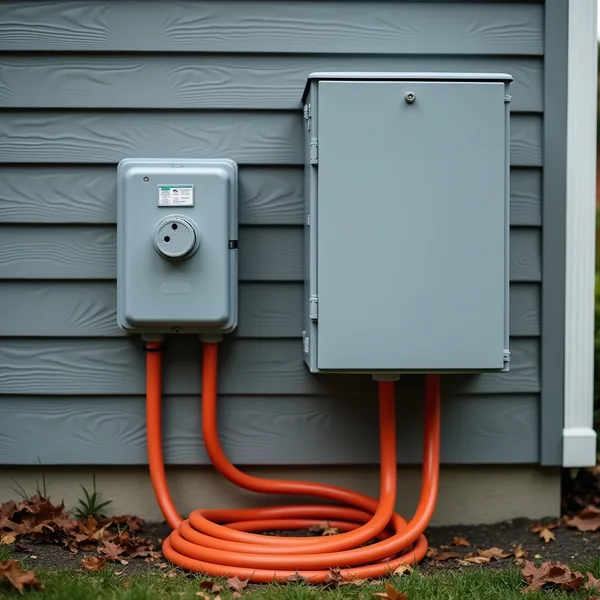
The inlet is the small part of the job; the interlock behind it is the part that keeps a line worker safe and the inspection passable.
A portable generator in the driveway does nothing for the circuits that matter most in an outage. Extension cords will run a lamp and charge a phone, but the boiler controls, the well pump, the sump and the furnace blower are hard-wired, and no cord reaches them. A generator inlet box closes that gap: it gives the cord a permanent, weather-rated place to land on the outside wall, and the connection to the panel is made once, properly, by someone who is allowed to make it.
The box itself is the small part of the job. What makes the installation lawful in New York — and safe for people nowhere near your house — is the hardware that goes in with it at the panel: the interlock or transfer switch that makes it physically impossible for utility power and generator power to be connected at the same moment.
What a generator inlet box install involves in New York
Read as a shopping list, this is three components and an afternoon. Read as an electrical job, it is a change to how your house connects to the grid, which is why it is permitted work performed by a licensed electrician and signed off by an inspector.
The three parts of the assembly
- The inlet. A weather-rated fitting mounted on an exterior wall. It carries pins rather than slots, so the end of the cord that is live when the generator is running is never a set of exposed energised sockets. The cover is gasketed and the fitting is rated for wet locations, because it will spend most of its life in rain and snow doing nothing.
- The feeder. A cable run from the inlet to a dedicated breaker in the panel, sized to the inlet’s rating and to the length of the run. This is the part that disappears into a wall or a joist bay and the part an inspector will want to see before it disappears.
- The transfer equipment. An interlock kit at the main panel, or a separate transfer switch. Without it you have an inlet box wired to a breaker, which is a hazard with a nice cover on it rather than a standby system.
Why the interlock is the whole point
Here is the failure this hardware exists to prevent. If a generator feeds a panel that is still connected to the utility, its current does not politely stop at your walls. It flows back out through the service conductors to the distribution transformer on the pole, and a distribution transformer works in both directions: fed from its low-voltage side, it steps the voltage back up on the primary side that runs down your street.
A line worker restoring that circuit has switched it off, tested it and grounded it, and expects it to be dead. Back-feeding a panel with no transfer equipment can put primary voltage on the line they are holding. That is not a code technicality or an insurance detail. It is the reason the requirement exists, and it is why an inlet box installed without an interlock is worse than no inlet box at all — it makes the dangerous connection convenient.
The same isolation protects the house in the other direction. When utility power returns to a panel that is still tied to a running generator, the two sources meet out of phase, and the generator is generally the thing that loses. An interlock removes both problems by removing the possibility: the main breaker and the generator breaker cannot be on at once, because a sliding plate physically blocks it.
What the code is asking for, and who signs off
The National Electrical Code treats a portable generator serving a house as an optional standby system, and the governing requirement is not about the generator at all — it is that transfer equipment must prevent the inadvertent interconnection of the two sources. New York State adopts the NEC through the Uniform Fire Prevention and Building Code, so that requirement applies statewide. New York City runs its own Electrical Code with local amendments on top of it, and work there is performed under a licensed master electrician.
In practice that means three things for a homeowner. The work is done by a licensed electrician. A permit is pulled from your municipality — the town, village or city building department, or the Department of Buildings in the five boroughs. And the finished work is inspected by an electrical inspection agency your jurisdiction accepts, with the certificate that inspection produces being the document your insurer will ask for if anything ever goes wrong.
This article deliberately stops short of a wiring sequence, and that is not squeamishness. Conductor sizing, breaker selection, whether a listed interlock even exists for your particular panel, and the order in which things are landed are decided at the panel by the person holding the licence and the permit. A generic sequence read online is precisely the input that produces a failed inspection, a voided listing, or something worse.
Interlock kit or transfer switch: the practical difference
Both approaches satisfy the same requirement in different ways, and the right one usually depends on your panel rather than your preference.
| Approach | How it isolates the utility | What it means in practice |
|---|---|---|
| Interlock kit at the main panel | A metal plate makes the main breaker and the generator breaker mutually exclusive | Any circuit in the panel can be used, one at a time, by managing breakers by hand. Requires a listed kit made for that panel and space in the right position |
| Manual transfer switch with its own subpanel | Selected circuits are moved onto a switch that chooses utility or generator per circuit | Simplest to operate under stress, because the choices are already made. Limited to the circuits moved onto it at installation |
| Automatic transfer switch | Senses the outage and switches sources without anyone present | Belongs with a permanently installed standby unit rather than a cord-connected portable one, and is a larger job |
| Cord into a dryer or range receptacle | Nothing isolates anything | Prohibited, uninspectable, and the specific arrangement that endangers line crews. It is not a budget version of this project |
Placement, cords, and the details that fail an inspection
Where the inlet goes is usually decided by where the generator can safely run, not by where the cable is easiest to pull. A portable generator produces carbon monoxide and has to sit outdoors, well clear of windows, doors and vents, and never in a garage or under a deck — including a garage with the door open. The inlet is then placed to suit that position while staying reachable and weather-protected.
Cord length and rating
The cord is part of the system, not an accessory. It must match the inlet’s amperage and configuration, and longer runs lose voltage, which is felt first by motor loads like a well pump or a compressor. Buying a cord long enough to move the generator further from the house is a reasonable instinct, but past a point it needs a heavier conductor to carry the same load.
Mounting and access
Inspectors look at ordinary things: a wet-location cover that closes over a connected cord, mounting into structure rather than into siding alone, working clearance at the panel, and a generator breaker positioned where the interlock expects it.
What actually drives the price
Quoted figures move with materials, labour rates and local fees, so treat any number you read — here or anywhere — as out of date and ask for written quotes instead. What is stable is the list of things that separates one quote from another: the distance and difficulty of the run from the panel to the exterior wall, whether the basement is finished or the wall is masonry, whether a listed interlock exists for your panel and there is space for the breaker, whether the panel is old enough that replacing it comes first, and your municipality’s permit and inspection fees. If a panel replacement enters the conversation, the reasoning is the same one set out for a panel upgrade in New York.
Where this sits next to solar and storage
An inlet box is a backup plan, not an energy plan. Rooftop solar alone does not run during an outage: a grid-tied inverter disconnects by design so it cannot energise the utility line, which is the interlock principle in another form. Choosing between a cord-connected generator and a battery is a genuine trade-off, weighed in a generator against a home battery in New York. Which circuits to back up at all is a question that comes before any hardware, and whole-house backup against critical loads is where to settle it. If the sign-off itself is unfamiliar, what happens at an electrical inspection in New York describes it.
Questions worth asking before the work starts
- Which transfer method are you proposing for my panel, and is there a listed interlock kit made for it?
- Which circuits will be usable on generator power, and what sets that limit?
- Who pulls the permit, and which inspection agency signs the work off?
- What inlet rating are you installing, and what cord size and length does it require?
- Where will the generator sit, and how far is that from the nearest window, door or vent?
An installer who answers those five without hesitating has done the job before. One who treats the interlock as an upsell is describing a job you do not want.
Frequently Asked Questions
Do I need a permit for a generator inlet box in New York?
Yes. Adding an inlet and a generator breaker changes your service wiring, so it is permitted electrical work. The permit comes from your municipal building department, or from the Department of Buildings in New York City, and the finished installation is inspected by an electrical inspection agency your jurisdiction accepts.
Can I install a generator inlet box myself?
The work is inside your service panel and it is inspected, so in practice it is done by a licensed electrician. Some New York jurisdictions issue homeowner permits for work on a house you own and occupy, but that varies by municipality and does not change the inspection requirement. Ask your building department before assuming either way.
What happens if a generator is connected without an interlock?
Current from the generator can flow back through the service conductors into the pole transformer, which steps the voltage up onto the line running down the street. A line worker who has switched that circuit off and grounded it can be exposed to primary voltage. It also risks destroying the generator when utility power returns out of phase. This is the hazard the transfer requirement exists to remove.
Is an interlock kit acceptable, or does code want a transfer switch?
Both are recognised ways of meeting the same requirement, which is that the two sources cannot be interconnected. An interlock kit has to be one listed for your specific panel and installed as the listing describes; a shop-made plate is not acceptable. Which one an electrician recommends usually depends on your panel and on how many circuits you want available.
How many circuits will run on a portable generator?
That is set by the generator’s output rather than by the inlet box. With an interlock you can use any circuit in the panel, but you manage the load by hand, turning off what you are not using. Motor loads such as a well pump or a compressor draw far more current while starting than while running, which is what usually determines the practical limit.
Can the generator run in my garage if the door is open?
No. Carbon monoxide accumulates in an attached garage even with the door open, and it moves into the house through the shared wall and door. A portable generator runs outdoors, clear of windows, doors and vents, and not under a deck or an overhang. Inlet placement is normally chosen to make a safe generator position convenient.
Does an inlet box let my solar panels power the house in an outage?
No, these are separate systems. A grid-tied solar inverter shuts down during an outage so it cannot energise the utility line, and an inlet box does not change that. Running on solar during an outage requires an inverter designed for it and, in most cases, a battery.
Will the installation affect my homeowners insurance?
Permitted, inspected work with a certificate behind it is straightforward to document if a claim ever involves it. Unpermitted electrical work is the situation that creates difficulty. Keep the inspection certificate with your other house records, and tell your insurer if they ask about standby equipment.
NY Solar Incentives
Independent New York solar research. We summarise NYSERDA, NY-Sun and federal programme rules from published sources and state plainly when a figure is an estimate. We are not a government agency and do not sell equipment.
Run the arithmetic on your own system
Check the dated program table and your arrangement before counting an incentive. Standard residential NY-Sun blocks are closed; Long Island Affordable Solar has a conditional income-verification route. The NY credit depends on qualified costs and tax liability, while the NYC abatement reduces future property-tax bills. The estimator keeps those timings separate.