How Long a Heat Pump Lasts in the New York Climate
Installers quote about fifteen years, but salt, snow depth, oversizing and slow refrigerant leaks decide whether a New York heat pump reaches year nine or year twenty-two.
On this page 6 sections
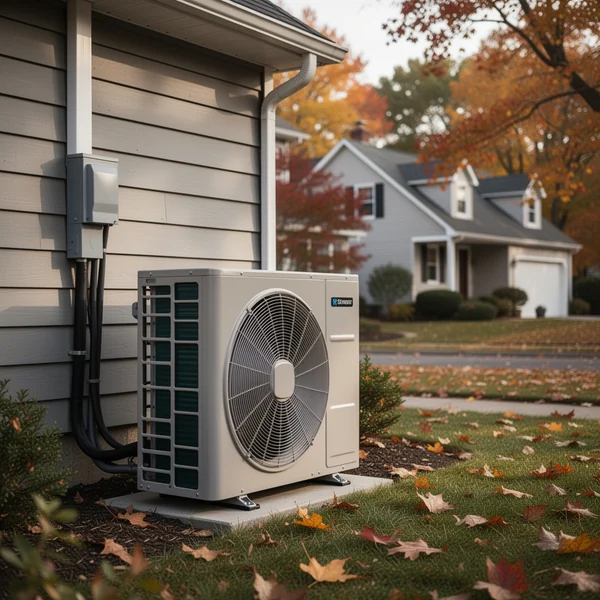
Installers across New York quote something like fifteen years of service life for an air-source heat pump, and that figure is a habit of the trade rather than a measurement of your house. Heat pump lifespan in the New York climate is decided far more by siting and maintenance than by the badge on the cabinet — how much salt the outdoor unit breathes, how deep it sits in February, whether it was sized to a load calculation or to a bid, and whether anyone has ever put a hose across the coil.
That is not a dodge. It is the difference between a unit that dies at year nine and one still running at twenty-two, and almost all of it is under your control.
Why the number you were quoted is softer than it sounds
Published service-life figures are national averages drawn from equipment tables, and they were mostly built around machines that cool. A central air conditioner in Rochester might run a few hundred hours across a Finger Lakes summer. Put the same compressor to work heating the house from late October through April and you have multiplied its annual run hours several times over. If your expectation for the new heat pump came from how long the old AC condenser lasted, you have imported a number from a machine with a completely different duty cycle.
Ground-source systems run on two clocks, not one. The buried loop is fusion-welded HDPE pipe with no moving parts, and loop warranties are commonly written in decades. The heat pump itself sits indoors in conditioned space and never sees weather, road salt or snow. That is why geothermal owners talk about replacing “the box in the basement” while the expensive part of the installation stays in the ground.
What actually shortens a heat pump’s lifespan in the New York climate
Salt, and not only on the coast
Salt aerosol attacks the aluminum fins and the copper-to-aluminum joints in the outdoor coil. If you are in Long Beach, the Rockaways, Southampton, Mamaroneck or anywhere the wind comes off open salt water, this is the single biggest variable in your unit’s life, and a coastal coil coating is worth asking about before the order is placed rather than after.
Upstate homeowners assume this does not apply to them. It does. A condenser sitting on the driveway side of a house on a plowed county road in Onondaga or Erie County takes brine spray every time a plow passes, all winter, for its whole life. Same chemistry, different delivery. Move the unit, put a splash barrier between it and the road, or rinse it.
Snow, ice and the defrost cycle
The outdoor unit has to breathe. A cabinet sitting on a low pad in Watertown, Oswego or the Tug Hill snow belt will be buried for weeks; the same pad height is perfectly sensible in Nassau County. Wall brackets or a tall stand are not an upsell in the snow belt, they are the install.
Defrost is the other half of it. Every defrost cycle sheds meltwater under the unit. If that water has nowhere to go it refreezes into a growing plinth of ice that lifts the cabinet out of level, strains the line set and eventually blocks the base pan. A gravel bed with real drainage under the stand, and a base pan heater where the winters justify it, prevent a failure mode that has nothing to do with the compressor and kills the machine anyway.
Oversizing
Compressors wear on starts and stops at least as much as on hours. A unit sized by a rule of thumb instead of a room-by-room load calculation will short-cycle its way through the whole shoulder season — the long, mild New York April and October when the house needs a trickle of heat and the equipment only knows how to deliver a flood. Inverter-driven cold-climate units modulate down and tolerate this much better than single-stage equipment, but an inverter unit that is still twice the size of the load will hit its minimum output and cycle anyway.
The slow refrigerant leak nobody found
Many compressors that “just died” at year nine died of running undercharged for two years. Flare joints on ductless line sets, repeated freeze and thaw, and years of compressor vibration are a combination that loses refrigerant slowly enough that nobody notices until the heating bill jumps and the head starts blowing lukewarm. This is the strongest argument for an annual professional check: a technician measuring superheat and subcooling finds this while it is still a fifteen-minute repair.
The maintenance that actually buys years
| Task | How often | Why it matters in New York |
|---|---|---|
| Rinse the outdoor coil with plain water | Twice a year; quarterly near salt water | Removes salt and road brine before it opens the fin-to-tube joint |
| Wash the ductless head filters | Monthly through the heating season | These are reusable, so nobody replaces them, so nobody remembers them |
| Clear snow to above the top of the cabinet and keep the base free | After every real storm | A buried unit runs constant defrost and still cannot make heat |
| Check the pad or stand for frost heave | Every spring | Freeze-thaw tips the unit; an out-of-level cabinet drains badly and stresses the line set |
| Professional refrigerant, electrical and airflow check | Annually | Catches slow leaks, loose lugs and failing contactors while they are cheap |
| Clean the blower wheel and indoor coil | Every few years | Restores the airflow the equipment was rated at; a dirty wheel quietly costs capacity |
Warranty length is not lifespan
Two things get conflated. The compressor warranty is often longer than the warranty on everything else, and it is the part people quote back at you. But almost every manufacturer requires online registration within a short window after installation to get the extended term — find that window in your own paperwork this week, not in year eight. And parts coverage still leaves you paying a New York labor rate to have the part installed, which on a compressor swap is most of the bill.
Keep one folder: the invoice, the AHRI certificate for the matched system, the electrical and mechanical permits, the registration confirmation, and any NYS Clean Heat rebate paperwork. When you sell, that folder is the difference between “there’s a heat pump” and a documented, warrantable, permitted system — the same way a solar folder is, as covered in our guide to selling a New York home with solar panels.
What replacement will cost you in 2026, and what it will not
Plan the replacement fund on the assumption of no federal help. Both federal residential credits ended for property placed in service after 31 December 2025. Section 25C, which carried up to $2,000 a year for heat pumps, and Section 25D, the residential clean energy credit, are both closed to 2026 installations. Any page still promising you 30% federal on a 2026 heat pump is describing last year.
What is still live is at state and utility level. NYS Clean Heat is run by NYSERDA with seven sponsoring utilities — Central Hudson, Con Edison, National Fuel Gas, National Grid, NYSEG, Orange & Rockland and RG&E. PSEG Long Island is not one of them and runs its own separate efficiency and heat pump programs, a distinction Long Island homeowners run into constantly and one we also cover in what actually exists in the PSEG Long Island rebate. Clean Heat amounts are not published as a single statewide table; they vary by utility and equipment, and the authoritative number for your address comes from the official finder at cleanheat.ny.gov. Do not budget against a figure you read on a blog, this one included.
One thing worth separating out because it gets confused: New York’s Form IT-255 credit — 25% of system cost capped at $5,000 — is a solar credit, not a heat pump credit. It remains available in 2026 and carries forward up to five years, but it will not follow your compressor. Our page on New York renewable energy incentives beyond solar lays out which programme covers which measure.
What to do next
- Walk out to the outdoor unit today and check three things: is the base clear, is it level, and can you see daylight through the coil fins when you look at them edge-on.
- Find the installation date and the manufacturer’s registration deadline in your paperwork. If you are inside the window and never registered, do it now.
- If the unit is within roughly a mile of salt water and does not have a coastal coating, book a coil rinse and put a recurring reminder in your calendar for spring and autumn.
- Before the first storm, measure the height of the cabinet against the snow line you actually got last winter. If the answer is uncomfortable, price a bracket or a taller stand now, in the off season.
- Book the annual service before September. Every New York HVAC company is booked solid the week of the first cold snap.
- When the unit does need replacing, run the Clean Heat finder for your address and your utility before you take quotes, so you know whether the rebate is coming off the invoice.
NY Solar Incentives
Independent New York solar research. We summarise NYSERDA, NY-Sun and federal programme rules from published sources and state plainly when a figure is an estimate. We are not a government agency and do not sell equipment.
Run the arithmetic on your own system
Check the dated program table and your arrangement before counting an incentive. Standard residential NY-Sun blocks are closed; Long Island Affordable Solar has a conditional income-verification route. The NY credit depends on qualified costs and tax liability, while the NYC abatement reduces future property-tax bills. The estimator keeps those timings separate.