Converting From Oil Heat to a Heat Pump in New York
An oil to heat pump conversion in New York is funded through your electric utility, not your fuel dealer — and with both federal credits expired, the NYS Clean Heat rebate now carries the whole incentive.
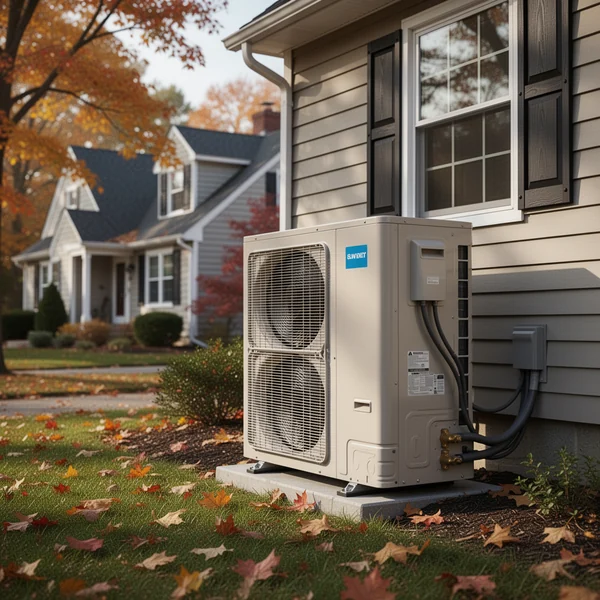
An oil to heat pump conversion in New York is paid for through your electric utility, not your fuel dealer. NYS Clean Heat is administered by NYSERDA with seven sponsoring utilities — Central Hudson, Con Edison, National Fuel Gas, National Grid, NYSEG, Orange & Rockland and RG&E — and for an oil-heated house the sponsor that matters is whichever of them sends your electric bill. The federal money people still expect to stack on top is gone: both Section 25C and Section 25D ended for property placed in service after 31 December 2025, so a household converting in 2026 gets nothing federal.
That single fact reshapes the arithmetic. For years the pitch was a heat pump rebate from the utility plus a federal credit worth up to $2,000 on the equipment. The $2,000 bucket existed while 25C did; it does not exist for a 2026 install. Any quote or website still building a payback around a 30% federal credit is working from a 2024 rulebook.
Find out who your Clean Heat sponsor actually is
Oil heat in New York clusters where the gas mains do not reach: the mid-Hudson Valley, the North Country, the Southern Tier, the Catskills, and large parts of Suffolk and Nassau. Because there is no gas utility in the picture, homeowners often assume there is no utility programme either. There usually is — it is on the electric side.
- Hudson Valley — Central Hudson covers Dutchess, Ulster, Orange, Columbia, Greene, Putnam and Sullivan, and it is a Clean Heat sponsor.
- Southern Tier, Finger Lakes, parts of the Capital Region — NYSEG.
- Rochester and Monroe County — RG&E.
- North Country, Mohawk Valley, Capital Region, much of Western New York — National Grid.
- Rockland and Orange — Orange & Rockland.
- New York City and Westchester — Con Edison.
PSEG Long Island is not a NYS Clean Heat sponsor. This matters enormously, because oil heat is common across Suffolk and Nassau and homeowners there are routinely pointed at Clean Heat pages that do not apply to them. PSEG Long Island runs its own separate efficiency and heat pump programmes; if you are on Long Island, start there rather than at cleanheat.ny.gov, and do not let a salesperson quote you a Clean Heat rebate you are not eligible for.
Rebate amounts are not published as one statewide table. They vary by utility, by equipment category, and by programme year. The official route is the address-based finder at cleanheat.ny.gov/find-available-rebates/, which asks for your address and returns what your sponsor is actually paying right now. Anyone quoting you a per-ton figure off the top of their head is guessing.
The real cost driver is your distribution, not the heat pump
Oil-heated New York houses almost never have ductwork. They have a boiler feeding cast-iron radiators or copper fin-tube baseboard, and that is what makes the conversion expensive or cheap depending on which path you take.
- Ductless mini-splits. Wall or floor heads in the rooms that matter, refrigerant lines run outside or through closets. No ductwork to build. The trade-off is aesthetics and the fact that heat does not travel well into closed bedrooms and around corners in an old farmhouse floor plan.
- Air-to-water heat pump. Replaces the boiler and keeps your existing radiators or baseboard. Attractive on paper, but the water temperature a heat pump produces efficiently is lower than what an oil boiler produced, so the existing emitters may not put out enough heat on a design-day morning. That gets checked with a room-by-room load calculation against the emitter output, not assumed.
- Ducted air handlers. A compact air handler in the attic or basement feeding a small duct system, sometimes zone by zone. Best comfort, highest install cost in a house that has never had ducts.
- Ground-source. Viable on the acreage that oil-heated rural properties often have, and it is a separate Clean Heat category with its own rebate treatment. The loop field is the cost.
Full replacement versus keeping the boiler
You do not have to remove the oil system on day one. A dual-fuel or “hybrid” setup keeps the boiler as backup for the coldest mornings while the heat pump carries most of the season. Utility rebate tiers commonly distinguish between a heat pump that displaces part of the heating load and one that replaces the fossil system entirely — the full-replacement tier is generally the better-funded one. Ask your contractor to show you both scenarios priced out, net of rebate, before you decide. In the Adirondacks or the Tug Hill area, keeping a backup through the first winter is a defensible choice even if you intend to remove it later.
Two things that blindside oil conversions
The electrical service
Houses built around an oil burner often have modest electrical service, because heat was never an electric load. Add a whole-home heat pump, and possibly an EV charger, and you may need a service upgrade. That upgrade is not on your schedule — it is on your utility’s, and in some territories the wait for a service change is measured in months, not weeks. Get the electrician’s load calculation done early and get the utility application filed early. If you are also considering solar, plan the two together; our guide to EV charging and solar panels in New York covers the same panel-capacity conversation.
The tank
Once the burner is gone you still own an oil tank. A basement tank is straightforward to decommission. A buried tank is not: it involves pumping, cleaning, and either removal or documented abandonment in place, plus soil questions if it has ever leaked. Rules are layered — the state DEC regulates petroleum bulk storage, and some counties, Suffolk in particular, impose their own requirements on residential tanks. Call your county health department and check DEC guidance before anyone touches it, and keep the paperwork: it is the first thing a buyer’s attorney asks for. Budget for tank work as a separate line, not as an afterthought inside the HVAC quote.
What is still available in New York, and what is not
| Programme | Status for a 2026 conversion |
|---|---|
| Federal 25C (energy efficient home improvement) | Ended for property placed in service after 31 Dec 2025. Nothing for 2026. |
| Federal 25D (residential clean energy) | Terminated for expenditures after 31 Dec 2025. |
| NYS Clean Heat | Live, through your electric utility if it is one of the seven sponsors. Amount via the official address finder. |
| NYSERDA EmPower+ | Income-qualified. Thresholds and amounts change — confirm directly with NYSERDA (1-866-NYSERDA) rather than trusting a third-party page. |
| NY State solar credit, Form IT-255 | 25% of solar system cost, capped at $5,000, five-year carryforward — solar only. It does not cover a heat pump. |
That last row is the most common confusion we see. New York’s solar credit is generous and still alive, but it is tied to solar electric equipment and claimed for the tax year you receive Permission to Operate. A heat pump is not solar equipment. If you are converting heat and adding panels, the two get their own paperwork; see how Form IT-255 is actually claimed and our roundup of New York State renewable energy incentives beyond solar.
Financing without a federal credit
With 25C gone, the financing question carries more weight than it did. NYSERDA’s on-bill recovery loan lets qualifying efficiency and clean heating work be repaid through your utility bill rather than a bank note, which changes the monthly comparison against a delivered-fuel bill. Our explainer on the NYSERDA on-bill recovery loan walks through the mechanics.
What to do next
- Look at your electric bill and identify your utility by name. If it says PSEG Long Island, go to PSEG Long Island’s own programmes — you are not in Clean Heat.
- Run your address through the finder at cleanheat.ny.gov/find-available-rebates/ and screenshot what it returns, with the date.
- Pull last winter’s oil delivery invoices — gallons and dollars, not a remembered average. That is the baseline any honest payback comparison needs.
- Get three quotes from Clean Heat participating contractors, and require each to show the rebate as an itemised line and to hand over a room-by-room load calculation.
- Ask each contractor for the equipment’s certified low-ambient capacity at your county’s winter design temperature — not the brochure’s seasonal average.
- Have an electrician do the load calculation and file any service upgrade with the utility before you schedule the install.
- Get a written quote for tank decommissioning from a separate contractor, and check your county’s rules first.
NY Solar Incentives
Independent New York solar research. We summarise NYSERDA, NY-Sun and federal programme rules from published sources and state plainly when a figure is an estimate. We are not a government agency and do not sell equipment.
Run the arithmetic on your own system
Check the dated program table and your arrangement before counting an incentive. Standard residential NY-Sun blocks are closed; Long Island Affordable Solar has a conditional income-verification route. The NY credit depends on qualified costs and tax liability, while the NYC abatement reduces future property-tax bills. The estimator keeps those timings separate.