The Central Hudson Solar Interconnection Application
In Central Hudson territory the municipal steps come first and they include historic review. Here is the whole sequence and where it stalls.
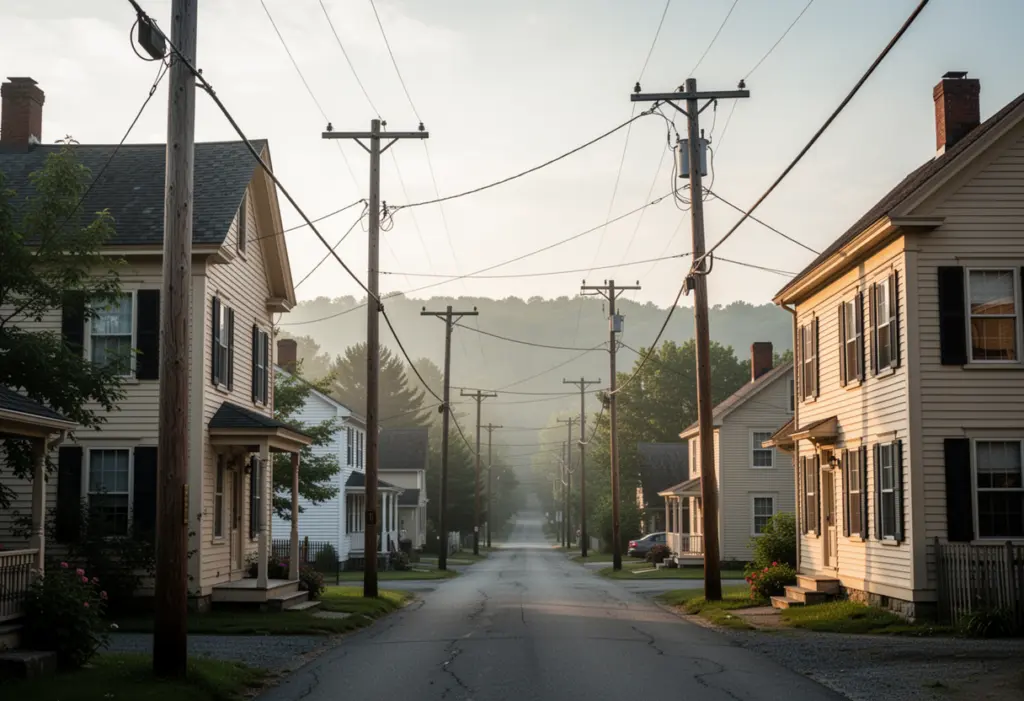
Central Hudson serves the mid-Hudson Valley — Dutchess, Ulster, most of Orange, and parts of Columbia, Greene, Putnam and Sullivan. Its interconnection process is conventional. What is distinctive about a Central Hudson project is what has to happen before the utility is involved at all.
The application itself
A formal request to connect a generator to Central Hudson’s distribution network. The utility checks that your system can export onto your circuit without causing voltage or protection problems for the other customers on it. For a standard residential rooftop array this is normally routine; on a circuit already carrying heavy distributed generation it can require a study or a distribution upgrade.
Your installer files it. You remain the customer of record, and the application carries your account details and system specification.
The step that comes first in this territory
Kingston, Rhinebeck, New Paltz, Hyde Park, Red Hook, Millbrook and much of Ulster and Dutchess carry significant historic districts and local architectural review. That review is a municipal step. It happens before the building permit, which happens before the installation, which happens long before Central Hudson issues permission to operate.
It can restrict street-visible placement, which in turn can change the system design and the production estimate. Raise it at the quoting stage. Discovering it after signing turns a schedule into a dispute, and it is the single most common source of unexpected delay in this part of the state.
The full sequence
- Historic or architectural review, where it applies.
- Interconnection application filed with Central Hudson.
- Screening, then approval to install — permission to build, not to run.
- Municipal building permit.
- Installation, then electrical inspection.
- Certificate filed with Central Hudson; meter exchanged or reprogrammed.
- Permission to operate.
The system may not be energised before permission to operate.
What to settle in writing
- Whether historic or architectural review applies to your address, and how long it adds.
- When the interconnection application will be filed — before installation.
- What happens to your deposit if a study or upgrade is required, and whether you may cancel.
What you have at the end — including the state’s highest solar charge
Phase One net metering, crediting exports at the full retail rate, held for 20 years from interconnection.
And the Customer Benefit Contribution, charged monthly on the DC size of your system. Central Hudson’s 2026 residential rate is $1.67 per kW-month — the highest in New York State. An 8 kW system pays $13.36 a month, about $160 a year. The same system on National Grid pays $7.76. It is billed on capacity regardless of production and recalculated annually rather than fixed at interconnection.
That number belongs in your arithmetic before you sign, and it will not be in the proposal.
Where the time actually goes
In Central Hudson territory the utility is rarely the longest step. Historic or architectural review, where it applies, can be measured in months. The building permit follows. Then the electrical inspection, then any re-inspection, and then the handoff of the inspection certificate to Central Hudson — which depends on your installer’s paperwork rather than on anyone’s backlog.
If a project goes quiet after installation, ask for a copy of the inspection certificate and the date it was submitted. A surprising share of stalled projects turn out to be ones where the certificate exists and nobody sent it.
Have this ready
- Your Central Hudson account number and the service address exactly as held.
- Twelve months of usage history.
- Proof of ownership, or written landlord consent.
- Any historic district determination for your property.
Frequently Asked Questions
Does historic district review delay solar in the Hudson Valley?
It can, and it is the most common source of unexpected delay in Central Hudson territory. Kingston, Rhinebeck, New Paltz, Hyde Park, Red Hook and Millbrook all have significant historic districts, and the review happens before the building permit and long before the utility.
What does Central Hudson charge a solar customer?
The Customer Benefit Contribution at $1.67 per kW-month of DC system size for 2026 — the highest residential rate in New York. An 8 kW system pays about $13.36 a month, roughly $160 a year, compared with $7.76 on National Grid.
When should the Central Hudson interconnection application be filed?
Before installation, so that a screening result requiring a study or an upgrade arrives before your roof has been drilled. Agree the timing and the deposit consequences in writing before you sign.
Can I run my system once the panels are installed?
No. Approval to install permits construction only. The system may be energised only after electrical inspection, the meter change and Central Hudson's permission to operate.
This article is general information, not tax, legal or financial advice. Incentive amounts, eligibility rules and deadlines change and depend on your utility, your tax situation and your property. Confirm current terms with NYSERDA, your utility and a qualified tax professional before making a decision.
NY Solar Incentives
Independent New York solar research. We summarise NYSERDA, NY-Sun and federal programme rules from published sources and state plainly when a figure is an estimate. We are not a government agency and do not sell equipment.
Run the arithmetic on your own system
Check the dated program table and your arrangement before counting an incentive. Standard residential NY-Sun blocks are closed; Long Island Affordable Solar has a conditional income-verification route. The NY credit depends on qualified costs and tax liability, while the NYC abatement reduces future property-tax bills. The estimator keeps those timings separate.