Average Solar Panel Cost in New York by System Size
Bigger arrays usually cost less per watt, but not indefinitely. Here is what drives the scaling in New York, and where it stops.
On this page 7 sections
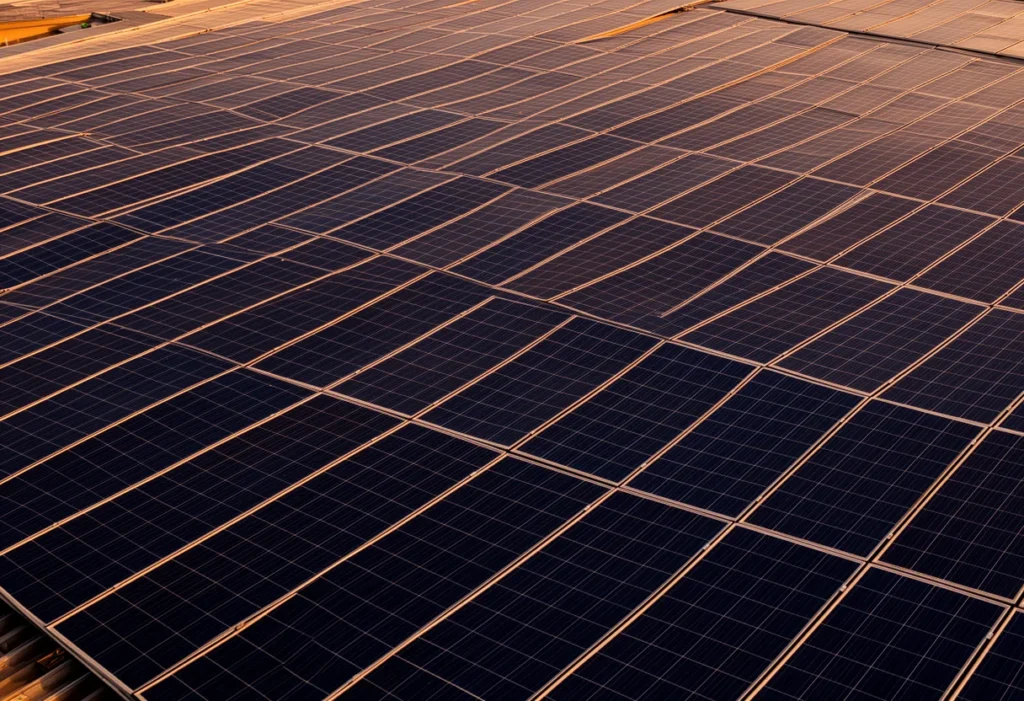
Averages are the least useful figure in solar and the most quoted. A statewide average blends a simple upstate ranch roof with a Brooklyn row house, a cash purchase with a leased system, and a small array with a large one.
What is more useful is the shape of the curve. The average cost of solar panels in NY behaves predictably as system size changes, and once you know why, a quote for your own size becomes easier to judge.
System size is set by your consumption, not your roof
The starting point is annual electricity use in kilowatt-hours, which appears on your utility bill or in your online account history. A design is sized to cover a proportion of that, allowing for how much sun the roof receives at its orientation and pitch.
Roof area only becomes the binding constraint when the roof is too small or too broken up for the capacity your usage justifies. In New York City that happens frequently; in most of the rest of the state it does not.
Aiming to cover far more than your annual use rarely pays, because compensation for exported electricity is not the same as the retail rate you avoid by consuming your own. The net metering explainer covers how that works in each utility territory.
Why price per watt falls as systems get larger
A solar project has two kinds of cost. Variable costs scale with capacity: modules, racking, most of the roof labour. Fixed costs barely move: system design, permit filing, the interconnection application, mobilising a crew, commissioning, the site visit, the sales process.
Divide a roughly constant block of fixed costs across more watts and the price per watt falls. That is the whole mechanism, and it is why a small system can look poor value on a per-watt basis while being entirely correctly priced.
It also means the saving from going one size larger is usually smaller than people expect, because you are only diluting the fixed portion further, not eliminating it.
Do the arithmetic with your own quote
System size in kilowatts multiplied by 1,000 gives watts. Divide the net contract price by that figure and you have your price per watt. Doing this for every quote puts proposals with different formats onto one comparable line, which is the point of the exercise.
Where the scaling stops
The curve is not smooth, because several costs step rather than slide.
The electrical service is the most common step. Below a certain capacity the existing service panel accepts the solar breaker; above it, an upgrade is required, and that upgrade is a discrete cost that appears all at once.
Inverter capacity steps too. Past a certain system size a second inverter, or a larger unit, is needed. Roof planes step as well: filling the good south-facing plane and spilling onto a second, more awkward orientation adds racking, labour and design time while producing less per panel.
These steps are why an installer sometimes quotes a slightly smaller system at a noticeably better price per watt. It is often the honest recommendation rather than a downsell.
| System size | Capacity in watts | Typically suits | What tends to happen to price per watt |
|---|---|---|---|
| 4 kW | 4,000 W | Small household, low usage, or a constrained roof | Highest, because fixed costs are concentrated |
| 6 kW | 6,000 W | Modest usage, single roof plane | Noticeably lower than a 4 kW system |
| 8 kW | 8,000 W | Typical family home with gas heating | Continues to fall, more slowly |
| 10 kW | 10,000 W | High usage, electric heating or an EV | Flattening; watch for panel upgrade or second inverter |
| 12 kW | 12,000 W | Large home, heat pump plus EV charging | Little further gain; step costs often reappear |
Why published averages will not match your quote
Three things distort any published average for New York. Regional mix is the first: the same design costs more in the five boroughs than in the Southern Tier, so an average is largely a statement about the sample, not the market.
Ownership model is the second. Leases and power purchase agreements are not priced per watt in the same way, and blending them with cash purchases produces a number that describes neither.
Timing is the third, and it matters more this year than usual. Any average built from data before 2026 reflects a world in which buyers received a federal tax credit. That credit ended for property with installation completed after 31 December 2025, so historic net-cost averages understate what a buyer pays today.
How the incentives interact with size
NY-Sun was paid per watt, so its total value scaled with system size, while the rate itself stepped down as regional megawatt blocks filled rather than varying by how large an array was. As of September 2026 NYSERDA has no open NY-Sun block for homes in any utility territory; check NYSERDA’s NY-Sun dashboard for a new one. Until then it adds nothing at any system size.
New York’s state income tax credit works differently. It is a percentage of qualified expenditure up to a statutory cap, so once a system is large enough to reach that cap, additional capacity brings no further state credit. That is a genuine reason the incentive value per watt falls on larger systems. Confirm the current cap with the New York State Department of Taxation and Finance, and see the state credit basics for how it is claimed.
Batteries change the shape of the number
Storage adds cost without adding array capacity, so including a battery inside a single price per watt makes a system look expensive against quotes that exclude one.
Ask for storage as a separate line and evaluate it on its own merits, which are mostly about outage resilience and time-of-use billing rather than about reducing the cost of the panels. Available support is described on the battery incentives page.
Ask for two sizes, not one
Request quotes for the size you think you need and for the next step up or down, each with its own price per watt. The two figures reveal where the step costs sit on your specific roof and service panel, which no published average can tell you.
Frequently asked questions
What size solar system does a typical New York home need?
It depends on annual kilowatt-hour consumption, roof orientation and how much of your usage you want to cover. A home heated with gas and without an electric vehicle needs considerably less capacity than one with a heat pump and an EV. Start from twelve months of bills rather than from a rule of thumb, as described in the guide to estimating your own system.
Why is a small system more expensive per watt than a large one?
Because design, permitting, interconnection filing, crew mobilisation and commissioning cost roughly the same regardless of array size. Spread across fewer watts, those fixed costs raise the per-watt figure. The total price is still lower; only the ratio is worse.
Should I oversize for a future EV or heat pump?
Adding capacity during the original installation is cheaper than a second project later, since you pay the fixed costs once. The counterweight is that exported electricity is generally worth less than electricity you consume yourself, so overshooting has diminishing value. If the change is likely within a few years, size for it; if it is speculative, size for today and check the design allows expansion.
Does a larger system receive a larger NY-Sun incentive?
Not at present: as of September 2026 NYSERDA has no open NY-Sun block for homes in any utility territory; check NYSERDA’s NY-Sun dashboard for a new one. When residential blocks were open, the incentive was calculated per watt, so a larger system attracted a larger total amount, subject to programme rules and caps, and the per-watt rate was set by the region’s current megawatt block, not by system size. Confirm block status and any limits with NYSERDA before assuming a figure.
Programme figures move, so verify them
NY-Sun has no residential block open as of September 2026, and the state credit percentage and cap are set in statute. Check the current position with NYSERDA and with the New York State Department of Taxation and Finance rather than relying on figures quoted in older articles or proposals.
NY Solar Incentives
Independent New York solar research. We summarise NYSERDA, NY-Sun and federal programme rules from published sources and state plainly when a figure is an estimate. We are not a government agency and do not sell equipment.
Run the arithmetic on your own system
Check the dated program table and your arrangement before counting an incentive. Standard residential NY-Sun blocks are closed; Long Island Affordable Solar has a conditional income-verification route. The NY credit depends on qualified costs and tax liability, while the NYC abatement reduces future property-tax bills. The estimator keeps those timings separate.