Home Batteries on Con Edison: What Changes
In Con Edison territory a battery is bought for outages, not savings — and in the five boroughs where it may be installed is the harder question.
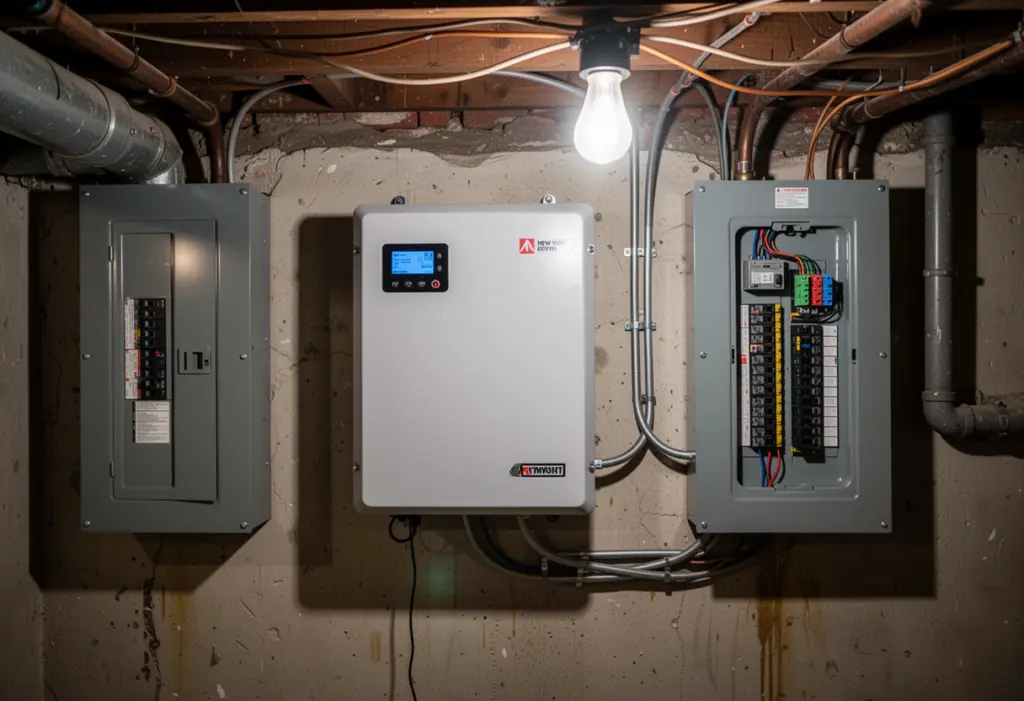
Con Edison customers ask about batteries more than most, partly because storm outages in Westchester and parts of the boroughs are a real memory. The honest framing is the same as everywhere in New York, with two local complications.
A battery does not save you money here
Under Phase One net metering, every kilowatt-hour you export is credited at the full retail rate and drawn back later at that same rate. Con Edison’s grid is already acting as your battery — at a hundred per cent round-trip efficiency, free, with unlimited capacity. A physical battery cannot beat that; it can only lose a few per cent to conversion on the way through.
If a salesperson tells you storage will increase your solar savings on a standard Con Edison residential account, ask them to show the arithmetic.
What it does buy: power in an outage
This surprises people: a grid-tied solar system without a battery shuts off in a power cut. Anti-islanding protection stops the inverter feeding a line crews may be working on. So the array produces nothing during an outage, in bright sunshine, unless there is storage and the switchgear to island the house.
That is the case for a battery in Con Edison territory, and for some households it is a strong one — medical equipment, a sump pump, a household that lost a week to a storm.
The NYC complication: where it may go
New York City applies its own requirements through the Department of Buildings and the Fire Department, and they are more restrictive than the rest of the state. Location is the binding question, and it is settled before the product.
Generally the distinctions that matter are between a detached garage, an attached garage, an exterior wall, an unfinished basement or utility space, and habitable space — with clearances, separation from living areas and aggregate stored energy all in play. In the five boroughs, treat general state guidance as a starting point only and get the specific position from your installer and the relevant agency before choosing a product or a place to put it.
In Westchester the picture is closer to the rest of the state, but your municipality still applies the code and interpretations differ.
Space, which is the other city constraint
A row house, a semi-attached house or a small lot may simply not have a compliant location with the required clearances. That is a real answer rather than an obstacle to argue with, and it is worth establishing early — before a design, not after.
For apartment and co-op residents the question generally does not arise at all: the equipment would be in common property, which makes it a board decision rather than yours.
What it does not change
The Customer Benefit Contribution is calculated on the DC size of the PV system, not on battery capacity. Adding storage to an existing array does not increase it. Con Edison’s 2026 residential rate is $1.29 per kW-month.
Your net metering is also unaffected: a system interconnected today holds Phase One net metering for 20 years, and adding storage does not restart that clock.
Capacity and power are different numbers
Capacity (kWh) is how long it lasts. Power output (kW) is how much it can run at once. A battery with generous capacity but modest output will run a fridge, lights and a router for a long time and will not start a central air conditioner. If backing up a specific load is why you are buying, the power figure is the one to check.
Most installations back up a critical loads sub-panel rather than the whole house, which is far cheaper and covers what actually matters. Ask for both to be priced, with the circuit list written out.
2026
The 30% federal residential credit is gone — section 25D was terminated for expenditures made after 31 December 2025, with an expenditure treated as made when the original installation is completed. Any battery quote still showing a federal credit line is overstating your net cost. NYSERDA has supported residential storage and the terms change, so ask what is open on the day you are quoted rather than relying on last year’s figure.
Frequently Asked Questions
Will a battery save money on Con Edison?
Very little. Phase One net metering credits exports at the full retail rate and lets you draw them back at that rate, so the grid already banks your surplus at no cost. A battery is bought for outage protection rather than savings.
Are New York City battery rules stricter?
Yes. The five boroughs apply their own requirements through the Department of Buildings and the Fire Department, and location — garage, exterior wall, basement, distance from habitable space, aggregate stored energy — is the binding question. Get the specific position before choosing a product.
Does adding a battery change my Con Edison charges?
No. The Customer Benefit Contribution is calculated on the DC size of the PV system rather than battery capacity, and net metering is unaffected — a system interconnected today holds it for 20 years regardless.
Do solar panels work during a Con Edison outage?
Not without a battery and the right switchgear. Anti-islanding protection shuts a grid-tied inverter down so it cannot feed a line crews may be working on, so the array produces nothing during an outage even in bright sun.
This article is general information, not tax, legal or financial advice. Incentive amounts, eligibility rules and deadlines change and depend on your utility, your tax situation and your property. Confirm current terms with NYSERDA, your utility and a qualified tax professional before making a decision.
NY Solar Incentives
Independent New York solar research. We summarise NYSERDA, NY-Sun and federal programme rules from published sources and state plainly when a figure is an estimate. We are not a government agency and do not sell equipment.
Run the arithmetic on your own system
Check the dated program table and your arrangement before counting an incentive. Standard residential NY-Sun blocks are closed; Long Island Affordable Solar has a conditional income-verification route. The NY credit depends on qualified costs and tax liability, while the NYC abatement reduces future property-tax bills. The estimator keeps those timings separate.