Home Battery Fire Code Rules in New York
Where the battery goes is settled by code, not preference — and getting it wrong after installation is an expensive correction.
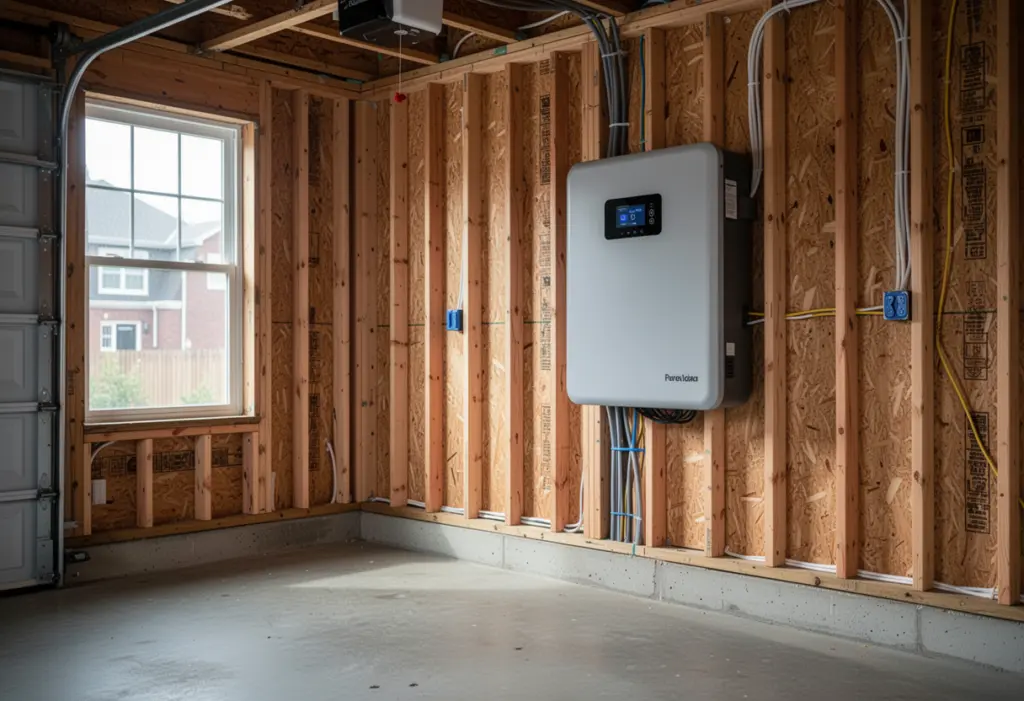
Home battery installations are inspected, and the location is the part that most often causes a correction. It is worth understanding before you choose a product, because in practice the location decides which products are even eligible.
Location is decided first, not last
The governing question is where the unit sits relative to the parts of the house people sleep and live in. Codes distinguish sharply between:
- An attached garage — the most common New York location.
- A detached garage or outbuilding — generally the least constrained.
- An exterior wall — common, and subject to the unit’s own temperature rating in a New York winter.
- An unfinished basement or utility space — sometimes acceptable, sometimes not, depending on separation from habitable rooms.
- Inside habitable space, or in a bedroom or a closet — generally not acceptable.
Requirements also cover clearances around the unit, separation between multiple units, whether fire-rated separation from living space is needed, and in some cases smoke detection and signage.
Your municipality applies the code, and interpretations vary between building departments. That is not a reason to guess — it is a reason to ask your installer which authority is inspecting and what that authority has required on their recent installations.
Aggregate capacity matters
Limits are generally expressed in terms of the total energy stored in a given location, so two units in one garage are treated differently from one. If you are planning to add a second battery later, raise it at the first installation — the location that works for one may not work for two, and discovering that afterwards means moving the first.
Listing and certification
Inspectors look for equipment that carries the appropriate product listing for residential energy storage. Any battery a reputable New York installer proposes will have it. The reason to know the term exists is the case where someone offers a self-assembled or imported unit at an attractive price — that is the offer to walk away from, because it will not pass, and an installation that cannot be inspected cannot be interconnected.
New York City is stricter
The five boroughs apply their own rules through the Department of Buildings and the Fire Department, and they are more restrictive than the rest of the state. If your property is in NYC, treat any general guidance about home batteries — including this page — as the starting point rather than the answer, and get the specific position from your installer and the relevant agency before committing to a product or a location.
What this means practically
- Decide the location before the product. Ask your installer to walk the property and identify compliant locations, then choose a unit that suits one of them.
- Check the temperature rating against where it will actually sit. An unheated garage in Watertown is a different environment from a basement in Queens, and cold affects both performance and, in some products, eligibility for that location.
- Ask which authority inspects and what they have required recently.
- Plan for expansion now if a second unit is possible later.
- Confirm the equipment is properly listed.
Why this is worth your attention
A battery installed in a location the inspector will not accept is not a paperwork problem. It is a unit that has to be moved, with the electrical work redone, and it happens because the location was chosen for convenience during the site visit rather than checked against what the local authority requires.
Ten minutes of asking prevents it entirely.
Frequently Asked Questions
Where can a home battery be installed in New York?
Typically an attached or detached garage, an exterior wall, or some unfinished basement and utility spaces, subject to clearances and separation from habitable space. Bedrooms, closets and habitable rooms are generally not acceptable, and your municipality applies the code.
Are New York City battery rules different?
Yes, and more restrictive. The five boroughs apply their own requirements through the Department of Buildings and the Fire Department, so treat general state guidance as a starting point and get the specific position before choosing a product or a location.
Does installing two batteries change the rules?
It can. Limits are generally expressed as total energy stored in a location, so two units are treated differently from one. Raise any plan to expand at the first installation, because a location that works for one may not work for two.
What happens if a battery is installed in the wrong place?
It has to be moved and the electrical work redone. It happens when a location is chosen for convenience during the site visit rather than checked against what the inspecting authority actually requires.
This article is general information, not tax, legal or financial advice. Incentive amounts, eligibility rules and deadlines change and depend on your utility, your tax situation and your property. Confirm current terms with NYSERDA, your utility and a qualified tax professional before making a decision.
NY Solar Incentives
Independent New York solar research. We summarise NYSERDA, NY-Sun and federal programme rules from published sources and state plainly when a figure is an estimate. We are not a government agency and do not sell equipment.
Run the arithmetic on your own system
Check the dated program table and your arrangement before counting an incentive. Standard residential NY-Sun blocks are closed; Long Island Affordable Solar has a conditional income-verification route. The NY credit depends on qualified costs and tax liability, while the NYC abatement reduces future property-tax bills. The estimator keeps those timings separate.