Ground Mount or Roof Mount Solar in New York?
A ground mount costs more and solves more. Here is exactly what it buys you, and when the extra is worth paying in New York.
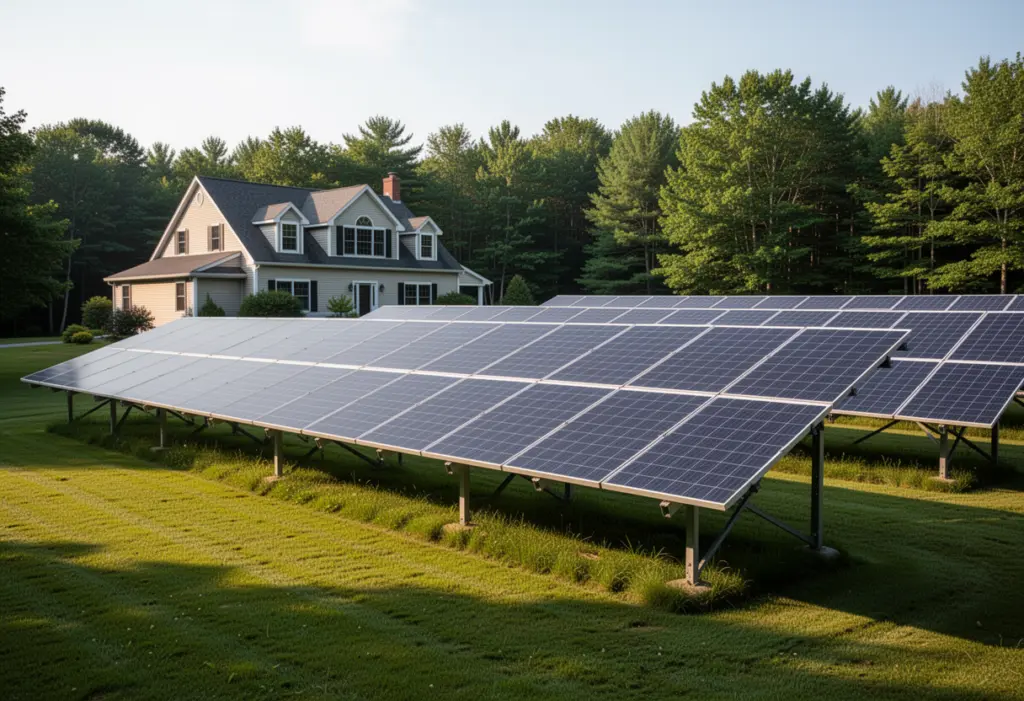
Most New York solar goes on roofs because most New York properties do not have the land for anything else. Where the land does exist — and upstate, in the Hudson Valley and on the North and South Forks it often does — a ground mount is worth quoting alongside the roof rather than dismissing.
What a ground mount costs you
More per watt, and the reasons are concrete rather than vague:
- A foundation. Concrete piers or driven ground screws, and in New York they must reach below the frost line — deeper upstate than downstate.
- A trench. Conduit from the array to the house, dug, laid and reinstated.
- More steel. A roof provides the structure free; a ground mount has to build it.
- Its own permitting questions — setbacks from boundaries, sometimes coverage limits, occasionally a zoning question the roof would never have raised.
What it buys you, and this is the part that matters
Orientation and tilt become yours to choose. Not what the roof happens to face — due south at the optimum angle. On a house whose roof faces east and west, this alone can be decisive.
The roof-age question disappears. This is the largest hidden cost in New York rooftop solar: a roof with under a decade left means replacing it first, or paying to remove and reinstall the array later. A ground mount is entirely unaffected by the roof, now or in fifteen years.
Shading can be solved by siting. Instead of accepting whatever the roof’s horizon is, the array goes where the sun is. In the Hudson Valley, Westchester and the Southern Tier — where shading is usually the binding constraint — this is frequently the difference between a project that works and one that does not.
Snow becomes manageable. A ground mount can be tilted steeply enough to shed well, and if it ever needs clearing it can be reached from the ground with a soft snow broom — safely, which a roof in February is not.
Maintenance is at ground level. Every future service call, panel replacement and inverter swap is cheaper and safer.
Panels run cooler with airflow on both sides, which slightly improves output — and it is the mounting that makes bifacial modules worth considering at all.
Size is not capped by roof area. On a small Nassau or Monroe County roof, usable area rather than consumption is what limits the system. Land removes that ceiling, which matters if an electric car or a heat pump is in the plan.
When the extra is worth paying
- The roof faces the wrong way, or is shaded, or is complicated by dormers and valleys.
- The roof has under about ten years left and you do not want to re-roof now.
- You need a larger system than the roof supports.
- The roof is slate, tile or otherwise difficult and expensive to mount on.
- You are upstate with snow, and shedding and safe access matter.
- You are on a farm or a large lot where the land has no competing use.
When it is not
- The roof is a good south-facing plane with a clear horizon and plenty of life left. Then it is simply the cheaper answer.
- The land is small, visible, or wanted for something else.
- Setbacks or local rules make siting awkward — worth checking before designing.
Questions to ask
- Quote both, with production estimates for each. The ground mount usually produces more per watt installed, and that partly offsets its higher cost per watt.
- What foundation, and to what depth? Frost line matters.
- How far is the trench run, and is it in the price?
- What setbacks apply, and has anyone checked them with the municipality?
- What snow and wind load is the structure designed to?
Compare the two on cost per kWh produced over the system’s life, not on cost per watt installed. That is the comparison that reflects what a ground mount actually buys.
Frequently Asked Questions
Is a ground mount more expensive than a roof mount?
More per watt installed, because of the foundation, the trench, the steel and its own permitting. But it usually produces more per watt because orientation and tilt are chosen rather than inherited, so compare on cost per kWh over the system's life instead.
What does a ground mount solve that a roof cannot?
Orientation and tilt, the roof-age question, shading that can be avoided by siting, snow shedding and safe ground-level clearing, cooler operation, ground-level maintenance for the system's whole life, and a size that is not capped by roof area.
Do ground-mounted solar arrays need a permit in New York?
Yes, and they raise questions a roof array does not — setbacks from boundaries, sometimes coverage limits, occasionally zoning. Have those checked with your municipality before the array is designed rather than after.
How deep does a ground mount foundation go in New York?
Below the local frost line, which is deeper upstate than downstate. Ask specifically what foundation is proposed and to what depth, because it is a real part of the cost difference.
This article is general information, not tax, legal or financial advice. Incentive amounts, eligibility rules and deadlines change and depend on your utility, your tax situation and your property. Confirm current terms with NYSERDA, your utility and a qualified tax professional before making a decision.
NY Solar Incentives
Independent New York solar research. We summarise NYSERDA, NY-Sun and federal programme rules from published sources and state plainly when a figure is an estimate. We are not a government agency and do not sell equipment.
Run the arithmetic on your own system
Check the dated program table and your arrangement before counting an incentive. Standard residential NY-Sun blocks are closed; Long Island Affordable Solar has a conditional income-verification route. The NY credit depends on qualified costs and tax liability, while the NYC abatement reduces future property-tax bills. The estimator keeps those timings separate.