The Best Roof Direction for Solar in New York
South-facing is the textbook answer. In practice most New York roofs are not south-facing, and east and west are far better than people assume.
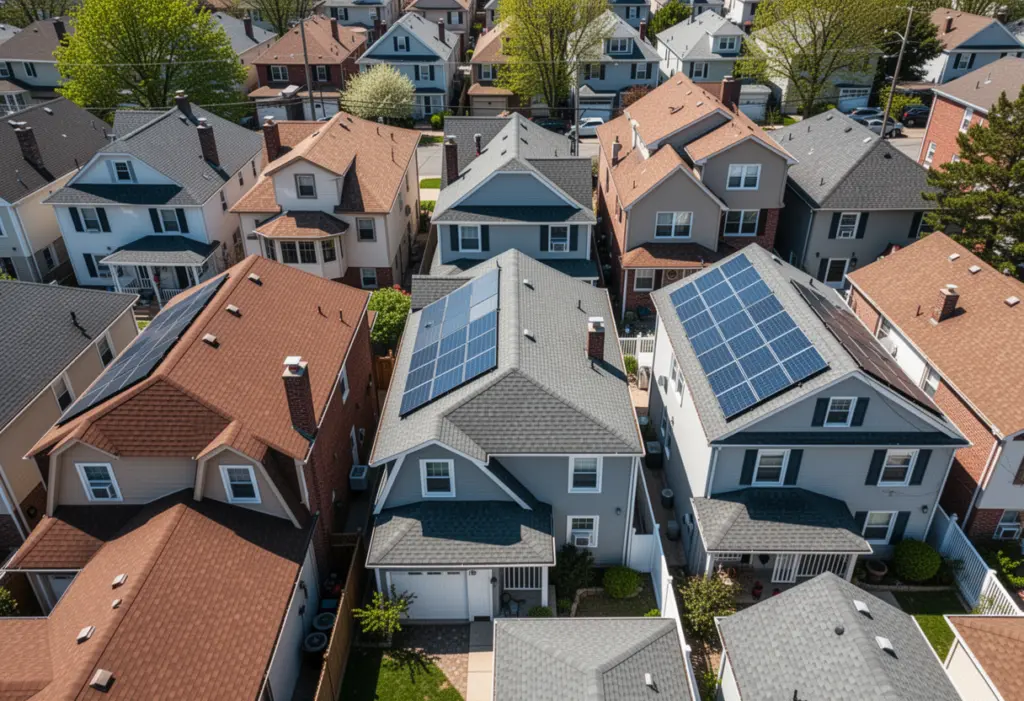
South is the best orientation for solar in New York, and that is where the useful part of the answer begins rather than ends — because most New York roofs are not south-facing, and the penalty for the alternatives is smaller than people assume.
Why south wins
New York sits at roughly 41 to 45 degrees north latitude. The sun tracks across the southern sky all year, and it is lowest in the south in winter. A south-facing plane is pointed at the sun for the greatest number of useful hours, and critically it captures the low winter sun that east and west planes largely miss.
South is therefore the benchmark, and every other orientation is described as a percentage of it.
What the other directions actually cost
Southeast and southwest lose very little. If your roof faces one of these, treat it as a south roof for practical purposes and do not let anyone tell you otherwise.
Due east and due west produce meaningfully less than south over a year, but they still produce well — enough that a large number of New York systems sit on them and perform as designed. East catches the morning; west catches the afternoon and evening.
West has a particular argument in its favour. Household electricity demand peaks in the late afternoon and evening, when people are home, air conditioning is running and cooking starts. A west-facing array produces into that window. Under Phase One net metering, which credits exports at the full retail rate regardless of time, that timing advantage does not show up in the credit — but if you have a battery, or if you are ever on a time-varying rate, it becomes real.
North is where it stops making sense in New York. A north-facing plane at this latitude receives too little direct sun to justify the equipment, and in winter it receives very little at all. There are exceptions on very shallow pitches, where the orientation matters much less, but as a rule a north-facing plane is not where an array goes.
Pitch, and why shallow roofs are more forgiving
The flatter the roof, the less the compass direction matters. A nearly flat roof — common on New York City and Long Island housing, and on many commercial buildings — is close to omnidirectional, which is why flat-roof installations are often tilted and racked to face south rather than following the roof.
A steep roof amplifies orientation in both directions: a steep south face is excellent, a steep north face is close to useless.
Steep also helps with snow, which is not a small consideration upstate. A steeper array sheds sooner and self-clears faster.
Shading beats orientation
This is the point that matters most and gets the least attention. An unshaded east roof will out-produce a shaded south roof. Orientation is a fixed, modest percentage; shading can remove far more, and it removes it disproportionately in winter when the sun is low and obstructions cast long shadows.
So the order of questions for a New York roof is:
- What is shaded, and at what times of year?
- Which planes are unshaded?
- Of those, which faces closest to south?
- Is there enough unshaded area on it?
An installer who starts at question three has skipped the two that matter.
Splitting an array across two planes
Common on New York’s complicated older roofs, and perfectly workable — an east/west split is a normal design. It does require module-level electronics (microinverters or optimizers) so that the two orientations do not drag on each other, and it requires a production estimate that models both planes rather than averaging them.
When the roof simply does not work
Three alternatives, in order of how often they apply in New York:
- A ground mount, if you have the land. It removes the orientation and pitch constraints entirely and can be aimed exactly where it should be. Common and practical upstate; rarely possible downstate.
- A garage, barn or outbuilding with a better-oriented roof than the house.
- Community solar, which needs no roof at all, has no up-front cost, and whose subscribers are exempt from the Customer Benefit Contribution that rooftop owners pay.
None of these is a consolation prize. For a shaded lot in the Hudson Valley or a north-facing house in the Southern Tier, they are simply the right answer.
Frequently Asked Questions
Do solar panels have to face south in New York?
No. South is the benchmark, southeast and southwest lose very little, and due east and due west still produce well enough that many New York systems sit on them. North-facing planes are generally not worth equipping at this latitude.
Is a west-facing roof good for solar in New York?
It produces less than south over a year but generates into the late-afternoon and evening period when household demand peaks. Under flat-rate net metering that timing does not change the credit, but it matters if you have a battery or a time-varying rate.
What matters more, roof direction or shading?
Shading. An unshaded east-facing roof will out-produce a shaded south-facing one. Orientation costs a fixed modest percentage; shading can remove far more, and it does so disproportionately in winter when the sun is low.
Can solar panels be split across two roof directions?
Yes, and an east/west split is a normal New York design given the complicated older roof stock. It needs module-level electronics so the two orientations do not drag on each other, and a production estimate that models both planes separately.
This article is general information, not tax, legal or financial advice. Incentive amounts, eligibility rules and deadlines change and depend on your utility, your tax situation and your property. Confirm current terms with NYSERDA, your utility and a qualified tax professional before making a decision.
NY Solar Incentives
Independent New York solar research. We summarise NYSERDA, NY-Sun and federal programme rules from published sources and state plainly when a figure is an estimate. We are not a government agency and do not sell equipment.
Run the arithmetic on your own system
Check the dated program table and your arrangement before counting an incentive. Standard residential NY-Sun blocks are closed; Long Island Affordable Solar has a conditional income-verification route. The NY credit depends on qualified costs and tax liability, while the NYC abatement reduces future property-tax bills. The estimator keeps those timings separate.