Con Edison Net Metering: How Your Solar Credits Work
Con Edison serves Manhattan, the Bronx, Brooklyn, Staten Island, most of Queens and most of Westchester. Here is what net metering actually credits you for, and what it does not.
On this page 11 sections
- 01What net metering means on Con Edison
- 02Which tariff generation your account is actually on
- 03Net metering vs. Value Stack (VDER)
- 04What happens when you generate more than you use
- 05The Customer Benefit Contribution — the charge nobody mentions
- 06The charges solar does not remove
- 07Does adding a battery change any of this?
- 08Getting connected: the sequence
- 09What to ask before you sign
- 10One thing that changed in 2026
- 11Frequently Asked Questions
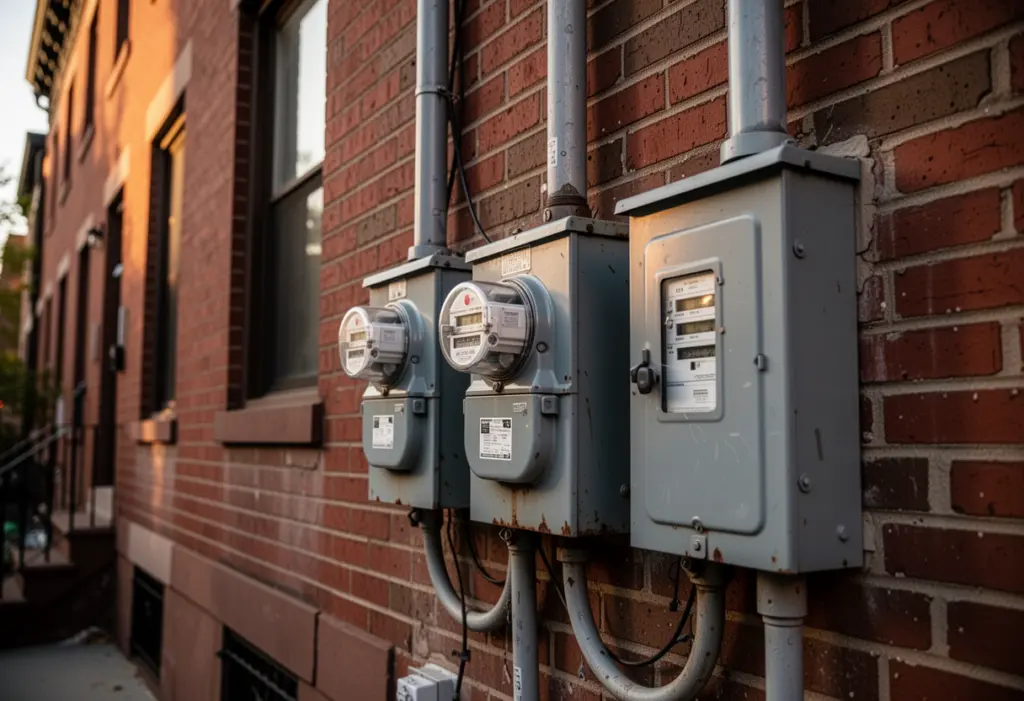
Con Edison serves Manhattan, the Bronx, Brooklyn, Staten Island and most of Queens, plus most of Westchester County. The exception is the Rockaway Peninsula in Queens, which is LIPA territory operated by PSEG Long Island — if that is your address, the PSEG Long Island rules apply to you rather than the ones below. It is also the utility whose bill confuses new solar owners most, because a Con Edison statement separates supply from delivery and solar only ever offsets part of one of them.
This is what actually happens to the electricity your roof produces, what it is worth, which tariff track decides that, and which lines on the bill will not move no matter how much you generate.
What net metering means on Con Edison
Your system is connected on the house side of the meter. Everything it produces is consumed in the house first. Only the surplus — the kilowatt-hours you generate but do not use at that moment — flows backwards onto the grid, and only that surplus is metered as an export.
Under Phase One net metering, which is what a residential rooftop system in Con Edison territory receives, each exported kilowatt-hour earns a credit at the full retail rate. A kilowatt-hour you push out at noon offsets a kilowatt-hour you pull back at nine in the evening. The meter records both directions and the bill nets them. What net metering does not do is pay you directly for that export the way a business selling electricity would be paid — the value only ever exists as an offset against your own future usage.
The important structural point: a system interconnected today holds that arrangement for 20 years. New York has changed the successor tariff several times, and each change applied going forward. Interconnection date is what fixes your treatment, which is why installers talk about it the way they do.
Which tariff generation your account is actually on
“Net metering” is not one static program — it is a label that has covered several different sets of rules over time, and Con Edison applies whichever one was in force when your system was approved, not whichever one is easiest to explain:
| When the system was interconnected | How leftover credits are treated |
|---|---|
| Before March 10, 2017 | Excess credits are cashed out automatically once a year, at Con Edison’s avoided-cost rate rather than the retail rate you were credited at. |
| March 10, 2017 through the residential mass-market cutoff | Phase One net metering — the track described above. Credits roll forward month to month and year to year for the life of the 20-year enrollment, with no automatic annual cash-out. |
| Larger or non-mass-market systems, including most community solar | Value Stack (VDER) instead of traditional net metering — see below. |
Do not infer your own track from the install year alone. These cutoffs reflect statewide Public Service Commission orders that Con Edison rolled out on its own schedule, and your interconnection agreement is the record that actually governs your account. If you are not sure which applies to you, your installer or Con Edison’s account team can confirm it from the tariff rider on file for your meter.
Net metering vs. Value Stack (VDER)
The Value of Distributed Energy Resources tariff, usually shortened to Value Stack or VDER, is the compensation model for larger and non-mass-market solar projects in New York, including most community solar arrays. Instead of one flat retail-rate credit, it breaks the value of exported electricity into several components — an energy value tied to wholesale market pricing, an avoided-capacity value, an environmental value for the renewable output, and in some cases a location-based value that pays more where the grid particularly needs it.
For a typical owner-occupied home with a rooftop system sized to its own usage, net metering is usually still the applicable framework. If your bill instead shows separate component credits labeled by categories like energy, capacity and environmental value rather than one net-metering line, you are on Value Stack regardless of your system’s size, and the CBC math and 20-year framing below do not describe your account in the same way.
Subscribing to an off-site community solar project is a different arrangement again: you receive a bill credit for your share of that project’s output under its own subscriber agreement, not a direct netting of electricity your own roof produced. Both can show up as a credit line on a Con Edison-branded bill, which is why the two get confused, but the agreement governing the credit rate is not the one on this page.
What happens when you generate more than you use
A well-sized system in New York overproduces from roughly March to September and underproduces from November to February. Con Edison does not send a cheque each month for the summer surplus. On the Phase One net metering track, the credit rolls forward on the account as a dollar balance and is drawn down through the winter.
That is why solar is sized against your annual consumption rather than your July bill. It is also why the first winter unsettles people who were told their bill would be zero: the balance built in August is the thing paying January, and if the system was undersized there is nothing left by February.
If a credit balance is still sitting on the account at the annual reconciliation, its treatment depends on which tariff generation you are on — the table above is the starting point, and it is a question to ask your installer in writing, with the answer specific to your service class, before you sign.
The Customer Benefit Contribution — the charge nobody mentions
Since 1 January 2022, a residential customer who interconnects solar in New York pays a monthly Customer Benefit Contribution. It funds low-income, energy-efficiency and clean-energy programmes that were historically paid for through volumetric charges — charges a solar customer largely stops paying.
The CBC is calculated on the DC size of your system, not on what it produces. For 2026 the final residential rate on Con Edison for a net-metered PV system is $1.29 per kW-month.
So the arithmetic is simple and worth doing before you sign anything:
- A 6 kW system: 6 × $1.29 = $7.74 a month, about $93 a year.
- An 8 kW system: 8 × $1.29 = $10.32 a month, about $124 a year.
- A 12 kW system: 12 × $1.29 = $15.48 a month, about $186 a year.
Three things about this charge routinely surprise people. It applies whether or not the sun shines that month, because it is billed on capacity. It is not locked in at interconnection — the utilities recalculate and publish rates annually, so this year’s number is not a promise about next year’s. And it does not apply at all to systems interconnected before 1 January 2022, to front-of-the-meter projects such as community solar, or to commercial accounts that carry a demand charge.
For context, Con Edison’s $1.29 sits in the middle of the state. Central Hudson customers pay $1.67, RG&E $1.31, NYSEG $1.19, PSEG Long Island $1.13, Orange & Rockland $1.00, and National Grid $0.97. Identical systems on identical roofs pay different amounts purely because of which utility the roof sits under.
The charges solar does not remove
This is where most Con Edison solar disappointment comes from. A Con Edison residential bill carries a basic service charge that exists regardless of consumption, and delivery charges that are only partly volumetric. Solar reduces the kilowatt-hours you buy; it does not repeal the fact that you are connected to a distribution network.
Expect a bill every month for as long as you are connected to the grid. A realistic target is a small bill, not no bill. If a salesperson has told you the bill goes to zero, that is the moment to ask them to put it in writing alongside the CBC line.
Does adding a battery change any of this?
Adding storage to an existing net-metered system does not by itself move the account onto Value Stack or change which tariff generation it falls under — the panels and the battery stay governed by whatever agreement is already on file. What changes is how much the battery is actually worth. Net metering already credits every exported kilowatt-hour at the full retail rate, so there is limited extra financial upside to shifting when you export it; the case for a battery on this track is mostly backup power during an outage. Under Value Stack, the credit varies by time and location, so a battery that shifts export timing can meaningfully increase what a system earns — part of why Value Stack projects are built around storage far more often than net-metered rooftop systems are.
Getting connected: the sequence
Net metering does not begin when the panels go up. It begins when Con Edison grants permission to operate, and that is a separate step at the end of a chain:
- Your installer files an interconnection application with Con Edison, normally before installation.
- Con Edison reviews it against the capacity available on your circuit and issues an approval to install.
- The system is installed and passes local electrical inspection.
- The inspection certificate goes to Con Edison, which then exchanges or reprograms the meter.
- Con Edison issues permission to operate. Only now may the system be switched on.
Running a system before permission to operate is a genuine problem, not a technicality — it can put the interconnection agreement and the net-metering arrangement at risk. Every day between mechanical completion and PTO is a day of production you do not get, which is why an honest installer gives you a range for this step rather than ignoring it.
What to ask before you sign
- What is the DC size in kW, and therefore what is my monthly CBC at the current Con Edison rate?
- Which tariff generation applies to my interconnection date — Phase One net metering, the pre-2017 annual cash-out, or Value Stack?
- What annual consumption is this system sized against, and what does the production estimate assume about shading?
- What is the expected wait for permission to operate in my part of the territory right now?
- Which charges on my bill will still be there after the system is running?
- Who files the interconnection application, and what happens to my deposit if Con Edison requires a distribution upgrade?
One thing that changed in 2026
The 30% federal residential clean energy credit under section 25D is gone. The One Big Beautiful Bill Act ended it for expenditures made after 31 December 2025, and the statute treats an expenditure as made when the original installation is completed — not when the system is placed in service. A household whose installation finished in December 2025 still qualifies even if Con Edison did not grant permission to operate until January 2026. A household buying now does not.
New York’s own 25% credit, capped at $5,000 and claimed on Form IT-255, is unaffected. Any 2026 quote that still shows a 30% federal line is wrong, and it is wrong by an amount large enough to change whether the project makes sense.
Frequently Asked Questions
Does Con Edison pay me for extra solar power?
Not as a cash payment each month. On the Phase One net metering track, surplus exports become a credit balance on your account that carries forward and is drawn down in the winter months when your system produces less than you use. Accounts interconnected before March 10, 2017 are cashed out once a year instead, at an avoided-cost rate rather than the retail rate.
How much is the Con Edison CBC charge in 2026?
The final 2026 residential rate for net-metered PV is $1.29 per kW-month of DC system size. An 8 kW system therefore pays about $10.32 a month, roughly $124 a year. The rate is recalculated annually and is not locked in at interconnection.
Is Con Edison net metering the same as Value Stack (VDER)?
No. Net metering credits exported electricity at a single retail rate. Value Stack breaks the credit into separate components tied to wholesale energy prices, capacity value and environmental value, and is the framework for most community solar and larger, non-mass-market systems rather than typical owner-occupied rooftop solar.
Will my Con Edison bill go to zero with solar?
No. A basic service charge and part of the delivery charge apply for as long as you are connected to the grid, and the Customer Benefit Contribution is billed on system size regardless of production. Aim for a small bill rather than no bill.
How long does permission to operate take with Con Edison?
It follows local electrical inspection and a meter exchange, and the wait varies by area and workload. Ask your installer for a current range in your specific part of the territory, and do not switch the system on before permission is granted.
Is net metering guaranteed for the life of my system?
A system interconnected today holds Phase One net metering for 20 years. The Customer Benefit Contribution rate is separate and does change annually, and the tariff track itself is fixed by the interconnection date rather than a choice you can revisit later.
NY Solar Incentives
Independent New York solar research. We summarise NYSERDA, NY-Sun and federal programme rules from published sources and state plainly when a figure is an estimate. We are not a government agency and do not sell equipment.
Run the arithmetic on your own system
Check the dated program table and your arrangement before counting an incentive. Standard residential NY-Sun blocks are closed; Long Island Affordable Solar has a conditional income-verification route. The NY credit depends on qualified costs and tax liability, while the NYC abatement reduces future property-tax bills. The estimator keeps those timings separate.