Solar Warranties and Maintenance in New York
A solar proposal saying "25-year warranty" is describing at least four separate agreements with different terms, different parties and different failure modes.
On this page 7 sections
“25-year warranty” printed on a proposal cover is not a warranty. It is a summary of the longest number appearing anywhere in a set of documents that includes at least four separate coverages, running for different periods, backed by different parties, against different failure modes.
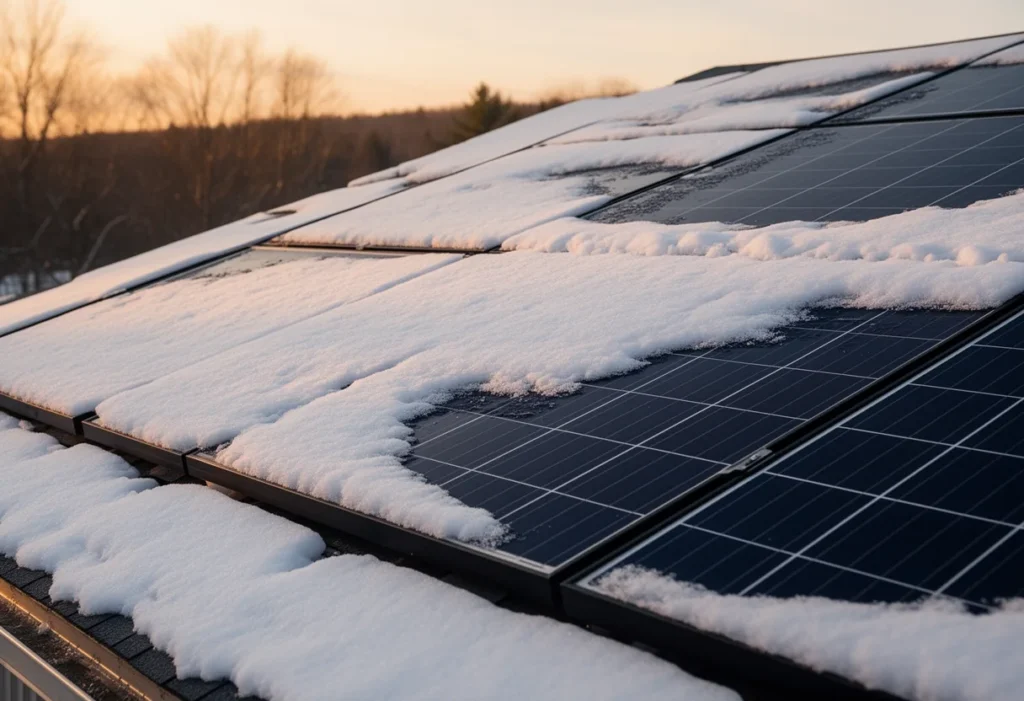
Understanding which is which matters because they fail differently. And in New York, where a rooftop array goes through freeze-thaw cycling, snow loading and hail every year, new york solar maintenance is not a theoretical concern. The climate tests the installation more than the panels.
Four warranties, not one
The coverages that apply to a typical residential system in New York break down as follows.
The panel product warranty covers manufacturing defects in the module itself — delamination, junction box failure, frame defects. It is backed by the panel manufacturer and follows the hardware regardless of who installed it.
The panel performance warranty is separate and covers output. Panels degrade slowly by design, and the performance warranty commits the manufacturer to a curve: output should remain above a stated percentage of nameplate at stated years. Falling below that curve is the breach.
The inverter warranty covers the electronics that convert DC to AC. It is generally shorter than the panel warranty and varies considerably by inverter type.
The workmanship warranty covers the installation — mounting, roof penetrations, flashing, wiring, conduit and labour. It is the installer’s own obligation, not a manufacturer’s, and it is the one that depends on the installing company still existing.
Write down four terms per quote
Panel product, panel performance, inverter, workmanship. Four numbers, per proposal. Most of what looks like a warranty difference between two quotes turns out to be one of these four, and it is usually the workmanship term.
The workmanship warranty is where New York quotes actually differ
Panel and inverter warranties are set by manufacturers and vary within a fairly narrow range across the equipment a New York homeowner is likely to be offered. The workmanship warranty is set by the installer, and it varies enormously.
It also covers the failures most likely to occur. A panel that fails outright is uncommon. A roof penetration that leaks because flashing was installed badly is a considerably more common outcome, and it is not covered by any manufacturer.
Things to establish. What is the term? Does it explicitly cover roof leaks caused by the installation, and does it cover the resulting interior damage or only the roof repair? Does it cover labour to remove and reinstall a panel under a manufacturer warranty claim — because a free replacement panel still costs money to swap? And is it backed by anything beyond the company’s own balance sheet?
That last question matters because residential solar has real business turnover. A twenty-five-year workmanship warranty from a company that stops trading in year six is worth what the company is worth. Some installers offer third-party-backed workmanship coverage; ask whether that applies. The broader vetting framework is in how to vet a solar installer in New York.
| Coverage | Backed by | Typical failure it addresses | Survives if the installer closes? |
|---|---|---|---|
| Panel product | Panel manufacturer | Delamination, junction box or frame defect | Yes — follows the hardware |
| Panel performance | Panel manufacturer | Output below the guaranteed degradation curve | Yes — follows the hardware |
| Inverter | Inverter manufacturer | Electronic failure, conversion fault | Yes, though labour to swap may not be |
| Workmanship | The installing company | Roof leaks, mounting, wiring, flashing, labour | Only if third-party backed |
| Roof membrane or shingle warranty | Roofing manufacturer | Roof failure — can be voided by improper attachment | Yes, if the attachment method preserved it |
| Monitoring service | Installer or platform provider | Loss of production visibility | Often not — frequently a subscription |
What New York weather actually does to a system
Solar hardware sold in the United States is generally certified against snow and wind loads, and panels handle cold well — cell efficiency is slightly better at low temperatures. The New York climate issue is not whether panels survive winter. It is what repeated cycling does to everything holding them in place.
Freeze-thaw cycling works on sealants and flashing. Water that enters a small gap, freezes and expands makes the gap larger, then does it again the following week. Upstate and in the city both, that cycle runs dozens of times a season. It is the mechanism behind most installation-related roof leaks, and it is why the quality of the flashing detail matters more here than in a mild climate.
Snow loading is the other consideration. Panels are certified for a snow load, but the racking, the attachment points and the roof structure beneath all carry it too. On a flat roof, snow does not slide off the way it does from a tilted array — which affects both loading and winter production.
Ice dams form at roof edges when heat escaping the building melts snow that refreezes lower down. An array does not cause ice dams, but it changes how snow sits and melts on a roof, and an installation that ignores existing ice dam patterns can make them worse.
Do not clear snow off panels
Snow generally slides or melts off a tilted array without help. Climbing onto an icy roof or reaching up with a tool risks scratching the glass, damaging the anti-reflective coating, voiding coverage — and, more seriously, a fall. The production lost during a snow-covered stretch is small relative to the annual total. If snow cover persists unusually long, ask the installer rather than improvising.
Maintenance in practice is mostly monitoring
A residential solar array has no moving parts and needs very little routine attention. What it needs is someone noticing when output drops.
Rain handles most cleaning in the New York climate. Panels under a tree that drops sap or near a source of soot may need occasional washing, but scheduled cleaning is rarely worth paying for on a residential array here.
Monitoring is the real maintenance task. Nearly every modern system reports production, and the value is in comparing what it produces to what it should produce. A string inverter failure can take an entire array offline, and without monitoring that can go unnoticed for a long time — usually until a utility bill arrives that is much larger than expected.
Check whether monitoring is included permanently or as a subscription, whether it is panel-level or system-level, and what happens to it if the installer stops trading. Panel-level monitoring identifies which module is underperforming; system-level tells you only that something is wrong.
Beyond that: a periodic visual check for lifted flashing or damaged conduit, attention after severe hail or wind, and keeping tree growth in check. Trees planted when a system was designed are taller a decade later, and shade that was not there at commissioning reduces output permanently.
Set one annual production check
Once a year, compare the last twelve months of actual production against the estimate in the original proposal, adjusted for expected degradation. A single number, checked annually, catches the failures that otherwise go unnoticed for years. Keep the proposal and the commissioning documents somewhere you will find them.
The roof under the array
The most consequential maintenance question is not about the solar system at all. It is the age of the roof it sits on.
An array is designed to last decades. If the roof beneath it has ten years left, the panels will need removing and reinstalling partway through, at the homeowner’s cost unless the contract says otherwise.
Before installation, get the roof’s remaining life assessed and decide whether to replace it first. It costs more up front and is almost always cheaper than removing and resetting an array later.
Also establish whether the attachment method preserves the existing roof warranty. Roofing manufacturers have requirements about penetrations, and an installation that ignores them can void coverage on the roof while leaving the solar warranty intact — the worst combination.
And check the contract for who pays for removal and reinstallation when the roof is eventually replaced, and whether the workmanship warranty survives if another company does the removal. Contracts are frequently silent, which in practice means the homeowner pays. This and related gaps are covered in solar contract red flags in New York.
Who holds the coverage under a lease or PPA
Under third-party ownership, maintenance responsibility usually sits with the owner rather than the resident, which is one of the genuine advantages of those arrangements.
But the terms need reading. What response time is committed when something fails? Is there a production guarantee with an actual remedy, or only a statement of expected output? Who is responsible if the roof needs replacing during the term — and does the provider charge for removal and reinstallation?
The ownership question also affects what happens at sale, since the agreement has to transfer to the buyer. Lease versus buy in New York covers the comparison.
Worth noting on the tax side, since it now bears on the buy-versus-lease decision: the 30% federal residential clean energy credit under section 25D of the Internal Revenue Code was terminated for expenditures made after 31 December 2025 by the One Big Beautiful Bill Act, signed 4 July 2025. An expenditure counts as made when the original installation is completed, so a system finished in December 2025 but switched on in January 2026 still falls under the old rules. A homeowner who buys a system whose installation is completed in 2026 claims no federal credit on their own return. Systems whose installation was completed in 2025 fell under the old rules, and unused credit from that year can generally be carried forward. A separate business-side federal credit still applies to a company that owns a leased or PPA system, which the homeowner never claims but which is priced into some offers.
As of September 2026 NYSERDA has no open NY-Sun block for homes in any utility territory; check NYSERDA’s NY-Sun dashboard for a new one. The main incentive directly available to a New York buyer now is the state credit for solar energy system equipment — a percentage of system cost up to a statutory cap, claimed on Form IT-255. Details are in our overview of the state credit.
Frequently asked questions
Do solar panels need cleaning in New York?
Rarely on a routine schedule. Rain and snowmelt handle most soiling in this climate, and the production gain from cleaning a residential array is usually small relative to the cost and the risk of roof access. Panels under trees that drop sap, or near a persistent soot source, are the exception worth asking an installer about.
Should I clear snow off my panels in winter?
Generally no. Snow slides or melts off a tilted array on its own, and clearing it risks scratching the glass, damaging coatings, voiding warranty coverage and falling from an icy roof. The production lost during snow cover is a small share of the annual total, since winter output is low regardless.
What is the difference between a panel warranty and a workmanship warranty?
The panel warranties are backed by the manufacturer and cover defects in the module and output falling below a guaranteed degradation curve. The workmanship warranty is the installer’s own obligation and covers the installation — mounting, roof penetrations, flashing and wiring. Manufacturer warranties follow the hardware if the installer closes; a workmanship warranty generally does not unless it is third-party backed.
What happens to the warranty when the roof needs replacing?
It depends on the contract, and many contracts do not address it. Removing and reinstalling the array is usually the homeowner’s cost, and if a different company performs the removal, the original workmanship warranty may not survive it. Ask for both points in writing before signing, and assess the roof’s remaining life before installation rather than after.
Verify current programme figures
Warranty terms are set by manufacturers and installers and vary by product, so read the actual documents for your equipment rather than relying on typical ranges. For incentives, confirm NY-Sun rates and block status with NYSERDA and state credit rules with the New York State Department of Taxation and Finance. This site is independent and is not affiliated with NYSERDA or any government agency.
NY Solar Incentives
Independent New York solar research. We summarise NYSERDA, NY-Sun and federal programme rules from published sources and state plainly when a figure is an estimate. We are not a government agency and do not sell equipment.
Run the arithmetic on your own system
Check the dated program table and your arrangement before counting an incentive. Standard residential NY-Sun blocks are closed; Long Island Affordable Solar has a conditional income-verification route. The NY credit depends on qualified costs and tax liability, while the NYC abatement reduces future property-tax bills. The estimator keeps those timings separate.