“Free Solar Panels” in New York: What That Really Means
Nobody is giving away solar panels in New York. Here are the four real offers behind the advertising, the monthly charge none of them mention, and the income-eligible programmes that are real.
On this page 13 sections
- 01Nobody is giving away free solar panels in New York
- 02The NYC wrinkle: most homes here can’t take a rooftop offer at all
- 03Offer one: the lease
- 04Offer two: the power purchase agreement
- 05Offer three: zero-down financing
- 06Offer four: community solar, which really does cost nothing upfront
- 07The four structures compared
- 08Why the tax change now favours these offers
- 09“Eleven states qualify for a free solar program” — what that advert actually is
- 10The cost the “free” offers do not mention
- 11The closest thing to genuinely subsidised solar in New York
- 12What actually goes wrong
- 13Frequently Asked Questions
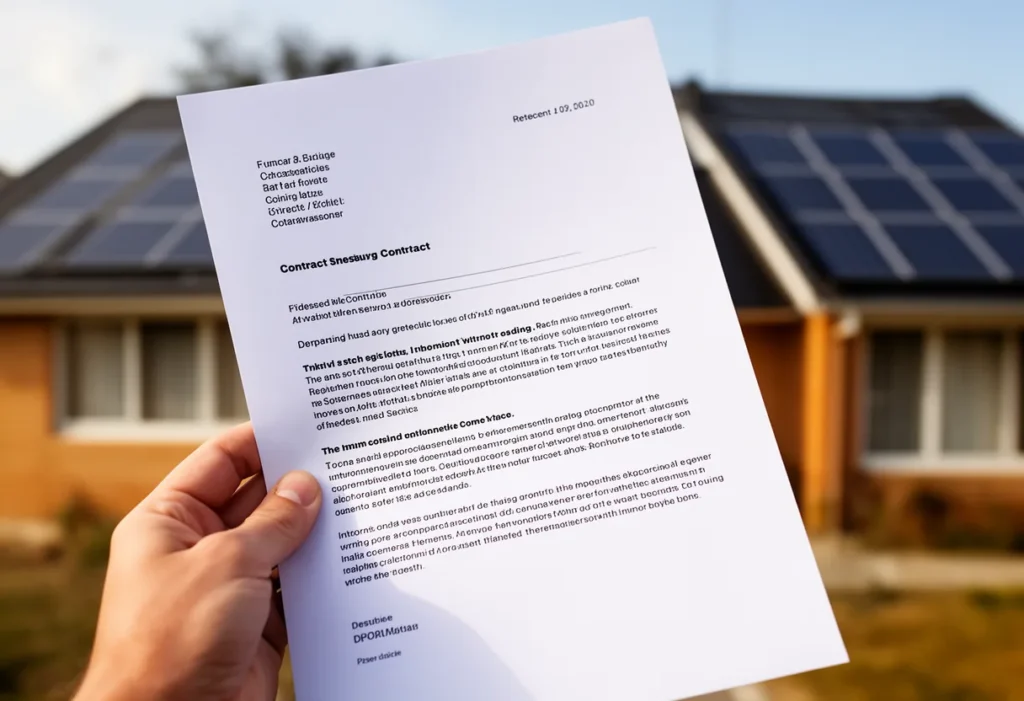
“Free solar panels” is one of the most heavily advertised phrases in New York City — mailers, robocalls and door hangers from Staten Island to the Bronx — and no program in the state actually gives panels away to a homeowner.
What the phrase covers is four quite different commercial arrangements, plus one wrinkle that matters specifically in New York City: most of these offers assume you personally own a roof, and a large share of New Yorkers do not. Each arrangement has a defensible use case and none of the four is free. The variable that matters most is who owns the equipment once it is on a roof — and whether you have a roof of your own to put it on at all.
- Lease — a company owns the panels, you pay a fixed monthly fee, and you need a roof you control.
- Power purchase agreement (PPA) — a company owns the panels, you pay per kilowatt-hour produced, and you need a roof you control.
- Zero-down loan — you own the panels from day one and repay a loan with interest; you still need a roof you control.
- Community solar, including Solar for All — no equipment on your property, no roof needed, and the only one of the four that is genuinely free to join.
Nobody is giving away free solar panels in New York
The state’s residential support ran through the NY-Sun incentive, paid per watt to a participating contractor, but as of September 2026 NYSERDA has no open NY-Sun block for homes in any utility territory; check NYSERDA’s NY-Sun dashboard for a new one. The main support that remains is a state tax credit claimed on your own return: 25% of qualified cost, up to $5,000, alongside the sales-tax exemption and the RPTL 487 property-tax exemption where they apply. The RPTL 487 exemption is not automatic: file form RP-487 with your assessor by the taxable status date (March 1 in most towns; January 2 in Nassau towns; May 1 or June 1 in Westchester towns; set by charter in cities; usually January 1 in villages), and the system must be built before January 1, 2030 (RP-487 instructions). It reduces the cost of a system. It does not cover it.
The only arrangement that genuinely costs a household nothing is a community solar subscription, and that installs nothing at your property. Everything else involves either paying for equipment or paying someone else for the electricity it produces.
So when an advertisement promises no cost, the correct next question is not whether it is true but which of the four structures above it describes.
The NYC wrinkle: most homes here can’t take a rooftop offer at all
A lease, a power purchase agreement and a zero-down loan are all rooftop products. They require a roof you control, and in a city where most residents live in co-ops, condos and rentals, that is exactly what a lot of readers searching “free solar panels nyc” do not have. A shareholder in a co-op needs board approval before anyone touches the roof; a renter cannot authorize work on a building they do not own at all. Solar for NYC apartments and co-ops covers what is actually possible in that situation, and it usually is not a rooftop system.
That gap is exactly why community solar and Solar for All ads over-index in city marketing. They are the one structure that can honestly claim no equipment and no cost, because nothing is installed at your address at all — which also makes them the offer most worth checking first if you live in a multifamily building. Statewide Solar for All is the low-income version: households enrolled in their utility’s Energy Assistance Program (EAP) get a monthly community-solar credit on their electric bill, with no upfront cost or fees, and enrolment in EAP enrolls them automatically. A standard subscription’s discount is set project by project, so treat any percentage you see quoted as a starting point to confirm, not a guarantee. NYSERDA’s Solar for All program covers the income-eligible version specifically.
Homeowners with their own roof face a separate NYC-specific step the rest of the state generally does not: a flat or shared roof, or a building in a historic district, can add a permitting or design-review stage before installation. Solar on flat roofs in New York City covers what that adds to the timeline. None of it changes which of the four financial structures below applies — it only changes how long it takes to get to a signed system.
Offer one: the lease
A leasing company installs and owns the system. You pay a monthly amount to use it, typically for a long term measured in decades, and the electricity it produces offsets your utility consumption.
The value proposition is that the lease payment plus your reduced utility bill comes to less than your old bill. Whether that holds depends on the payment, any annual escalation clause, and how your production compares with the estimate.
You do not own the equipment, so you cannot claim ownership-based benefits on it in the ordinary way, and the system is a contractual encumbrance when you sell. Lease against purchase in New York works through the comparison.
Offer two: the power purchase agreement
A PPA looks similar from the driveway and is different on paper. The provider owns the system and you buy the electricity it generates, at a stated rate per kilowatt-hour, rather than renting the hardware.
If the system underproduces you buy less electricity from the provider and more from the utility. If it overproduces you buy more from the provider. The risk profile is genuinely different from a lease and the rate escalator is the clause to read most carefully.
Both leases and PPAs are legitimate structures with real customers who are satisfied with them. Neither is a grant, and neither should be described as free. The PPA page covers how the rate and escalator interact.
The escalator is the number to find. Most long-term lease and PPA agreements include an annual increase in the payment or the per-kilowatt-hour rate. A modest-sounding annual percentage compounds substantially over a twenty-year term. Ask for the payment schedule for every year of the agreement, in writing, rather than the first-year figure alone.
Offer three: zero-down financing
The third structure is a purchase paid for with a loan requiring no deposit. You own the system from day one and you owe the full cost plus interest.
This is often the best economic outcome of the three, because ownership means the savings accrue to you after the loan is repaid. It is also the one most often mis-sold as free, because the customer pays nothing at signing.
Two things deserve scrutiny. The first is dealer fees, which are sometimes built into the system price rather than disclosed as a finance cost. The second is whether the monthly payment quoted assumes a lump-sum prepayment funded by a tax credit you may not receive in full. Solar loans in New York explains what to compare.
Offer four: community solar, which really does cost nothing upfront
The fourth is the only one where nothing is installed and nothing is owed. You subscribe to a share of an off-site project and receive credits against your utility bill, typically paying the provider less than the credits are worth.
There is no equipment on your property, no roof risk, no board approval and generally a defined notice period for cancellation. For renters, co-op and condo owners, and anyone with a shaded or ageing roof — a large share of the city — it is usually the only realistic option, and it is the one case where “free” is not a stretch. The community solar guide covers what to check in a subscription agreement.
It also produces the smallest savings of the four for a standard subscription, because you are buying a discount rather than displacing your own consumption. Statewide Solar for All removes the cost for enrolled low-income households, but it is still a bill credit rather than a bill elimination.
Before assuming you don’t qualify or nothing is available near you, three things are worth five minutes each:
- Have your utility account number ready — most sign-up and eligibility checks ask for it.
- Check with your utility (Con Edison, PSEG Long Island, National Grid, NYSEG, RG&E or Central Hudson) or NYSERDA directly for community solar projects currently enrolling subscribers in your territory, since availability changes as projects fill.
- If your household income is low, ask your utility about its Energy Assistance Program (EAP): enrolment in EAP is what brings the Statewide Solar for All credit, automatically and at no cost.
The four structures compared
| Structure | Who owns the system | Paid upfront | Needs a roof you control | At sale of the house |
|---|---|---|---|---|
| Lease | The leasing company | Usually nothing | Yes | Buyer assumes the lease or it is bought out |
| Power purchase agreement | The provider | Usually nothing | Yes | Buyer assumes the agreement or it is bought out |
| Zero-down loan | You | Nothing at signing, repaid with interest | Yes | Loan repaid or transferred; system conveys with the house |
| Community solar / Solar for All | The project owner | Nothing | No | Cancel or transfer the subscription |
Why the tax change now favours these offers
Until recently, buying was strongly favoured by the federal tax code because the homeowner could claim a 30% residential credit under section 25D. That credit terminated on 31 December 2025 following the One Big Beautiful Bill Act signed on 4 July 2025.
A household buying a system whose installation is completed in 2026 or later gets nothing on its federal return. Systems whose installation was completed in 2025 were covered by the previous rules and unused credit from those can generally be carried forward.
A separate business-side credit still applies to the company that owns a leased or PPA system. That is the honest explanation for why third-party offers still reference a federal incentive: the incentive exists, it belongs to the provider, and in strict tax terms it now tilts the comparison towards arrangements the homeowner does not own. New York’s own state credit remains available and, notably, can apply to qualifying long-term lease and PPA agreements as well as purchases, subject to the Form IT-255 rules.
Three documents to ask for before signing anything. The full agreement including all schedules, not a summary. The production estimate with its assumptions about shading and orientation. And the transfer provisions that apply if you sell the property, or if you sell shares in a co-op. If any of the three is unavailable before signing, that is the answer.
“Eleven states qualify for a free solar program” — what that advert actually is
If you have searched for free solar panels you have probably met a version of this: an advertisement announcing that a specific number of states — eleven, twelve, seventeen, the number changes — have been approved for a free solar programme, and asking whether yours is one of them.
There is no such programme. No federal or state authority has designated a list of states whose residents receive solar panels at no cost. The number is a hook, and the “check if your state qualifies” button is a lead form: your details are sold on to installers, and what you are eventually offered is one of the four structures described above.
Two tells are worth recognising, because they appear in almost every version:
- A programme with no name. Real New York programmes are named and documented — NY-Sun, Affordable Solar, Form IT-255, RPTL 487. An advert that says “the programme” without naming it is not describing one.
- A deadline that never quite arrives. NY-Sun incentives did step down as capacity blocks filled, and the residential blocks have now closed — but that is a published schedule on NYSERDA’s dashboard, not a countdown clock on a landing page.
A genuinely useful thing to know: since 31 December 2025 the 30% federal residential credit no longer exists for homeowners who buy. Any advert still built around it is, at best, out of date.
The cost the “free” offers do not mention
Every rooftop system in New York interconnected on or after 1 January 2022 carries a monthly Customer Benefit Contribution, charged on the DC size of the system rather than on what it produces. It funds low-income, energy-efficiency and clean-energy programmes that a solar household would otherwise stop contributing to.
For 2026 the residential rates are $1.29 per kW-month on Con Edison, $1.13 on PSEG Long Island, $0.97 on National Grid, $1.19 on NYSEG, $1.31 on RG&E, $1.67 on Central Hudson and $1.00 on Orange & Rockland. On an 8 kW system that is roughly $93 to $160 a year depending only on which utility serves the roof.
It is not a large sum. It is, however, a recurring charge that appears on your bill after a “no cost” installation, it is recalculated every year rather than fixed, and it is almost never in the sales conversation.
Community solar subscribers do not pay it at all, because a community solar array is in front of the meter rather than behind yours. That is a genuine, rarely-mentioned point in favour of the one option on this page that really does cost nothing upfront.
The closest thing to genuinely subsidised solar in New York
If your household income is low relative to your area, there are real programmes, and there have been more: Affordable Solar is now closed outside Long Island. They are the ones the “free solar” adverts are least likely to tell you about.
- Affordable Solar. NY-Sun’s higher per-watt rate for lower-income households ($0.80 per watt), paid through your contractor. It is closed in Con Edison territory and upstate: the Con Edison track ran from 05/30/2025 to 10/15/2025 and the upstate one from 12/18/2025 to 03/09/2026. On Long Island, NYSERDA’s April 2026 NY-Sun Program Manual still lists it at $0.40 per watt, not tied to a block and paid to a participating NY-Sun contractor, who must pass it on in your contract; ask the contractor to confirm funding is still available.
- Income-eligible community solar. Statewide Solar for All gives households enrolled in their utility’s Energy Assistance Program (EAP) a monthly community-solar credit on their electric bill, with no upfront cost or fees; enrolment in EAP enrolls you automatically.
- Energy affordability and efficiency programmes. Not solar, but frequently worth more per dollar than solar for a household with an inefficient building envelope — and they are means-tested rather than advertised.
None of these makes a system free. All of them are, or were, real, named and checkable, which is more than the adverts offer.
What actually goes wrong
The complaints that recur are not usually about the technology. They are about mismatched expectations at the point of sale.
Production estimates that assumed an unshaded roof, which is harder to guarantee between city buildings. Escalators that made year fifteen uncomfortable. Roofs that needed replacing three years after panels went on them, with removal and reinstallation costs nobody had discussed. Board approvals that took months longer than the salesperson implied. And sales of houses, or co-op shares, where the buyer’s lender balked at assuming an agreement.
None of these are exotic. All of them are visible in the documents, or askable of the board, beforehand. The red flags checklist covers the specific clauses to find.
Verify the current figures. Incentive rates, tax rules and program terms change, and contract terms vary between providers. Confirm incentive details with NYSERDA, confirm state tax questions with the New York State Department of Taxation and Finance or a qualified preparer, and read the specific agreement — or ask your co-op board — rather than relying on any general description.
Frequently Asked Questions
Is there any way to get solar panels in New York City for free?
Not panels on your own roof, no. Every no-upfront-cost rooftop offer is a lease, a power purchase agreement or a loan, and all three carry long-term payment obligations. The only genuinely free option is a community solar subscription, and for income-eligible households, Solar for All — both of which deliver bill credits without installing anything at your property, which is also why they are the option most renters and co-op owners actually end up using.
What is Solar for All and how is it different from regular community solar?
Statewide Solar for All is the low-income version of community solar. Households enrolled in their utility's Energy Assistance Program (EAP) get a monthly community-solar credit on their electric bill, with no upfront cost or fees, and enrolment in EAP enrolls them automatically. Standard community solar is a subscription you sign up for yourself, and its discount is set project by project, so confirm the figure for the specific project you're offered rather than assuming a standard rate.
I live in a co-op or condo. Can I even get a rooftop lease or PPA?
Only with board approval, since the roof is common property, not something one shareholder controls. That approval process is separate from and in addition to whichever of the four financial structures you choose, and it is worth confirming with your board before you sign anything with an installer. A community solar subscription needs none of this, since nothing is installed on the building.
Why do companies still advertise a federal tax credit?
Because a business-side credit still applies to the company that owns a leased or PPA system, even though the residential credit under section 25D ended on 31 December 2025. The incentive is real but it belongs to the provider, not to the household. If a company tells you that you will personally claim 30% back on a purchase whose installation is completed in 2026 or later, that is incorrect.
What happens to a lease or PPA when I sell the house or my co-op shares?
The agreement has to be dealt with at closing, usually by the buyer assuming it or by the seller buying out the contract. Buyers and their lenders sometimes resist assumption, which can complicate or delay a sale. Read the transfer and buyout provisions before signing, because they set what your options will be years later.
Is a zero-down loan better than a lease?
Often, because ownership means the savings belong to you once the loan is repaid, and New York's state tax credit may be available to you. It depends on the interest rate, any fees folded into the system price, and whether you have state tax liability to use. Compare the total repaid over the loan term against the total paid over a lease term rather than comparing monthly payments.
This article is general information, not tax, legal or financial advice. Incentive amounts, eligibility rules and deadlines change and depend on your utility, your tax situation and your property. Confirm current terms with NYSERDA, your utility and a qualified tax professional before making a decision.
This article is general information, not tax, legal or financial advice. Incentive amounts, eligibility rules and deadlines change and depend on your utility, your tax situation and your property. Confirm current terms with NYSERDA, your utility and a qualified tax professional before making a decision.
NY Solar Incentives
Independent New York solar research. We summarise NYSERDA, NY-Sun and federal programme rules from published sources and state plainly when a figure is an estimate. We are not a government agency and do not sell equipment.
Run the arithmetic on your own system
Check the dated program table and your arrangement before counting an incentive. Standard residential NY-Sun blocks are closed; Long Island Affordable Solar has a conditional income-verification route. The NY credit depends on qualified costs and tax liability, while the NYC abatement reduces future property-tax bills. The estimator keeps those timings separate.