Solar Incentives for Seniors in New York: What Applies
There is no senior solar programme in New York. The incentives are the same ones everyone gets, but three of them behave very differently on a retirement income.
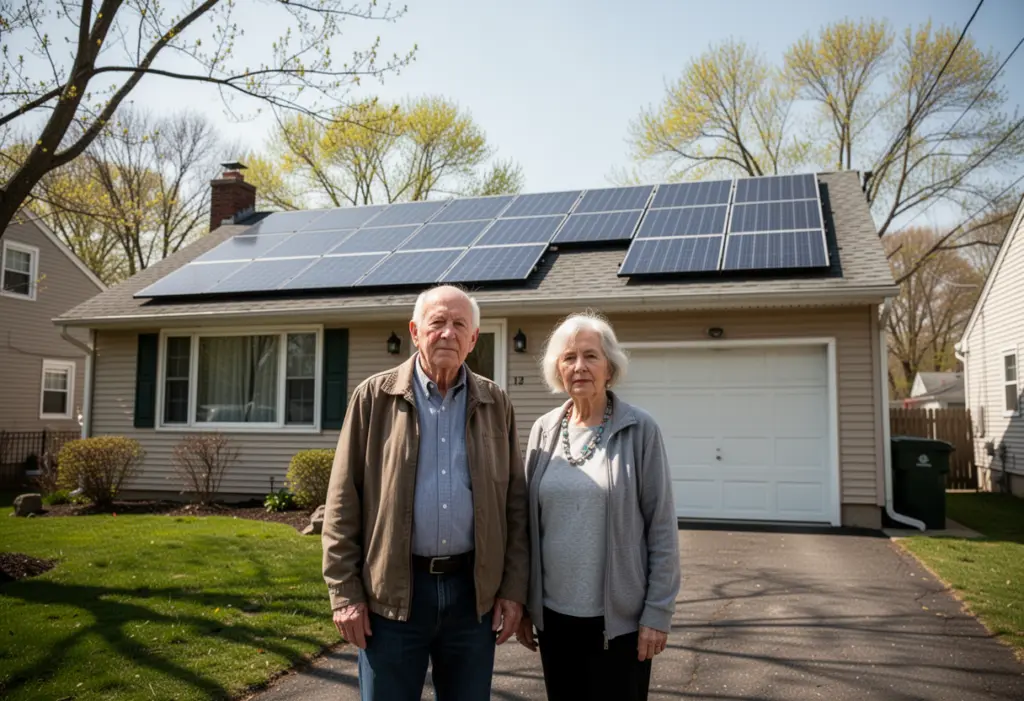
There is no age-based solar incentive in New York. No senior rebate, no retiree discount, no programme that pays more because of a birth date. Anyone presenting one is describing something else. What is true, and more useful, is that the ordinary incentives behave very differently on a retirement income — and one of them can be worth nothing at all.
The state credit is limited by tax you actually owe
New York’s solar energy system equipment credit is 25% of qualified expenditure capped at $5,000, claimed on Form IT-255 for equipment installed and used at your principal residence. It is not refundable. It reduces New York State tax you owe, and if you owe little it delivers little. Unused credit carries forward for up to five years, but a carryforward is only worth something against liability you will actually have.
This is where retirement income matters. New York taxes retirement income differently from wages, and Social Security in particular is not taxed by the state. A household living mainly on Social Security and pension income can therefore have a New York liability far smaller than the $5,000 ceiling implies. Before you treat that figure as money, ask your preparer a specific question: what was my New York State tax liability last year, and what is it likely to be for the next five? If the honest answer is a few hundred dollars a year, the credit is worth a few hundred dollars a year, not $5,000.
That single arithmetic check changes which route makes sense. It is also the reason a lease or a power purchase agreement is worth pricing alongside a purchase — although note that the New York credit reaches a lease or PPA only where the agreement runs ten years or more, and that minimum applies to the lease as well as to the PPA.
Affordable Solar was about income, not age, and it is closed
NYSERDA’s Affordable Solar incentive increased the NY-Sun incentive for households under 80% of area median income, whatever their age. It is not available now: as of September 2026 NYSERDA has no open NY-Sun block for homes in any utility territory, and the Affordable Solar tracks closed with them (Con Edison’s in October 2025, the rest of the state’s in March 2026); check NYSERDA’s NY-Sun dashboard for a new one. If a track reopens, retirement frequently moves a household across that line for the first time, so a check that came back negative during working years is worth running again. It was applied by the contractor as a price reduction rather than claimed on a return, so you would have to raise it and ask to see the reduction on the contract.
The horizon question, asked honestly
Solar economics in New York rest on long instruments. Phase One net metering holds for 20 years from interconnection. RPTL 487’s property tax exemption runs 15 years. A panel warranty runs longer still. If the plan is to stay in the house indefinitely, those horizons are an advantage. If the plan is to move within five years, the real question is not what the array does to the electric bill but what it does to the sale:
- A purchased, paid-off array is the simplest thing to sell with. There is nothing for a buyer’s attorney to clear.
- A loan-financed array frequently carries a UCC filing against the equipment. It shows up in the title search and has to be paid off or assumed at closing.
- A lease or PPA has to be assigned to the buyer, and the finance company has to approve that buyer. Start that process when the house is listed, not when it is under contract.
Ask the same question about financing. The On-Bill Recovery Loan available through Energy Finance Solutions is repaid on the utility bill and the obligation travels with the meter; the Smart Energy Loan is a conventional instrument repaid by you. Which is preferable depends entirely on whether you may sell.
Do not oversize, and do not be rushed
The Customer Benefit Contribution is billed monthly on the DC size of the array regardless of what it produces, and it applies to systems interconnected on or after 1 January 2022. On NYSEG the 2026 residential rate is $1.19 per kW-month, so a 6 kW system pays $7.14 a month, about $86 a year. Build that same array at 9 kW to cover consumption you do not have and you pay $10.71 a month for capacity that banks credits you never draw down. Size to the load you actually have.
On property tax, RPTL 487 exempts the added value of the system for 15 years where the county, the municipality and the school district have each not opted out, and only where the system is constructed before 1 January 2030. It is a separate programme from any senior citizens exemption or enhanced STAR benefit already on your parcel. Ask your assessor how they sit together rather than assuming either one displaces the other.
The 2026 position, plainly
The 30% federal residential credit is gone — section 25D was terminated for expenditures made after 31 December 2025, with the expenditure treated as made when the original installation is completed. Any proposal still showing it is wrong. What remains for a New York homeowner is the state credit on IT-255, the state sales tax exemption, RPTL 487, and net metering at the full retail rate; NY-Sun, Affordable Solar included, has no open block for homes as of September 2026. Every one of these can change. Verify the current position with NYSERDA and the New York State Department of Taxation and Finance, and be wary of any pitch that arrives at the door with a deadline attached to it.
Frequently Asked Questions
Are there special solar incentives for seniors in New York?
No. New York has no age-based solar programme. Seniors use the same incentives as everyone else — the state credit on Form IT-255, the sales tax exemption and RPTL 487 — but a retirement income changes what several of them are worth.
Can I use the $5,000 New York credit on a small retirement income?
Only to the extent you owe New York State tax. The credit is non-refundable and carries forward five years, and New York does not tax Social Security, so ask your preparer what your actual state liability is before treating $5,000 as money.
Does retiring help me qualify for Affordable Solar?
Not in 2026. As of September 2026 NYSERDA has no open NY-Sun block for homes in any utility territory, Affordable Solar included. The adder was based on household income under 80% of area median income rather than age, so if a track reopens, retirement can move a household under that line.
What if I sell the house in a few years?
A paid-off purchased array is the simplest to sell with. A loan may carry a UCC filing that a title search finds, a lease or PPA must be assigned with the finance company's approval, and an On-Bill Recovery Loan is repaid on the utility bill and travels with the meter.
This article is general information, not tax, legal or financial advice. Incentive amounts, eligibility rules and deadlines change and depend on your utility, your tax situation and your property. Confirm current terms with NYSERDA, your utility and a qualified tax professional before making a decision.
NY Solar Incentives
Independent New York solar research. We summarise NYSERDA, NY-Sun and federal programme rules from published sources and state plainly when a figure is an estimate. We are not a government agency and do not sell equipment.
Run the arithmetic on your own system
Check the dated program table and your arrangement before counting an incentive. Standard residential NY-Sun blocks are closed; Long Island Affordable Solar has a conditional income-verification route. The NY credit depends on qualified costs and tax liability, while the NYC abatement reduces future property-tax bills. The estimator keeps those timings separate.