Power Purchase Agreements for New York Homeowners
A power purchase agreement sells electricity, not equipment. What the rate, the escalator and the assignment clause commit a New York household to over twenty years.
On this page 8 sections
- 01The contract rate, not the panel count, is the product
- 02Escalators compound quietly
- 03Production estimates are not guarantees unless the contract says so
- 04How a PPA differs from Solar for All New York and community solar
- 05Who claims the incentives under a PPA
- 06The end of the term is a decision point, not an ending
- 07Selling the house means assigning the contract
- 08Frequently asked questions
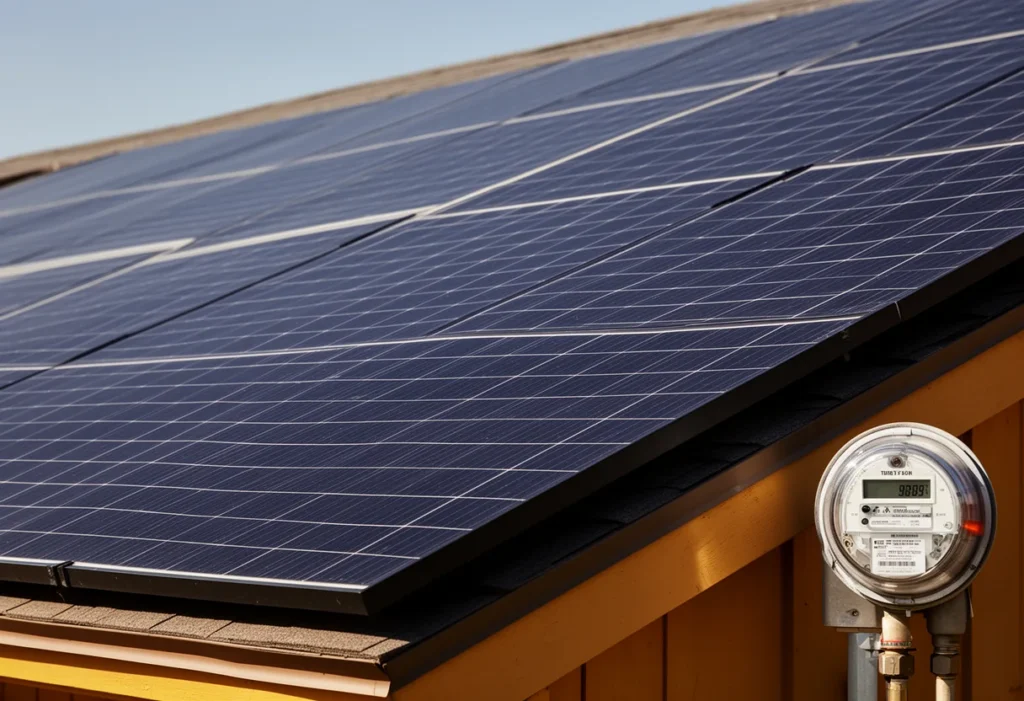
A power purchase agreement is not a way of buying solar panels. It is a contract to buy electricity, at an agreed price per kilowatt-hour, generated by equipment that someone else owns and keeps on your roof.
That distinction decides nearly everything downstream: who claims incentives, who replaces a failed inverter, what happens in year twenty, and what a buyer’s attorney will ask for when the house sells. It also separates a PPA from a subscription arrangement such as Solar for All New York, where nothing is installed at your address at all.
The contract rate, not the panel count, is the product
Under a PPA the household pays for metered production from the system. If the array produces nothing in a given month, the PPA bill for that month is nothing, and the utility supplies the house as usual.
The whole economic question is therefore whether the contract rate per kilowatt-hour stays below what the utility would have charged for the same energy, across the entire term. Nobody knows that at signing. Anyone presenting it as settled is presenting a forecast as a fact.
New York complicates the comparison slightly, because the utility bill separates supply from delivery and a solar kilowatt-hour does not offset every line on it. The mechanics of that are set out in how net metering credits work in New York, and they are worth understanding before judging any quoted rate.
Escalators compound quietly
Most PPAs include an annual escalator: a fixed percentage by which the contract rate rises each year. A figure that reads as trivial in year one is a substantially different rate by year fifteen.
Some providers offer a flat-rate version at a higher opening price. That structure is easier to assess honestly, because only one number has to be judged rather than a starting point and a growth rate together.
The useful request is not the percentage. It is the full schedule of rates for every year of the term, in cents per kilowatt-hour, printed in the contract.
Ask what utility rate increase the proposal assumes
Savings projections in PPA proposals rest on an assumed annual rise in the utility’s rate. That assumption is an input chosen by whoever built the model, and a higher one makes any escalator look better. Ask for the assumed figure in writing, then ask to see the same projection rerun with a lower one.
Production estimates are not guarantees unless the contract says so
Every proposal contains a modelled annual production figure. Whether that figure carries any contractual weight depends on the presence of a production guarantee and on what the guarantee actually promises.
A guarantee that credits the customer for a shortfall against a modelled baseline is a financial remedy. It is not an obligation to diagnose or repair the underlying cause quickly, and the two are often confused.
Read the maintenance clause separately from the guarantee clause. Ask who is responsible for shading that develops from tree growth, for roof work that requires temporary removal, and for the cost of that removal and reinstallation.
How a PPA differs from Solar for All New York and community solar
NYSERDA’s Solar for All New York provides income-eligible households with a credit on their electricity bill by assigning them a share of a community solar project, at no cost to the participant, with no equipment installed at their home. Eligibility is determined by income or by participation in specified assistance programmes, and it is administered through NYSERDA rather than by a salesperson at the door.
That is a fundamentally different arrangement from a PPA. There is no contract term to assign at sale, no hardware on the roof, and no obligation attaching to the property. Details of eligibility and how the credit appears on a bill are on our page covering NYSERDA’s Solar for All programme.
Ordinary paid community solar sits between the two: a subscription to a share of an off-site array, typically with a discount against the credit value received and usually with shorter notice periods for cancellation. Our guide to community solar in New York covers how those subscriptions are priced. For renters, apartment dwellers and anyone with a shaded or structurally unsuitable roof, these routes are the only ones available, which is a reason they are frequently the right answer rather than a consolation.
| Feature | Power purchase agreement | Lease | Community solar subscription |
|---|---|---|---|
| What you pay for | Metered kilowatt-hours produced | Use of the equipment, at a fixed monthly rate | A share of an off-site project’s output |
| Equipment at your address | Yes, owned by the provider | Yes, owned by the provider | None |
| Who maintains it | The provider | The provider | The project operator |
| How the price changes | Usually a fixed annual escalator | Usually a fixed annual escalator | Normally a set discount against credit value |
| When you move | Contract assigned, prepaid or bought out | Contract assigned, prepaid or bought out | Cancel or transfer, typically on short notice |
Who claims the incentives under a PPA
The federal residential clean energy credit under section 25D was terminated by the One Big Beautiful Bill Act, signed 4 July 2025, for expenditures made after 31 December 2025. An expenditure counts as made when the original installation is completed, so a system finished in December 2025 but switched on in January 2026 still falls under the old rules. It was never available to a PPA customer in any case, because the customer never owned the equipment.
A separate business-side federal credit still applies to the company that owns the system, under its own rules and its own timetable. That is why third-party offers can price in a federal incentive that no homeowner ever claims. It is a real incentive; it reaches the household, if at all, only through the contract rate.
New York’s state credit is the more interesting case. The Solar Energy System Equipment Credit claimed on Form IT-255 can treat amounts paid under a qualifying written agreement of at least a minimum term as qualified expenditure, subject to the statutory cap. Whether a specific PPA qualifies depends on its terms, so it is a question for the IT-255 instructions and a tax preparer, not for the sales proposal. NY-Sun incentives, meanwhile, were paid through the installing contractor and reduced the provider’s cost, not your bill directly, and as of September 2026 NYSERDA has no open NY-Sun block for homes in any utility territory.
The end of the term is a decision point, not an ending
PPAs typically run for a long fixed term, after which the contract sets out the options: renew at a stated basis, purchase the system at a valuation defined in the document, or have it removed.
The purchase option is the clause worth reading closely at signing rather than in year twenty. A price defined as fair market value at the time is not a price you can plan around; a price defined by a stated formula or schedule is.
Removal terms matter as much. Ask whether removal is at the provider’s cost, and what standard the roof is restored to afterwards.
Read the assignment clause before the price
Find the section governing what happens if you sell the house, and read it first. It should state the buyer’s qualification requirements, the transfer fee if any, the prepayment calculation, and the removal cost if no transfer happens. If that section is vague, the price on the front page is not the risk you are taking.
Selling the house means assigning the contract
A PPA does not simply convey with the property. It is assigned to the buyer, who normally has to meet the provider’s credit criteria, and the process runs on the provider’s timetable rather than the closing schedule.
Where a buyer declines, the seller is left with prepayment or removal, both priced by the provider under the contract. Neither is usually a small figure mid-term.
This is manageable when it starts early. It becomes a problem when it surfaces during attorney review, which is why selling a New York home with solar panels is worth reading before listing rather than after an offer arrives.
One more contractual point deserves attention: the clauses covering roof access, insurance requirements and what happens if a re-roof is needed mid-term. Those provisions, alongside the ones covered in common red flags in New York solar contracts, generate more disputes than pricing does.
Frequently asked questions
Do I own the panels at the end of a PPA?
Not automatically. At the end of the term the contract normally offers a choice between renewing, purchasing the system at a price defined in the agreement, or having it removed. Which of those is attractive depends on how the purchase price is defined, so read that clause before signing rather than at the end of the term.
Can I claim any tax credit on a PPA in New York?
The federal residential credit ended for expenditures made after 31 December 2025 and was never available to PPA customers anyway. New York’s state credit is different: its rules can treat payments under a qualifying written agreement of at least a minimum term as qualified expenditure, up to the statutory cap. Whether your specific contract qualifies is a question for the Form IT-255 instructions and a tax preparer.
What happens if I sell my house during the PPA term?
The contract has to be assigned to the buyer, and the buyer generally has to meet the provider’s credit requirements before the provider will approve the transfer. If the buyer will not take it on, the remaining alternatives are prepaying the balance or paying for removal, both calculated under the contract. Start the process with the provider as soon as you decide to list, because it runs on their timetable.
Is a PPA the same as community solar?
No. A PPA installs equipment on your roof and sells you the power it produces under a long fixed term, whereas community solar is a subscription to a share of an off-site project with no hardware at your address and typically much shorter notice periods. NYSERDA’s Solar for All is a further variant that provides a community solar credit at no cost to income-eligible households. The obligations they create are not comparable.
Check current terms with the named administrator
Programme rules, eligibility thresholds and incentive levels change over time. Confirm Solar for All eligibility and NY-Sun incentive levels with NYSERDA, and confirm the state credit position for your specific agreement with the New York State Department of Taxation and Finance or a tax preparer. This site is independent and is not NYSERDA or any state agency.
NY Solar Incentives
Independent New York solar research. We summarise NYSERDA, NY-Sun and federal programme rules from published sources and state plainly when a figure is an estimate. We are not a government agency and do not sell equipment.
Run the arithmetic on your own system
Check the dated program table and your arrangement before counting an incentive. Standard residential NY-Sun blocks are closed; Long Island Affordable Solar has a conditional income-verification route. The NY credit depends on qualified costs and tax liability, while the NYC abatement reduces future property-tax bills. The estimator keeps those timings separate.