What Solar Costs in Brooklyn
Brooklyn's housing stock produces a distinctive set of solar costs. Row house roofs, narrow streets and Con Edison interconnection account for most of the difference.
On this page 7 sections
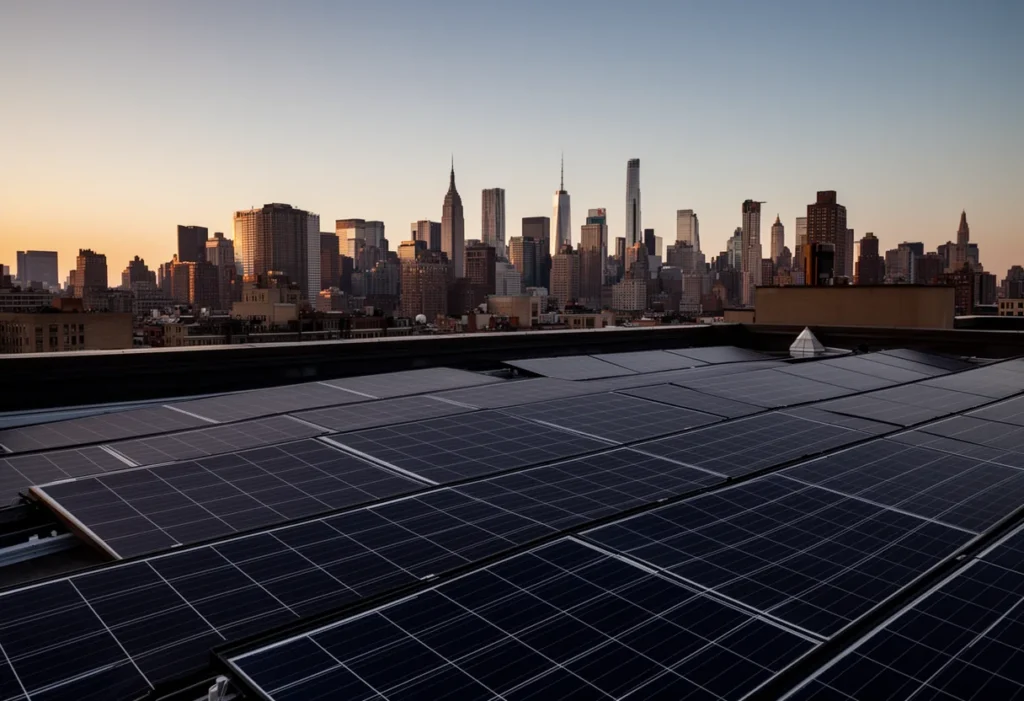
Brooklyn is not a single solar market. A detached house in Marine Park and a row house in Bushwick present entirely different problems to an installer, and the quotes reflect that.
What they share is a set of local conditions that push solar panel cost Brooklyn NY quotes above what the same system would cost in a suburb an hour north: flat roofs, constrained street access, city filing requirements and a single utility.
The roof decides most of the price
Much of Brooklyn’s housing stock has flat or low-slope roofs. These are fitted with ballasted or hybrid racking that tilts the modules to a working angle rather than lying flush against a pitch.
Ballast means weight, and weight means the roof structure has to be assessed as able to carry it. Where the framing will not, the options are penetrating attachments with proper flashing or structural reinforcement, and both add cost.
Tilted rows also shade one another if placed too close, so a flat roof holds less capacity than a pitched roof of the same footprint. Add the access paths and clearances required for fire safety and the usable area shrinks again. The same system size therefore needs more roof in Brooklyn than it does upstate, and on a small row house it may simply not fit. More on that is on the page about flat roof installations.
Street access is a genuine cost, not an excuse
On a suburban job the crew parks in the driveway and sets a ladder. On a Brooklyn block there may be no parking, no side access and no way to get material to a third-storey roof other than through the building or up an exterior stair.
Sidewalk protection may be needed. A permit to occupy the roadway may be needed. Every one of those adds crew hours that have nothing to do with electrical work, and on a modest array those hours are spread across few watts.
That is the mechanism behind the high price per watt on small city systems. It is worth asking an installer to state which access measures they have priced, because the answer varies from block to block.
Ask what the access assumption is
A quote built on driveway access to a two-storey roof will not survive contact with a narrow street and a fourth-floor walk-up. Confirm in writing how material will reach the roof and whether sidewalk protection, a lift or a street permit is included, before the price is fixed.
Filing in the city adds professional time
Outside the five boroughs, many municipalities use the New York State Unified Solar Permit for straightforward residential systems. Brooklyn does not fall under that framework.
Work is filed with the Department of Buildings, generally through a registered design professional whose drawings and time appear inside your quote. Ask which firm is filing and confirm their registration; an installer who is vague about this is a warning sign well before contract stage.
Where a property sits in a landmarked district, or is an individually designated landmark, additional review may apply to anything visible from the street. That does not necessarily prevent an installation, but it affects placement, timeline and design cost, and it needs to be established early rather than discovered late.
Con Edison interconnection sets the schedule
Brooklyn sits in Con Edison territory, so interconnection and the meter arrangement run through that utility’s process. The application cost is inside the installer’s price; the waiting is not, and it is often the longest step in the project.
This matters if a loan starts accruing before the system is permitted to export. Ask for the installer’s recent experience of Con Edison timelines in your area and treat any promise of a specific approval date with caution, since the schedule is not theirs to control.
Con Edison territory also has its own NY-Sun megawatt block sequence, separate from Upstate and Long Island. Its last residential block closed on 29 May 2025 and its Residential Affordable Solar block on 15 October 2025, so no NY-Sun incentive comes off a Brooklyn home’s contract at present. As of September 2026 NYSERDA has no open NY-Sun block for homes in any utility territory; check NYSERDA’s NY-Sun dashboard for a new one.
| Cost driver | Brooklyn row house | Staten Island detached house | Upstate detached house |
|---|---|---|---|
| Roof type | Usually flat, ballasted racking | Often pitched shingle | Usually pitched shingle |
| Structural review | Commonly required for ballast | Sometimes required | Rarely required |
| Site access | Narrow street, hoisting, possible permits | Driveway access typical | Driveway access typical |
| Permitting | DOB filing by a design professional | DOB filing by a design professional | Often the Unified Solar Permit |
| Utility | Con Edison | Con Edison | Varies by region |
| Local incentive | NYC property tax abatement applies | NYC property tax abatement applies | Not available |
What Brooklyn homeowners can actually claim
Two programmes are open to a Brooklyn homeowner now, and they arrive at different times.
NY-Sun is not one of them at present. It used to be paid per watt through a participating contractor at the Con Edison region’s block rate and deducted from the contract price, but as of September 2026 NYSERDA has no open NY-Sun block for homes in any utility territory.
New York’s state income tax credit is claimed afterwards on Form IT-255, calculated as a percentage of qualified expenditure up to a statutory cap, and usable only to the extent you have state tax liability, with the balance generally carried forward.
The NYC solar property tax abatement is filed with the Department of Buildings and applied against the property tax bill in four annual instalments. It is not cash, and it only benefits a property with a tax liability to reduce. Details are on the abatement page.
The federal residential credit is not on this list. Section 25D terminated for expenditures made after 31 December 2025, so a Brooklyn homeowner buying in 2026 receives no federal credit on their own return. An expenditure counts as made when the original installation is completed, so a system finished in December 2025 but switched on in January 2026 still falls under the old rules. A separate business credit can still apply to a company that owns a leased or PPA system, which is why some third-party offers still cite a federal incentive the customer never claims.
If your roof will not work, subscription is the alternative
Renters, co-op shareholders and anyone with a shaded or structurally unsuitable roof cannot install, which describes a large share of Brooklyn. Community solar in Brooklyn provides bill credits from an off-site array with no equipment, no roof work and no upfront cost.
Getting comparable quotes in a market this varied
Because Brooklyn conditions differ block by block, quotes diverge more here than almost anywhere else in the state. The way to make them comparable is to fix the variables yourself.
Ask each installer for system size in watts, the gross price, any NY-Sun deduction (there should be none while no residential block is open), the net price and the resulting price per watt, plus a written list of exclusions covering roof work, structural reinforcement, service panel upgrades and access equipment. Then check whether each is a NYSERDA participating contractor, which matters if NYSERDA opens a new residential NY-Sun block, since the incentive is only paid through one. The guide to choosing a Brooklyn installer covers what else to verify.
Frequently asked questions
Why does solar cost more in Brooklyn than in the suburbs?
Chiefly roof type, access and filing. Flat roofs need ballasted racking and a structural assessment, narrow streets require hoisting and sometimes sidewalk protection or a street permit, and city filings must be made by a registered design professional. Equipment costs roughly the same in both places, so the gap is labour, logistics and professional time.
Can a Brooklyn row house take rooftop solar?
Often yes, but capacity is limited by the roof’s footprint, by the spacing that tilted rows need to avoid shading each other, and by required fire access paths and clearances. A structural review is usually needed before ballasted racking can be used. The realistic system size is generally smaller than the same household would install on a pitched suburban roof.
Do landmark rules prevent solar in Brooklyn?
Not automatically, but properties in landmarked districts or with individual designation can face additional review of anything visible from the street. That may influence panel placement, project timeline and design cost. Establish your property’s status before design work begins rather than after a layout has been agreed.
What are my options if I rent or live in a co-op?
Installing generally requires control of the roof, which renters do not have and co-op shareholders hold collectively through the board. Community solar is the practical alternative: you subscribe to a share of an off-site array and receive credits on your Con Edison bill with no installation and no upfront cost. It moves with you if you change address within the same utility territory.
Confirm current figures before you commit
The Con Edison region has no NY-Sun residential block open as of September 2026, and the state credit percentage, cap and rules are statutory. Verify current terms with NYSERDA, the credit with the New York State Department of Taxation and Finance, the abatement with the NYC Department of Buildings, and interconnection requirements with Con Edison.
NY Solar Incentives
Independent New York solar research. We summarise NYSERDA, NY-Sun and federal programme rules from published sources and state plainly when a figure is an estimate. We are not a government agency and do not sell equipment.
Run the arithmetic on your own system
Check the dated program table and your arrangement before counting an incentive. Standard residential NY-Sun blocks are closed; Long Island Affordable Solar has a conditional income-verification route. The NY credit depends on qualified costs and tax liability, while the NYC abatement reduces future property-tax bills. The estimator keeps those timings separate.