The National Grid Heat Pump Rebate, Line by Line
National Grid's share of NYS Clean Heat, read as an invoice: which line the rebate sits on, what drives its size, and why upstate and downstate customers differ.
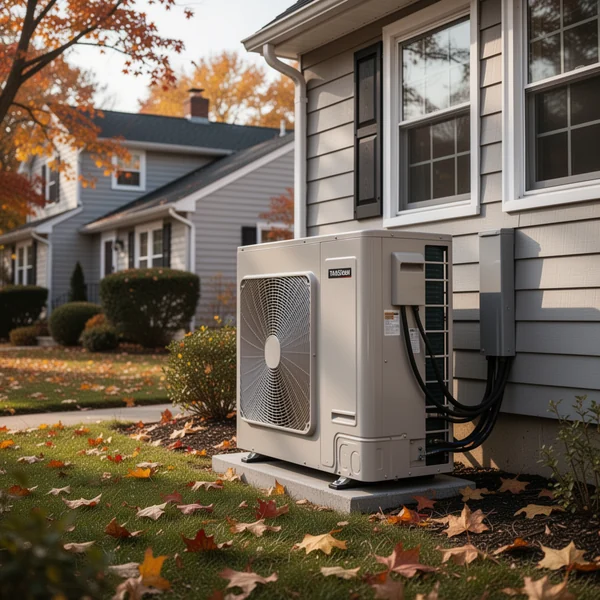
The National Grid heat pump rebate is National Grid’s share of NYS Clean Heat, the statewide programme NYSERDA runs with seven sponsoring utilities. It is not a cheque you apply for after the job: your installer enrols in the programme, submits the application, and the rebate lands as a discount line on your invoice — which is why the single most important question you can ask a contractor is whether they are a participating contractor at all.
What follows is the invoice, line by line, and where the rebate sits within it. It deliberately does not quote a dollar amount, because the amounts are set per utility and per equipment type and are not published as one statewide table. The live figure for your address is at cleanheat.ny.gov/find-available-rebates, and anyone who tells you a flat per-ton number for “New York” is repeating something they read about a different state.
First: which National Grid are you a customer of?
This trips up more people than any other part of the process, because National Grid’s New York territory is two different businesses.
- Upstate — the Buffalo and Niagara region, Syracuse and Onondaga County, the Capital District, the Mohawk Valley and the North Country — National Grid delivers both electricity and gas to much of the territory.
- Downstate — Brooklyn, Staten Island, parts of Queens, and Long Island — National Grid delivers gas only. Your electricity comes from Con Edison in the city or PSEG Long Island on the Island.
That matters because the seven Clean Heat sponsors are Central Hudson, Con Edison, National Fuel Gas, National Grid, NYSEG, Orange & Rockland and RG&E — and PSEG Long Island is not among them. So a Nassau County house with National Grid gas sits in a genuinely different position from a house in Amherst with National Grid electric, and a Brooklyn brownstone with National Grid gas and Con Edison electric is different again. Do not assume the programme page you found applies to you because the name on your gas bill matches. Put the street address into the finder and let it tell you which sponsor’s rules govern the job.
The invoice, line by line
A heat pump quote from a competent New York contractor breaks into six or seven lines. Here is what each one is, who controls it, and whether the Clean Heat rebate touches it.
| Line | What it covers | Does the rebate apply? |
|---|---|---|
| Load calculation and design | ACCA Manual J room-by-room load, equipment selection (Manual S), duct design if ducted (Manual D) | Not a separate incentive, but programme paperwork usually depends on it existing |
| Equipment | Outdoor unit, indoor heads or air handler, line sets, controls | Yes — this is what the incentive is calculated against, and the model must be on the qualifying product list |
| Installation labour | Mounting, refrigerant lines, condensate, commissioning | Included in the installed cost the programme reviews |
| Electrical | New circuit, disconnect, sometimes a panel or service upgrade | Usually a separate trade line; a service upgrade is normally your cost |
| Ductwork or ducting modifications | New trunk, returns, sealing, or a low-static air handler in a tight space | Part of installed cost; on a retrofit this line moves the total more than the equipment does |
| Removal and disposal | Old furnace or boiler out, oil tank if applicable | Your cost |
| Permits and inspection | Municipal mechanical and electrical permits, third-party electrical inspection where the town uses one | Your cost |
| NYS Clean Heat incentive | Applied by the participating contractor | Shown as a negative line, reducing what you pay |
Read that table once and a pattern falls out: the rebate is calculated off the heat pump, but the total is often driven by the electrical and duct lines. Two quotes for the same equipment can differ substantially because one contractor plans to reuse your existing ductwork and the other has looked at it and concluded it cannot carry the airflow a heat pump needs. The second contractor is usually the honest one.
What determines the size of the incentive
Without quoting figures, the structure is worth understanding because you can influence it:
- Capacity, not house size. Clean Heat incentives are calculated from the rated heating capacity of the equipment you install, not from a flat per-household amount. This is one reason no single number can be published.
- Whole-home versus partial. A design that removes fossil heating as the primary system is treated differently from adding a couple of ductless heads while the gas furnace stays in charge. Ask explicitly which category the contractor is applying under — it changes the number and it changes what you are allowed to do with the old boiler.
- Equipment on the qualifying list. Cold-climate performance criteria apply. For an upstate New York winter you want to see the model’s rated capacity and coefficient of performance at low outdoor temperatures anyway; the NEEP cold-climate air-source heat pump product list publishes capacity and COP at 47°F, 17°F and 5°F for listed models, and that is the honest way to compare two proposals.
- Ground-source is its own category. A geothermal system is a different measure with a different incentive path from an air-source heat pump.
The sequence, and where it goes wrong
The order of operations is: choose a participating contractor, get a load calculation, agree a design, the contractor submits the programme application, the work is done and commissioned, the contractor closes out the paperwork, the incentive is settled. Two failure modes recur.
Enrolling after the fact. A contractor who is not participating cannot retroactively claim on your behalf once the equipment is in. If you love a company that is not enrolled, ask them to enrol before the job — some will — but do not sign expecting it to be sorted out later.
Assuming a federal credit on top. Clean Heat rebates can be stacked with federal incentives where federal incentives exist. For a 2026 installation, they do not. Section 25C — the credit that carried the $2,000 heat pump cap — applied to property placed in service before 31 December 2025, and Section 25D terminated for expenditures after the same date. A New York household installing a heat pump in 2026 gets nothing federal. If a National Grid-area quote shows a 30% federal line or a $2,000 credit, that line is stale; ask for a corrected quote and re-rank your bids. Our note on what changed federally for New York covers the same cutoff.
What else National Grid customers should check while they are at it
If you are already having an electrician on site and already dealing with National Grid paperwork, it is worth knowing what else that utility runs. We cover National Grid solar incentives in New York and, separately, the question people ask most often — whether a National Grid solar rebate exists at all. If a heat pump is going to raise your electricity use significantly, the export side of your bill starts to matter too; National Grid net metering explained is the companion piece. And for spreading the cost, the NYSERDA on-bill recovery loan puts the payment on the utility bill rather than a separate account.
What to do next
- Run your address through the Clean Heat finder and confirm National Grid is the sponsor for the service you actually take — gas, electric, or both.
- Ask each contractor, first call: “Are you a participating Clean Heat contractor with National Grid?” Stop there if the answer is no.
- Ask for the quote broken into the lines above, with the Clean Heat incentive shown as its own negative line rather than folded into a single “after incentives” price.
- Ask for the Manual J, and ask for the model’s rated capacity and COP at 5°F. If a contractor will not produce either, that tells you something.
- Have the electrical scope priced separately. If the panel needs work, that is a real cost the rebate does not cover, and you want it visible.
- Strike any federal credit line from a 2026 quote before comparing bids.
NY Solar Incentives
Independent New York solar research. We summarise NYSERDA, NY-Sun and federal programme rules from published sources and state plainly when a figure is an estimate. We are not a government agency and do not sell equipment.
Run the arithmetic on your own system
Check the dated program table and your arrangement before counting an incentive. Standard residential NY-Sun blocks are closed; Long Island Affordable Solar has a conditional income-verification route. The NY credit depends on qualified costs and tax liability, while the NYC abatement reduces future property-tax bills. The estimator keeps those timings separate.