How to Read NYSERDA’s Heat Pump Contractor List
The NYSERDA heat pump contractor list tells you who can process your Clean Heat rebate. It is not a quality ranking. Here is how to read it, and vet what it returns.
On this page 7 sections
- 01What the NYSERDA heat pump contractor list actually certifies
- 02Reading an individual listing without over-reading it
- 03The Long Island exception that trips people up
- 04Five questions that separate two contractors from the same list
- 05Cross-checking a name once the list has given it to you
- 06The money question the list cannot answer
- 07What to do next
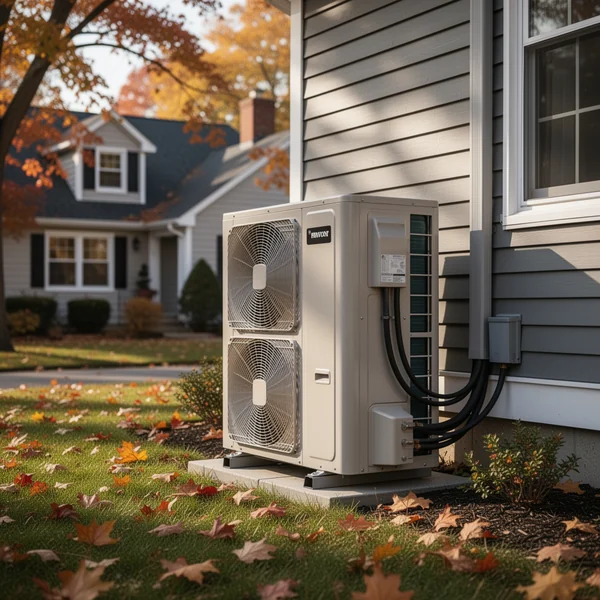
The NYSERDA heat pump contractor list is a directory of companies that have signed a participation agreement with NYS Clean Heat, and being on it means one thing: that firm is authorised to process your utility’s Clean Heat rebate as a discount on your invoice. It is a paperwork credential, not a quality ranking — the list will show a one-truck operator and a hundred-person mechanical contractor on the same screen with nothing to tell them apart.
That is not a flaw. The list does the job it was built for, which is to tell you who can hand you the money. The mistake is treating it as a vetted shortlist of good installers. Here is how to read it for what it is, and what to do with the names it returns.
What the NYSERDA heat pump contractor list actually certifies
NYS Clean Heat is administered by NYSERDA together with seven sponsoring utilities: Central Hudson, Con Edison, National Fuel Gas, National Grid, NYSEG, Orange & Rockland and RG&E. The rebate is paid through the contractor rather than to you, which is why participation matters at all. A firm that has not signed the agreement can still install you a perfectly good heat pump — it simply cannot bring the utility incentive with it, and you have no route to claim that money yourself afterwards.
So the list confirms that a company has agreed to the programme’s rules, will install equipment from the qualifying product lists, and will file the documentation and accept the programme’s quality-assurance inspections. Every one of those is worth having. None of them is a statement about workmanship.
What it does not confirm is just as important. It is not a NYSERDA endorsement, it carries no pricing information, it does not rank anyone, and it says nothing about whether the firm has ever worked on a building like yours. A contractor who has done four hundred ductless retrofits in Westchester colonials and one who has done four sit in the same alphabetical run.
Reading an individual listing without over-reading it
Two fields on a listing are genuinely load-bearing. The first is service territory — contractors post the counties they will travel to, and the honest ones keep it tight. A firm listing every county from Montauk to Chautauqua is either a large multi-branch operation or is planning to subcontract you out, and it is fair to ask which.
The second is equipment category. Clean Heat splits work into distinct buckets — ducted air source, ductless air source, ground source, and heat pump water heaters — and a contractor may participate in some and not others. A company set up for ductless mini splits is not automatically the right firm for a ducted whole-home changeover in a Capital Region ranch, and a ground source loop field is a different trade entirely, involving drillers most HVAC companies do not employ.
The Long Island exception that trips people up
PSEG Long Island is not a NYS Clean Heat sponsoring utility. It runs its own separate efficiency and heat pump programmes. If you are in Nassau or Suffolk and you search the Clean Heat contractor directory, you may well find companies that work your area — they serve Con Edison and NYSEG territory too — but the incentive path for your address runs through PSEG Long Island, not through Clean Heat. Establish which programme is paying before you sign anything, because the rebate mechanics, the paperwork and the eligible equipment lists are not the same.
Five questions that separate two contractors from the same list
Once you have three names, the list has done its work and the real vetting starts. These are the questions that produce different answers from different firms.
- Will you run a Manual J load calculation, and will you give me the printout? Not a rule-of-thumb size off the square footage, and not the tonnage of the furnace you are replacing. Ask to see the design temperature it was run at and the room-by-room loads. A Buffalo design day and a Long Island design day are not the same number, and the sizing follows from it.
- What happens below the design temperature? Every cold-climate heat pump has a point where output falls and something else has to help. Ask whether that something is electric resistance strips, an existing boiler or furnace kept as backup, or nothing at all — and ask what the plan does to your winter electric bill when it engages.
- If this is ducted, what did you measure? Ductwork sized for a hot-air furnace often moves the wrong volume for a heat pump, which delivers cooler supply air and needs more of it. A contractor who has not put a gauge on your system and has not looked in the attic is quoting a guess.
- Who handles the electrical, and is a panel upgrade inside this price or outside it? This is the single most common source of a “surprise” change order in New York retrofits. Get it in writing either way.
- Which utility account is the rebate filed against, and is it off-invoice? Ask what happens if the programme’s rebate level changes between the day you sign and the day the equipment goes in — who absorbs the difference is a contract question, not a courtesy question.
Cross-checking a name once the list has given it to you
New York does not license home improvement contractors at the state level, so the checks are local and you have to know where to look. New York City licenses through the Department of Consumer and Worker Protection. Nassau, Suffolk, Westchester and Rockland counties each run their own home improvement contractor licensing, and Putnam does too. Ask for the licence number for the jurisdiction the work is in, then verify it yourself rather than accepting a number on a truck door.
Then ask for a current certificate of insurance naming you, with general liability and New York State workers’ compensation coverage. An uninsured crew on your roof or in your crawlspace is your exposure, not theirs. This is the same discipline that applies to any trade working on your house — the guide on how to vet a solar installer in New York walks the same ground for rooftop work, and the checks transfer almost one for one.
It is also worth understanding what a programme-qualified status does and does not mean generally, because the same confusion runs through the solar side of NYSERDA’s work; the explainer on what a NYSERDA-qualified contractor actually is makes the distinction plainly.
The money question the list cannot answer
Clean Heat rebate amounts are not published as a single statewide table. They vary by sponsoring utility and by equipment type, and they are revised. The only figure worth planning around is the one the official address-based finder at cleanheat.ny.gov/find-available-rebates returns for your service address. Run that yourself before you take quotes, so you arrive at the conversation knowing roughly what the incentive layer looks like rather than taking a contractor’s word for it.
One thing you should be clear on before any of this: the federal credits are gone. Section 25C, the Energy Efficient Home Improvement Credit that carried a $2,000 annual cap for heat pumps and heat pump water heaters, applied to property placed in service through 31 December 2025. Section 25D terminated for expenditures after the same date. A New York household installing in 2026 gets nothing federal. If a salesperson works a 30 per cent federal credit into your numbers, that quote is wrong and everything built on top of it is wrong too.
What to do next
- Run your address through the Clean Heat rebate finder first, so you know which sponsoring utility applies and what the incentive structure looks like before anyone quotes you. On Long Island, go to PSEG Long Island’s own programme pages instead.
- Pull three names off the contractor list that all show your county in their service territory and the specific equipment category you want.
- Ask each of the five questions above and write the answers down. The gaps between the three sets of answers are the actual decision.
- Verify the home improvement contractor licence with the city or county that issues it, and get a certificate of insurance with workers’ compensation before work starts.
- Strike any federal tax credit line out of every quote you receive for a 2026 install, and re-check the total.
NY Solar Incentives
Independent New York solar research. We summarise NYSERDA, NY-Sun and federal programme rules from published sources and state plainly when a figure is an estimate. We are not a government agency and do not sell equipment.
Run the arithmetic on your own system
Check the dated program table and your arrangement before counting an incentive. Standard residential NY-Sun blocks are closed; Long Island Affordable Solar has a conditional income-verification route. The NY credit depends on qualified costs and tax liability, while the NYC abatement reduces future property-tax bills. The estimator keeps those timings separate.