Solar Incentives on National Grid in New York
National Grid customers in upstate and western New York draw on state incentives rather than utility ones. What the utility does control is the meter, the interconnection and how credits appear.
On this page 8 sections
- 01National Grid solar incentives in NY come from the state, not the utility
- 02Which NY-Sun region National Grid customers fall into
- 03What the utility actually controls
- 04How net metering appears on a National Grid bill
- 05Rooftop solar against community solar on a National Grid account
- 06Practical checks in upstate and western New York
- 07The federal credit no longer applies to a purchase
- 08Frequently asked questions
Homeowners in Syracuse, Buffalo, Albany and the towns between them tend to start by looking for a rebate from their utility. It is a reasonable place to look and it is the wrong one.
National Grid solar incentives in NY are, with limited exceptions, not paid by National Grid. The money comes from the state. What the utility controls is the connection, the meter and the arithmetic that turns exported electricity into credits on a bill.
National Grid solar incentives in NY come from the state, not the utility
The principal incentive National Grid residential customers had was NY-Sun, administered by NYSERDA. It paid a per-watt amount on installed direct-current capacity, and it paid it to a participating contractor rather than to the household. As of September 2026 NYSERDA has no open NY-Sun block for homes in any utility territory; check NYSERDA’s NY-Sun dashboard for a new one.
The homeowner never applied and never received a payment. The effect showed up as a lower contract price, which is why the incentive was invisible unless the quote itemized it; on a home quote written today the NY-Sun line should be $0. The NY-Sun overview explains what a compliant quote should show.
The main state support that remains is the New York State tax credit for solar energy system equipment, claimed on Form IT-255 with your state return. It is 25% of qualified expenditure, capped at $5,000, and it is not refundable: where the credit exceeds the tax owed in a single year, the unused part carries forward for up to five years. Alongside it: no sales tax where the exemption applies, the RPTL 487 property-tax exemption where your jurisdictions have not opted out, and bill credits for the power you send to the grid, minus the monthly Customer Benefit Contribution for systems interconnected since 2022. The RPTL 487 exemption is not automatic: file form RP-487 with your assessor by the taxable status date (March 1 in most towns; January 2 in Nassau towns; May 1 or June 1 in Westchester towns; set by charter in cities; usually January 1 in villages), and the system must be built before January 1, 2030 (RP-487 instructions).
Which NY-Sun region National Grid customers fall into
NY-Sun allocates capacity in regional megawatt blocks rather than one statewide pool. National Grid’s electric service territory sits within the upstate region, alongside the other upstate investor-owned utilities, rather than in the Con Edison or Long Island blocks.
That mattered because the per-watt rate stepped down independently in each region as its block filled. A rate quoted by a relative on Long Island tells a National Grid customer nothing useful about their own.
It also means the status is regional. In the upstate region the last standard residential block (block 14, $0.15 per watt) closed on 12/17/2025, and the Residential Affordable Solar track ($0.80 per watt) ran from 12/18/2025 to 03/09/2026. Check NYSERDA’s published status rather than the figure printed on a proposal.
National Grid is a gas utility in places it is not the electric utility
Some New York households buy gas from National Grid and electricity from someone else, including in parts of the downstate area. Solar incentives, net metering and interconnection all follow your electric service, so check which company appears on the electricity supply portion of your bill before assuming which rules apply.
What the utility actually controls
Three things sit squarely with National Grid, and all three can hold up a project.
The first is interconnection. A system cannot be energized until the utility has reviewed the application and issued permission to operate. Your installer normally handles the paperwork, but the queue is the utility’s.
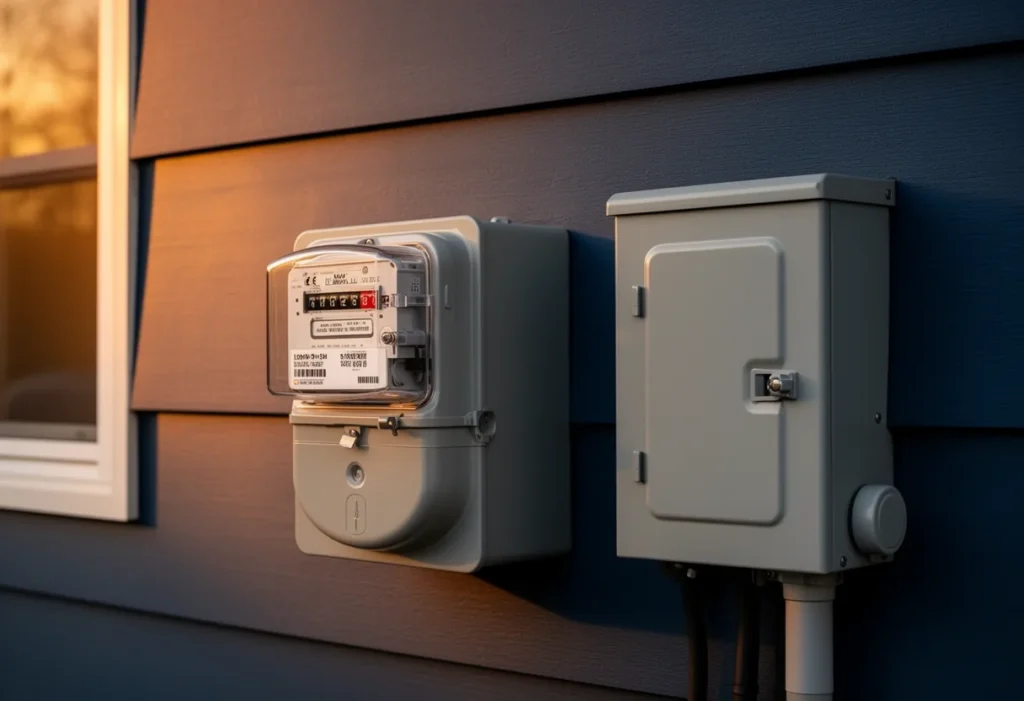
The second is metering. Net metering requires a meter that measures flow in both directions, and exchanging it is a utility task with its own scheduling.
The third is the bill itself, including how credits are displayed, when they are applied and how any annual reconciliation works. None of that is set by your installer.
How net metering appears on a National Grid bill
The concept is straightforward. Electricity your system exports to the grid earns credits, which offset electricity you draw later. Over a sunny month a household can export more than it imports and see the surplus carried forward.
What surprises people is that the bill does not go to zero. Fixed service charges continue regardless of consumption, and depending on the arrangement in force there may be an additional monthly charge tied to the size of the installed system rather than to usage.
New York has also revised its net metering rules more than once, and the terms that apply depend in part on when a system was interconnected. Because of that, the arrangement your neighbour has may not be the arrangement you are offered. How net metering works in New York sets out the moving parts, but the tariff on file for your account is the binding version.
Rooftop solar against community solar on a National Grid account
| Consideration | Rooftop system | Community solar subscription |
|---|---|---|
| Upfront cost | Purchase price, or a lease or loan payment | Typically none |
| Who owns equipment | You, if you buy it | The project owner |
| Where the value appears | Reduced consumption plus export credits | Credits applied to your National Grid bill |
| State tax credit | May apply to a qualifying purchase or long-term agreement | Not applicable to a subscription |
| Roof condition matters | Yes, and it can be decisive | No |
| Ending the arrangement | Sell the house or the system | Cancel with the contractual notice period |
For upstate households with heavy tree cover or an ageing roof, the second column is often the practical answer. Community solar on a National Grid account covers how the credits are applied.
Practical checks in upstate and western New York
Snow is the question everyone asks. Panels tilted on a pitched roof shed snow reasonably well and production losses concentrate in the months when output is lowest anyway, so the effect on an annual estimate is real but smaller than intuition suggests. Ask how the production estimate handles it rather than accepting an unexplained annual figure.
Shading matters more. Mature trees on a lot that has been settled for decades take a heavier toll on annual output than winter weather, and a proper shading analysis should be part of any serious proposal.
Older service equipment is the third item. Homes with small or ageing electrical panels sometimes need an upgrade before a system can be connected, and that cost belongs in the comparison from the start rather than appearing after signing.
Pull twelve months of usage first
National Grid provides historical consumption data for your account. Twelve months of actual kilowatt-hours is the only sound basis for sizing a system, and it lets you check an installer’s production estimate against something other than their own software. It also exposes quotes sized to the roof rather than to the household.
The federal credit no longer applies to a purchase
Older guidance for upstate homeowners assumed a 30% federal residential credit sitting on top of the state measures. That credit, under section 25D, terminated on 31 December 2025 following the One Big Beautiful Bill Act signed on 4 July 2025.
A household buying a system outright or with a loan, whose installation was completed in 2026 or later, receives nothing on its federal return. Systems whose installation was completed in 2025 were governed by the previous rules, and unused credit can generally be carried forward.
A separate business-side credit still applies to companies that own leased or third-party-owned systems. That is why some upstate offers still reference a federal incentive: it belongs to the provider, not to the household.
Frequently asked questions
Does National Grid pay a rebate for rooftop solar?
National Grid is not the source of New York’s residential solar incentives. The per-watt NY-Sun incentive came from NYSERDA and was paid to your contractor, and as of September 2026 it has no open block for homes; the state tax credit comes from the state and is claimed on your return. The utility’s role is interconnection, metering and applying credits to your bill.
Will my National Grid bill go to zero?
Almost certainly not. Fixed service charges continue whatever your consumption, and depending on the arrangement in force there may be a further monthly charge related to system size. A well-sized system reduces the energy portion of the bill substantially, but the account stays open and billed.
How long does interconnection take upstate?
It varies with application volume, local circuit conditions and whether a meter exchange or service upgrade is needed. Your installer submits the application, but the queue belongs to the utility, so ask for a realistic range rather than a promise. Do not plan around a system being live before permission to operate is issued.
Is the incentive rate the same across all of New York?
No. NY-Sun allocates capacity in separate regional blocks, and National Grid’s electric territory sits in the upstate region rather than the Con Edison or Long Island ones. Each region stepped its rate down at its own pace as capacity was used, so only the upstate figure is relevant to a National Grid customer, and for homes that figure is now $0: the last upstate residential track closed on 03/09/2026.
Verify the current figures
Incentive rates, tariff terms and net metering rules change, and the terms applying to your system depend on your utility, your rate class and your interconnection date. Confirm incentive details with NYSERDA and billing or interconnection details with National Grid directly before relying on them.
NY Solar Incentives
Independent New York solar research. We summarise NYSERDA, NY-Sun and federal programme rules from published sources and state plainly when a figure is an estimate. We are not a government agency and do not sell equipment.
Run the arithmetic on your own system
Check the dated program table and your arrangement before counting an incentive. Standard residential NY-Sun blocks are closed; Long Island Affordable Solar has a conditional income-verification route. The NY credit depends on qualified costs and tax liability, while the NYC abatement reduces future property-tax bills. The estimator keeps those timings separate.