Why Your Electric Bill Is Still High After Solar
A bill that stays high after solar usually has an explanation, and only one of the common explanations is an actual fault.
On this page 9 sections
- 011. Charges that never depended on consumption
- 022. Delivery and supply are separate
- 033. The array was sized against a house that no longer exists
- 044. It is winter, and settlement is annual
- 055. Shade that was not in the model
- 066. Something genuinely is wrong
- 07Confirm which utility you are actually on
- 08What is still working in your favour in 2026
- 09Frequently Asked Questions
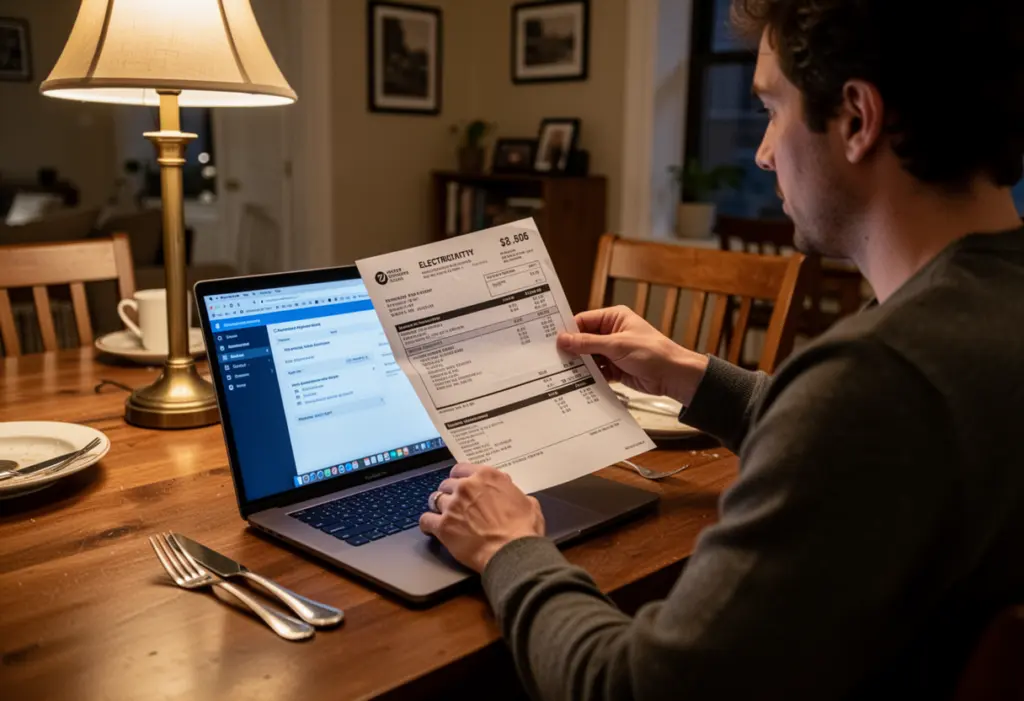
Solar rarely takes a New York electricity bill to zero, and the reasons are usually structural rather than faulty. Work through them in order and you will normally identify which one is yours within a few minutes. Only one of them is an actual defect worth calling anyone about.
1. Charges that never depended on consumption
A fixed service charge is billed for having an account and a live connection at all. It survives solar untouched, as does anything calculated on the fixed portion of the bill.
Then there is the Customer Benefit Contribution, which is levied on the DC size of your array rather than on anything you consumed or produced. For 2026 the residential rates run from $0.97 per kW-month at National Grid to $1.67 at Central Hudson. On a 10 kW array that is between $9.70 and $16.70 a month, roughly $116 to $200 a year, appearing before a single kilowatt-hour is counted. It applies to systems interconnected on or after 1 January 2022. This is the line most often reported as an error, and it is not one.
2. Delivery and supply are separate
New York bills split delivery from supply. Your array reduces volume through both, but if you signed with an energy services company years ago, your supply price is governed by that contract and not by your panels. A high supply rate on a legacy agreement can swallow a large share of what solar saved you. Solar does not renegotiate it. Look at what you are paying per kilowatt-hour for supply, and treat that as a separate decision.
3. The array was sized against a house that no longer exists
This is the most common cause of genuine disappointment. If the system was designed from twelve months of bills taken before you added a heat pump, an EV charger, an induction range or a heat pump water heater, it was sized for your old load. Electrification is cumulative and every addition lands on the same meter. An array that covered 90% of your consumption in the design year can cover far less after two new loads arrive, and nothing has failed — the house changed.
The same effect appears with a new occupant, a home office, a hot tub, or a basement finished into living space.
4. It is winter, and settlement is annual
December and January are the shortest days of the year, snow cover removes production days outright, and heating and lighting load peaks in the same weeks. That produces a large winter bill on a perfectly healthy system. Net metering is designed to settle across a year: summer surplus builds a credit balance that winter consumption draws down. Judging an installation on a single month, in either direction, will mislead you. Wait for a full twelve months before drawing conclusions.
5. Shade that was not in the model
A satellite-based production estimate and an on-site shade assessment can diverge substantially, and the gap is largest in exactly the low-sun months when you can least afford it. Trees also grow. If production is consistently below the estimate in spring and autumn but fine at midsummer, a shading pattern is the first thing to look for.
6. Something genuinely is wrong
Two symptoms justify a call rather than patience.
- No export credit ever appears across a full summer. The meter configuration is the first suspect, and the utility is the party to ask.
- Monitoring and the bill disagree. Pull your production data for the same billing period and compare. A large unexplained gap points at the equipment, the communications or the meter, and your installer should account for it.
A third, less obvious one: check whether an unfamiliar charge is actually a loan repayment. NYSERDA’s On-Bill Recovery Loan is repaid as a line on the utility bill itself, so a household that financed that way is looking at a bill that includes the cost of the system.
Confirm which utility you are actually on
Read the name printed on your own bill rather than assuming from a county. Territory boundaries do not follow county lines cleanly, especially between NYSEG, National Grid and Central Hudson, and the differences are real money — the same array pays $0.97 per kW-month in one territory and $1.67 in another. There are also municipal electric utilities across the state, and their customers sit outside Public Service Commission jurisdiction altogether: no PSC net metering, no Customer Benefit Contribution and no state interconnection process, with terms set locally and available only by asking.
What is still working in your favour in 2026
Even on a disappointing bill, the underlying arrangement is strong. Phase One net metering credits exports at the full retail rate and holds for 20 years from interconnection, which is the single largest support left to residential solar in New York now that section 25D has been terminated for expenditures made after 31 December 2025 — a 2026 buyer claims nothing federally. If you have not yet claimed it, New York’s 25% credit capped at $5,000 on Form IT-255 is not refundable but carries forward for up to five years, so an unused amount from an earlier year may still be available to you. It requires the equipment to be installed and used at your principal residence in New York, so a second home, a camp or a rental property does not qualify. Check too whether RPTL 487‘s 15-year property tax exemption was applied to your assessment, and whether the state sales tax exemption appeared on your original invoice. Programme terms and the capacity rates are revisited annually, so verify the current position with NYSERDA and with the New York State Department of Taxation and Finance rather than from the paperwork you were handed at installation.
Frequently Asked Questions
Why is my New York electric bill not zero after solar?
Fixed service charges and the Customer Benefit Contribution do not depend on consumption. The capacity charge alone runs from $0.97 to $1.67 per kW-month across New York utilities in 2026, which is roughly $116 to $200 a year on a 10 kW array before any electricity is counted.
Could my array simply be too small?
Often it was sized correctly for the house at the time. If a heat pump, an EV charger or an induction range arrived afterwards, the load grew and the array did not. Electrification is cumulative and every addition lands on the same meter.
How do I tell whether something is broken?
Two signs justify a call: no export credit appearing across a full summer, which points at the meter configuration, and a large unexplained gap between your monitoring data and the bill for the same period, which points at the equipment or communications.
Should I judge the system on one bill?
No. Net metering settles across the year, with summer surplus carrying winter deficit, so a single December bill tells you very little. Wait for a full twelve months before drawing conclusions in either direction.
This article is general information, not tax, legal or financial advice. Incentive amounts, eligibility rules and deadlines change and depend on your utility, your tax situation and your property. Confirm current terms with NYSERDA, your utility and a qualified tax professional before making a decision.
NY Solar Incentives
Independent New York solar research. We summarise NYSERDA, NY-Sun and federal programme rules from published sources and state plainly when a figure is an estimate. We are not a government agency and do not sell equipment.
Run the arithmetic on your own system
Check the dated program table and your arrangement before counting an incentive. Standard residential NY-Sun blocks are closed; Long Island Affordable Solar has a conditional income-verification route. The NY credit depends on qualified costs and tax liability, while the NYC abatement reduces future property-tax bills. The estimator keeps those timings separate.