National Grid Battery Storage: What It Buys You Upstate
Upstate outages are a weather story, and a battery answers that. It answers almost nothing about your payback under full retail net metering.
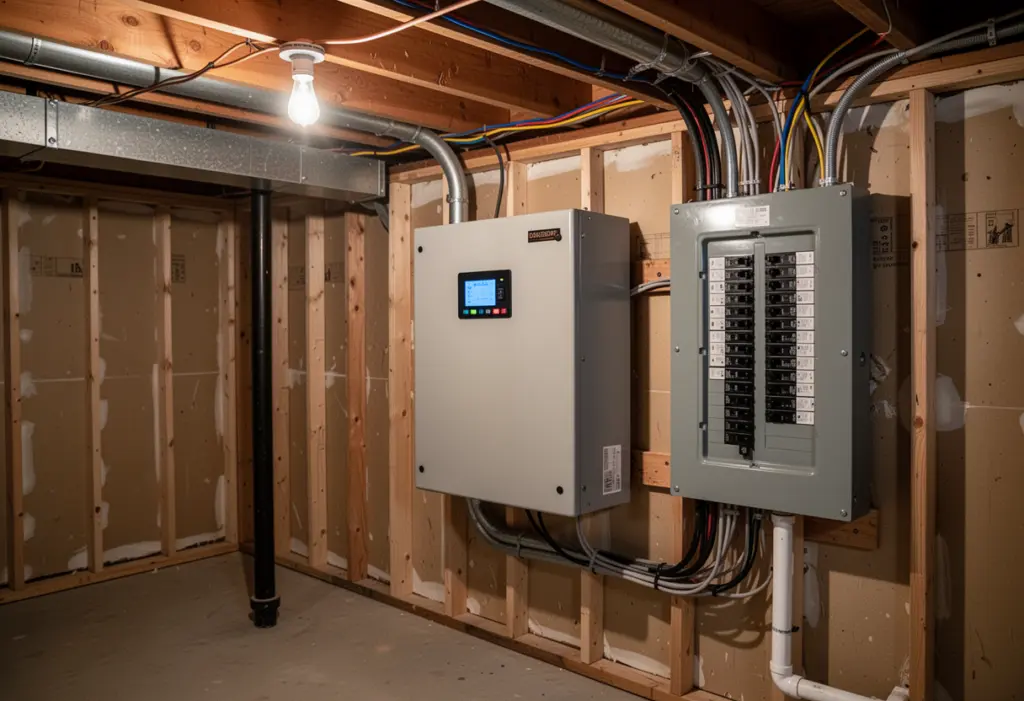
Storage in National Grid territory is bought for weather. Lake-effect bands off Erie and Ontario, wet spring snow on leafed-out trees, and the ice events that periodically take the Mohawk Valley and the Capital District apart are what put batteries in upstate basements. They are not bought because the arithmetic favours them, and it is fairer to say so at the start.
Why the payback case is thin
Under Phase One net metering New York credits exported energy at the full retail rate, and the arrangement holds for 20 years from interconnection. Storage earns money where exports are compensated far below retail, so that the owner is better off keeping the electricity than selling it. That gap is what a battery monetises, and in this market it is small. Anyone modelling a battery as a payback accelerator here should be asked to show the price difference they are capturing.
National Grid also happens to have the state’s lowest Customer Benefit Contribution at $0.97 per kW-month of DC array size for 2026 residential customers, so a 10 kW array pays $9.70 a month or about $116 a year. Storage does not reduce that line either. It is billed on the solar capacity, and how a paired system is handled on your account is a question for National Grid directly.
Scope is where people are disappointed
The gap between what a homeowner pictures and what is installed is almost always scope, not capacity. Whole-home backup and a critical loads sub-panel are different products at different prices. Insist the contract names circuits:
- Heating controls and the circulator or blower. A gas or oil furnace with no power is not heat.
- The sump pump, in any house where a wet basement is a live risk during a thaw.
- Refrigeration, one or two lighting circuits, and a named outlet for anything medical.
- The exclusion list, in writing and before you sign. It is the page nobody reads until the power is already off, and in an upstate winter the line to interrogate hardest is anything electric that touches heat.
Siting, which is a cold-weather question here
Batteries have an operating temperature range and they behave differently at the cold end of it. An unheated detached garage in Watertown or Utica is not the same environment as a conditioned basement, and the difference shows up as available capacity on exactly the nights you need it. Ask where the unit is going, what the manufacturer specifies for that location, and whether the installer has put units in comparable spaces through a full winter.
Two more upstate constraints. Snow load and roof access affect whether the solar side can recharge the battery at all during a multi-day storm, and a snowed-over array with a full battery is a house on a countdown. And a great deal of housing across Buffalo, Syracuse and the older Capital District neighbourhoods still runs a 100 amp service. A battery, a solar breaker and possibly an EV charger together are frequently more than that panel will take, and a service upgrade is a separate job with its own cost and schedule. Establish the service size before anybody quotes storage.
The 2026 change that reset every comparison
The 30% federal residential credit is gone. Section 25D was terminated for expenditures made after 31 December 2025, and an expenditure is treated as made when the original installation is completed — not when it is placed in service, and not when the utility grants permission to operate. Home storage leaned heavily on that credit. A residential buyer in 2026 gets none of it, and a proposal or spreadsheet carrying a 30% federal line against the battery is describing a world that ended.
New York’s 25% credit capped at $5,000 on Form IT-255 is for qualified solar energy system equipment at a principal residence. Ask for an itemised invoice separating the solar equipment from the storage equipment, and let a tax preparer decide what belongs in the claim. A single undifferentiated total makes that impossible to establish afterwards.
Check whose grid you are actually on
National Grid covers Buffalo, Syracuse, the Capital District and much of upstate, but not every community inside that outline. Municipal electric utilities operate at Solvay and Skaneateles in Onondaga County, Akron and Springville in Erie, Green Island in Albany County, Sherrill and Boonville in Oneida, and Massena in St. Lawrence. Those customers sit outside Public Service Commission jurisdiction: no capacity charge, no PSC net metering, no state interconnection process, and export and storage terms set entirely by the local utility. Read the bill rather than a map.
What is available in 2026 and how to verify it
Most consumer incentives in New York attach to solar. The one aimed at storage is NYSERDA’s Residential Energy Storage incentive, for a home battery of 25 kWh or less installed by a participating contractor; ask whether your installer participates and check NYSERDA’s page for the current terms. NY-Sun, the per-watt solar incentive a contractor applies while a regional megawatt block is open, is not available to homes: as of September 2026 NYSERDA has no open NY-Sun block for homes in any utility territory; check NYSERDA’s NY-Sun dashboard for a new one. That includes the Affordable Solar incentive for low- to moderate-income households, whose blocks have closed as well. The state sales tax exemption applies to residential solar equipment. RPTL 487 exempts the added property value for 15 years where the municipality, the county and the school district have each not opted out, for construction before 1 January 2030 — noting that in Buffalo and Syracuse the school district check does not arise, because Big Five districts levy no separate property tax. Programme terms and rates are revisited annually, so confirm the current position with NYSERDA and with National Grid before committing.
Frequently Asked Questions
Does a battery make financial sense on National Grid?
Usually not on its own terms. Phase One net metering credits exports at the full retail rate for 20 years from interconnection, leaving little price gap for storage to capture. Buy it for outage resilience during lake-effect and ice events.
Where should the battery be installed in an upstate house?
Somewhere within the manufacturer's operating temperature range. An unheated detached garage in Watertown or Utica behaves very differently from a conditioned basement, and the difference appears as lost capacity on the coldest nights.
Is there a federal credit on storage in 2026?
No. Section 25D ended for expenditures made after 31 December 2025, with an expenditure treated as made when the original installation is completed. Redo any comparison that still shows a 30% federal line.
Will my 100 amp service handle solar plus a battery?
Often not, particularly in older Buffalo, Syracuse and Capital District housing, and less so again with an EV charger in the mix. Establish the service size before storage is quoted, because an upgrade is a separate job with its own cost.
This article is general information, not tax, legal or financial advice. Incentive amounts, eligibility rules and deadlines change and depend on your utility, your tax situation and your property. Confirm current terms with NYSERDA, your utility and a qualified tax professional before making a decision.
NY Solar Incentives
Independent New York solar research. We summarise NYSERDA, NY-Sun and federal programme rules from published sources and state plainly when a figure is an estimate. We are not a government agency and do not sell equipment.
Run the arithmetic on your own system
Check the dated program table and your arrangement before counting an incentive. Standard residential NY-Sun blocks are closed; Long Island Affordable Solar has a conditional income-verification route. The NY credit depends on qualified costs and tax liability, while the NYC abatement reduces future property-tax bills. The estimator keeps those timings separate.