The RG&E CBC Charge: What Solar Customers Pay Monthly
The Customer Benefit Contribution is billed on the size of your array rather than on anything it produces, and for 2026 RG&E residential customers pay $1.31 per kW-month. The arithmetic is one multiplication.
On this page 8 sections
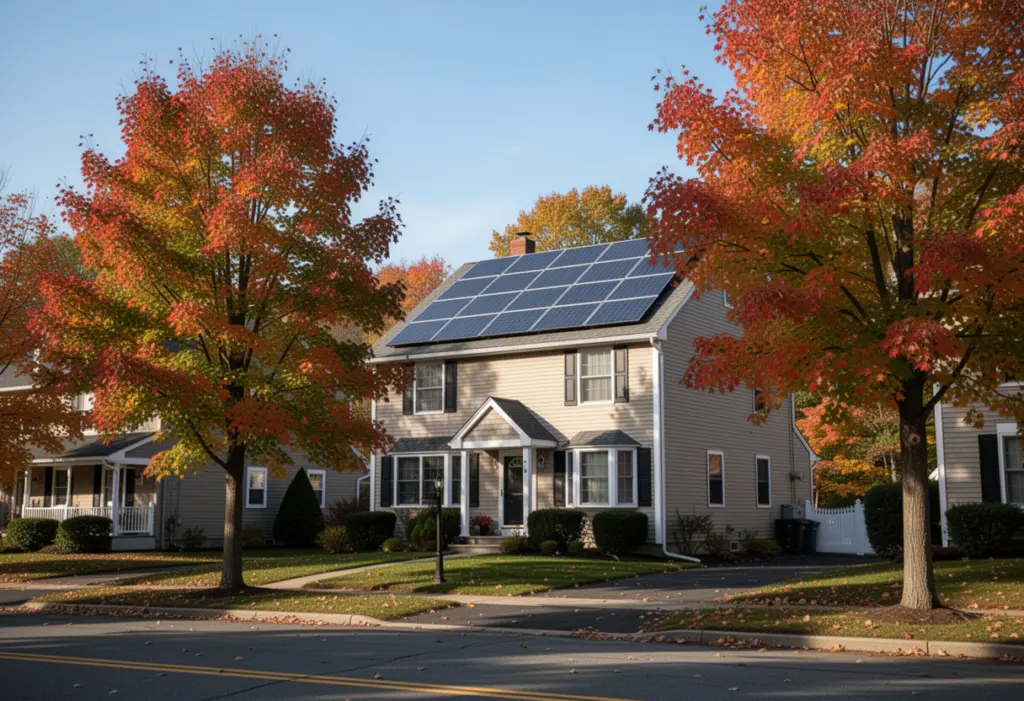
The Customer Benefit Contribution is a monthly charge based on the DC size of your solar array, not on how much electricity it makes. For 2026 the residential rate in RG&E territory is $1.31 per kW-month, so the whole calculation is one multiplication: an 8 kW system pays 8 x $1.31 = $10.48 a month, about $126 a year. A 5 kW system pays $6.55 a month, roughly $79 a year. Nothing about a cloudy July changes either figure.
What the charge is for
The contribution funds public benefit programmes, including low income support, energy efficiency and clean energy work. It is applied to solar customers as a capacity-based charge rather than folded into a volumetric rate, which is why it appears as its own line rather than moving with your usage.
Who actually pays it
- Systems interconnected on or after 1 January 2022. The test is the interconnection date. If your array was connected in 2019 you do not owe this charge, and any page that says solar customers have paid it since 2022 is describing the wrong group of people.
- Not front-of-the-meter projects. Community solar subscribers pay no Customer Benefit Contribution at all, which is one of the sharper differences between subscribing and owning a roof array.
- Not commercial accounts with a demand charge.
- Not municipal electric customers. If your electricity comes from a village or city electric department rather than from RG&E, you are outside Public Service Commission jurisdiction altogether: no PSC net metering, no Customer Benefit Contribution and no state interconnection process.
That last point matters in Monroe County specifically, because RG&E does not serve all of it. A small number of villages inside the county run their own municipal electric departments, and a homeowner there is on entirely different terms. The only reliable test is the utility name printed on your own bill, not the county you live in, so read the bill before assuming any of this page applies to you.
The rate is not locked in at interconnection
This surprises people who assume the charge behaves like their net metering arrangement. Phase One net metering credits exports at the full retail rate and holds that structure for 20 years from interconnection. The Customer Benefit Contribution does not work that way: the rates are recalculated annually, so the figure you were quoted at signing is a snapshot of that year rather than a commitment for the life of the system.
Practically, that means a proposal showing a fixed monthly charge running out to year twenty is showing you an assumption. Ask what it assumed.
How RG&E compares, and the detail that catches people out
The 2026 residential rates vary considerably across the state, and RG&E sits near the top of the range. Against RG&E at $1.31, National Grid residential is $0.97, Orange & Rockland is $1.00, PSEG Long Island is $1.13, NYSEG is $1.19, Con Edison is $1.29 and Central Hudson is $1.67. On a 10 kW array that is $13.10 a month in RG&E territory against $9.70 on National Grid, a difference of about $41 a year decided by nothing but which utility the roof sits under.
There is also a genuine oddity worth knowing if you have a small business or a mixed account. For 2026, RG&E’s small commercial rate of $0.96 is lower than its residential rate of $1.31. That is unusual, though not unique: NYSEG and Orange & Rockland also price small commercial below residential. Do not assume the residential figure applies to a farm stand, a shop or a mixed-use building without checking which service classification the meter is on.
Value Stack projects are priced differently again, at $0.65 residential for RG&E in 2026, but the Value Stack is for community distributed generation and larger or commercial projects rather than for a mass-market residential rooftop. Most residential rooftop customers here are on Phase One net metering, not on the Value Stack, so the net metered figure is the one to use.
Where it lands on your bill
Look for it as a separate line item rather than as part of your delivery charge, and check the capacity it is being billed on. The charge follows the DC system size, which is the sum of the module nameplate ratings, not the inverter rating and not the AC output. Those numbers differ on most systems, and a billing error is easiest to spot by comparing the kW figure on the bill against the DC size on your interconnection paperwork.
If they disagree, take the permission to operate letter and the equipment list to the utility rather than to the installer, since the billing record is the utility’s.
What this should change about sizing
Because the charge is on capacity and not on production, every extra kilowatt you install costs a fixed amount every month whether or not you ever consume what it makes. An oversized array in RG&E territory therefore costs twice: you paid for panels that build net metering credits you never draw down, and you pay $1.31 a month for each of those kilowatts indefinitely. Two unnecessary kilowatts is $2.62 a month, a little over $31 a year, forever.
Size to the load you actually have. If a heat pump or an electric vehicle is genuinely coming, model that load and say so, because that is a real reason to build headroom and a comfortable margin is not.
The 2026 incentives that sit around it
None of them offset this charge, so treat the contribution as a running cost rather than as something a rebate absorbs. NY-Sun, which the installer applies as a reduction in the price rather than something you claim, is not one of them in 2026: as of September 2026 NYSERDA has no open NY-Sun block for homes in any utility territory, and that includes its Affordable Solar blocks for income-qualified households; check NYSERDA’s NY-Sun dashboard for a new one. The state sales tax exemption on residential solar equipment shows up in how the invoice is written, and localities may elect separately on their local share, so the total differs by county and city. The one you claim yourself is the state solar energy system equipment credit: 25 percent of qualified expenditure capped at $5,000 on Form IT-255, for equipment at your principal residence in New York, limited by your actual state tax liability and carried forward for up to five years.
On the property side, RPTL 487 shelters the added value of the system from real property tax for 15 years, subject to three separate opt-out checks — municipality, county and school district — and to the system being constructed before 1 January 2030. Inside the City of Rochester the school district is fiscally dependent and levies no separate property tax, so that third check does not exist here. And there is nothing federal left to add: the 30 percent residential credit under section 25D was terminated for expenditures made after 31 December 2025, with an expenditure treated as made when the original installation is completed. Rates and rules both move, so take the Customer Benefit Contribution figure from NYSERDA and your own bill, and the tax position from the New York State Department of Taxation and Finance.
Frequently Asked Questions
How much is the RG&E CBC charge?
For 2026 the residential rate is $1.31 per kW-month of DC system size. An 8 kW array pays 8 x $1.31 = $10.48 a month, about $126 a year, regardless of how much it produces.
Does the CBC apply to my older solar system?
Only to systems interconnected on or after 1 January 2022. The test is the interconnection date, so an array connected before then does not owe the charge.
Is the rate fixed for the life of my system?
No. The rates are recalculated annually and are not locked in at interconnection, unlike Phase One net metering, which credits exports at the full retail rate and holds for 20 years from interconnection.
Do community solar subscribers pay the CBC?
No. Community solar is front-of-the-meter and subscribers pay no Customer Benefit Contribution at all, which is one of the clearer financial differences between subscribing and owning a rooftop array.
This article is general information, not tax, legal or financial advice. Incentive amounts, eligibility rules and deadlines change and depend on your utility, your tax situation and your property. Confirm current terms with NYSERDA, your utility and a qualified tax professional before making a decision.
NY Solar Incentives
Independent New York solar research. We summarise NYSERDA, NY-Sun and federal programme rules from published sources and state plainly when a figure is an estimate. We are not a government agency and do not sell equipment.
Run the arithmetic on your own system
Check the dated program table and your arrangement before counting an incentive. Standard residential NY-Sun blocks are closed; Long Island Affordable Solar has a conditional income-verification route. The NY credit depends on qualified costs and tax liability, while the NYC abatement reduces future property-tax bills. The estimator keeps those timings separate.