Solar Panel Cleaning Cost in New York and When It Pays
The question is not what a cleaner charges. It is whether the production you get back is worth more than the invoice, and on a rain-washed pitched roof it usually is not.
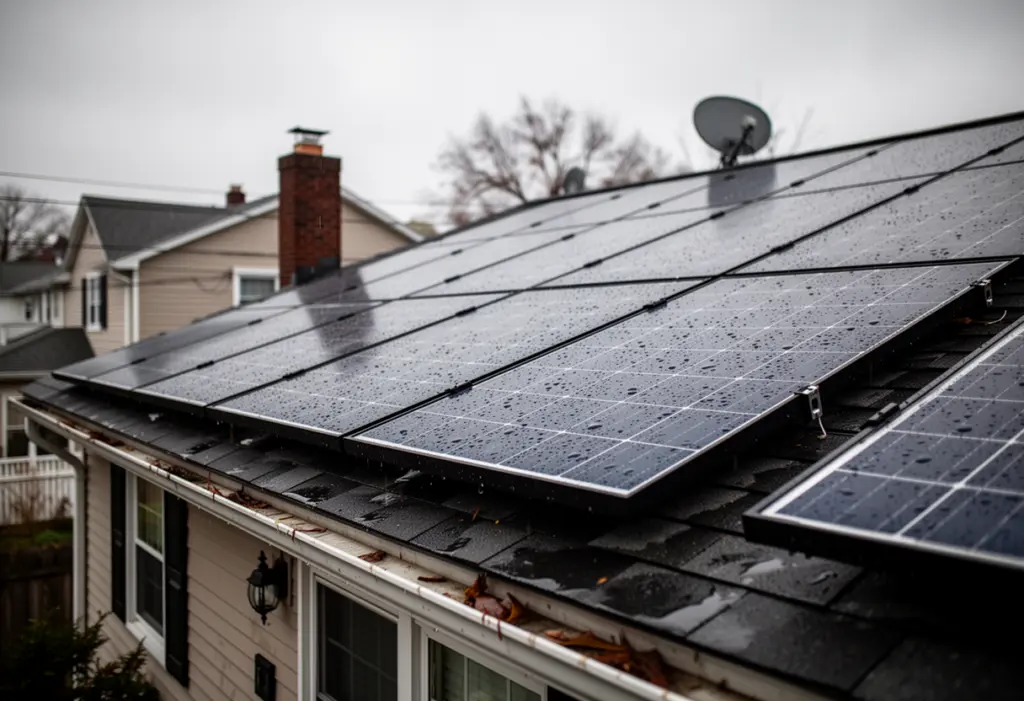
Prices for solar panel cleaning in New York are set by the individual contractor and vary with roof pitch, access, height and how many panels there are, so any single figure quoted at you is a starting point for a negotiation rather than a market rate. The more useful question is whether the job pays for itself, and on a rain-washed pitched roof in New York it usually does not.
The arithmetic that answers it
Work it with your own numbers rather than with anyone else’s. Take the quoted cleaning price and divide it by the retail rate per kilowatt-hour on your own bill. That gives the number of kilowatt-hours the cleaning has to recover before it breaks even. Then compare that against your annual production from your monitoring app and ask whether the soiling you can see could plausibly account for it.
Under Phase One net metering the credit for an exported kilowatt-hour is the full retail rate, which makes this comparison clean: a recovered kilowatt-hour is worth what a purchased one costs you. Run the division before you book anything, and ask any cleaner who claims a production gain to put the expected percentage in writing and say how it will be measured. Most will not, and that answer is itself informative.
When cleaning genuinely is worth it in New York
- Low-slope and flat roofs, common on city row houses, two-family properties and some Long Island builds. Water sheets off a steep array and puddles on a shallow one, so dirt stays.
- Bird roosting under or above the array. Droppings are opaque, they bake on, and a single heavily soiled cell can drag a whole string on a system without panel-level electronics.
- Agricultural dust, pollen loads or a gravel driveway that reliably coats the glass in the same weeks each year.
- Ground mounts catching sprinkler overspray, mud splash from the ground or grass clippings.
- A visible film that a full week of rain has not moved, which is the practical test. If rain clears it, you are being sold rain.
What can go wrong, and who carries it
Panels have an anti-reflective coating and sealed edges. A pressure washer, an abrasive pad, a household detergent or a hard-water rinse can damage the coating, drive water past the seals or leave mineral deposits that are worse than the dirt. Manufacturer warranties frequently exclude damage from improper cleaning, so a cheap wash can cost you a panel and the labour to swap it. Walking on the array is worse. Ask for proof of insurance, ask what they use on the glass, and if the answer includes pressure, decline.
Do not attempt to clear snow with tools. Snow sheds from a pitched array once the surface warms, and roof rakes crack glass and tear flashing. The winter production you are chasing is small and the roof damage is not.
The charge that carries on regardless
Dirty or clean, the Customer Benefit Contribution is billed on the DC size of the array rather than on production, for systems interconnected on or after 1 January 2022. A 7.5 kW array pays 7.5 x $1.29 = $9.68 a month on Con Edison, about $116.10 a year, and 7.5 x $1.31 = $9.83 a month on RG&E, about $117.90 a year, at the 2026 residential rates. That is the fixed side of owning capacity. It is an argument for noticing a real production loss quickly, and it is not an argument for washing glass that rain will wash.
Community solar subscribers pay no Customer Benefit Contribution at all, and they have no glass to clean, which is one of the quieter advantages of a subscription over a roof.
If your utility is a village department
Customers of a municipal electric utility such as the Village of Groton Electric Department, Sherburne Municipal Electric or the Village of Penn Yan Municipal Utilities Board are outside Public Service Commission jurisdiction: no Customer Benefit Contribution, no PSC net metering, and export terms set by the utility itself. That changes the value of a recovered kilowatt-hour, so ask your own utility what it credits before running the arithmetic above. Confirm the utility from the name on your bill.
Where this sits among the 2026 incentives
Cleaning is a service, not equipment, so it is outside the New York State residential sales tax exemption on solar energy system equipment, and it is not the kind of expenditure the 25% credit capped at $5,000 on Form IT-255 was written for. Confirm any treatment with the person who prepares your return. Nothing here is affected by the federal credit, which no longer exists for a residential buyer: section 25D was terminated for expenditures made after 31 December 2025, an expenditure being treated as made when the original installation is completed. The realistic financial goal for an existing array is simply to keep it producing what it produced in its first year, and to check that claim against your own monitoring data rather than against a service invoice. Programme rules change annually, so verify with NYSERDA and the Tax Department when it matters.
Frequently Asked Questions
How much does solar panel cleaning cost in New York?
There is no standard rate. Contractors price by roof pitch, height, access and panel count, so get more than one quote and treat any headline figure as a starting point rather than a market price.
Does cleaning actually increase production?
It depends entirely on how soiled the array is. Divide the quoted price by the retail rate on your own bill to get the kilowatt-hours the job has to recover, then ask whether the dirt you can see could plausibly account for that much.
Can I clean the panels myself?
From the ground with a soft brush on a pole and plain water, on a low array, some people do. Do not walk on the roof, do not use a pressure washer, and do not use household detergents, which can damage the coating and void a warranty.
What about snow?
Leave it. Snow slides off a pitched array once the surface warms, and roof rakes and metal tools crack glass and tear flashing. On a low-slope roof the honest answer is to accept the winter loss.
This article is general information, not tax, legal or financial advice. Incentive amounts, eligibility rules and deadlines change and depend on your utility, your tax situation and your property. Confirm current terms with NYSERDA, your utility and a qualified tax professional before making a decision.
NY Solar Incentives
Independent New York solar research. We summarise NYSERDA, NY-Sun and federal programme rules from published sources and state plainly when a figure is an estimate. We are not a government agency and do not sell equipment.
Run the arithmetic on your own system
Check the dated program table and your arrangement before counting an incentive. Standard residential NY-Sun blocks are closed; Long Island Affordable Solar has a conditional income-verification route. The NY credit depends on qualified costs and tax liability, while the NYC abatement reduces future property-tax bills. The estimator keeps those timings separate.