Bird Netting for Solar Panels in New York
The gap between a panel and the roof is dry, sheltered and warm, and New York birds and squirrels find it quickly. Netting is worth doing, at the right moment and with the right questions asked first.
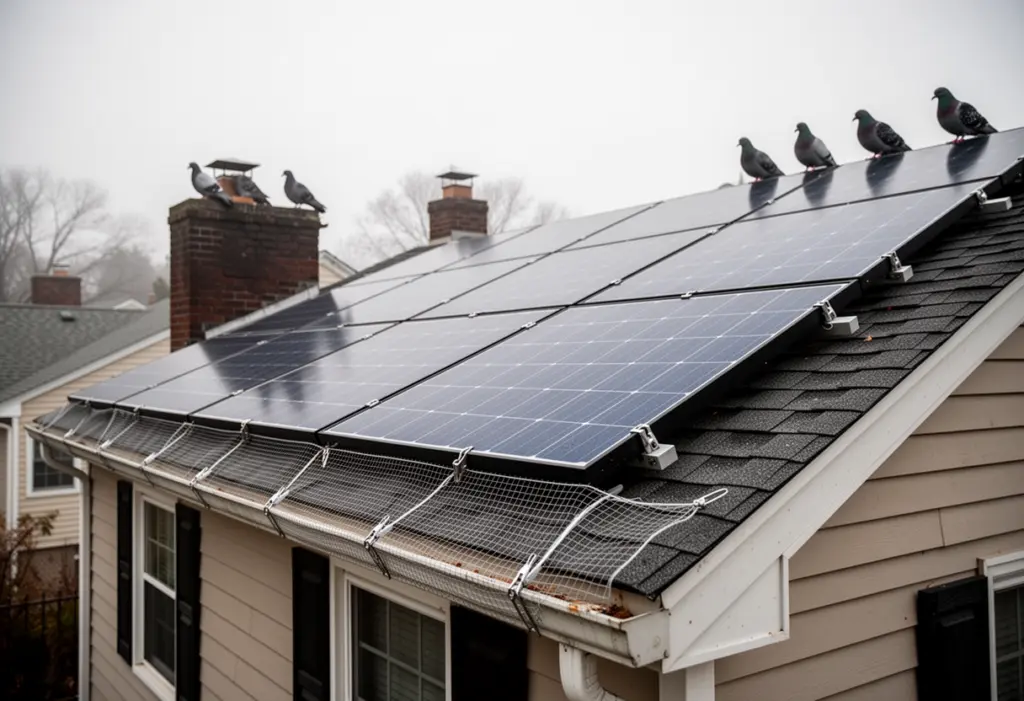
If birds or squirrels are already living in the gap under your array, netting is worth doing and the sooner the better. If they are not, it is an option to price at installation rather than a job to book this month. A perimeter guard protects the wiring and the roof surface underneath. It does not raise production in any way you will notice, and it does not change a single line on your electricity bill.
What gets in there, and why it matters
A rooftop array sits roughly four to six inches above the roof on rails. That gap is dry, shaded in summer, warm in winter and completely sheltered from anything that hunts from above. Pigeons, starlings, house sparrows and grey squirrels all find it, usually within a season or two of the array going up.
The nest itself is not the expensive part. Three things that follow it are:
- Chewed conductors. Squirrels strip insulation from the DC wiring running between modules. That is an arc fault risk, and the repair means lifting panels off the rails to reach it.
- Packed nest material and droppings hold moisture against the shingles under the array, which is the one part of your roof nobody can inspect without a partial removal.
- Blocked gutters and valleys. In a New York winter that is how water ends up sitting where it should be draining, and refreezing overnight.
What the work should actually look like
Done properly it is a fine stainless or coated mesh clipped to the outer lip of the module frame with purpose-made clips, running the full perimeter of the array. Three questions decide whether a given contractor is doing it properly:
- Does anything penetrate the roof deck? It should not. New holes in a roof to hold a bird guard is a poor trade.
- Does anything screw into, glue to or drill through the module frame? Manufacturers set out what may be attached to a frame, and going outside that is a straightforward way to lose a product warranty on equipment worth far more than the mesh.
- Who warrants the guard and the labour, and for how long? Work done by someone other than your installer sits in the gap between two warranties, and that gap is where disputes live.
Fit it at installation, or accept that it costs more later
On installation day the crew is already on the roof with the lift, the ladders and the fall protection in place, so adding a perimeter guard is largely material cost. A retrofit is a separate mobilisation, and where there is an established nest it begins with removing packed debris and cleaning the roof surface before anything can be closed off.
There is also a timing rule that has nothing to do with solar. Many native birds and their active nests are legally protected, while several of the common urban nuisance species are not. Ask the contractor to identify what is up there before anything is sealed, rather than discovering the distinction afterwards.
What netting will not do for you
It is not a production upgrade. Soiling from droppings on the glass is real but modest on a pitched New York roof that rain washes several times a month, and paying for a regular cleaning contract on that basis is rarely worth the money.
It also does nothing to the fixed monthly charge on your system. The Customer Benefit Contribution is billed on the DC size of the array, not on what it produces, so a 9 kW system pays nine times the rate every month whatever the birds are doing: $8.73 on National Grid, $11.61 on Con Edison and $15.03 on Central Hudson at the 2026 residential rates. Between roughly $105 and $180 a year, decided by which utility the roof sits under and by nothing else. It applies to systems interconnected on or after 1 January 2022, and the rates are recalculated annually.
Snow, ice and the lower edge
In the snow belt counties the lower edge of an array is where sliding snow arrives, and a perimeter guard sits exactly there. It is usually fine. Ask how the mesh is fixed, and whether the contractor has used it on roofs of this pitch through an upstate winter, because a guard that tears loose in February leaves you with two problems instead of one.
Where this sits against the incentives
New York's 25% credit on Form IT-255, capped at $5,000, covers qualified solar energy system equipment expenditures at your principal residence. A guard priced inside the original installed system is a different question from an add-on bought three years later, and it is a question for whoever prepares your return rather than for an installer with a clipboard.
The 30% federal residential credit is gone. Section 25D was terminated for expenditures made after 31 December 2025, and an expenditure is treated as made when the original installation is completed, so any 2026 quote still carrying a federal line is materially wrong. Incentive programmes change every year, so check the state credit at tax.ny.gov and NY-Sun at nyserda.ny.gov before relying on any figure, including the ones on this page.
Frequently Asked Questions
Do solar panels in New York need bird netting?
Only if birds or squirrels are actually getting into the gap under the array. A perimeter guard protects the wiring and the roof surface beneath the panels; it does not raise production and it does not reduce your monthly charges.
Is it cheaper to fit bird netting during installation?
Yes. The crew, the lift and the fall protection are already on site, so it is largely material cost. A retrofit is a separate visit and usually starts with clearing out an established nest and cleaning the roof surface.
Can a bird guard void my solar panel warranty?
It can, if it is screwed, drilled or glued to the module frame outside what the manufacturer allows. Ask whether anything attaches to the frame or penetrates the roof deck before the work starts.
Does bird netting reduce the Customer Benefit Contribution?
No. That charge is billed on the DC size of the array rather than on production, so a 9 kW system pays nine times the 2026 rate every month – $8.73 on National Grid, $15.03 on Central Hudson – regardless of soiling.
This article is general information, not tax, legal or financial advice. Incentive amounts, eligibility rules and deadlines change and depend on your utility, your tax situation and your property. Confirm current terms with NYSERDA, your utility and a qualified tax professional before making a decision.
NY Solar Incentives
Independent New York solar research. We summarise NYSERDA, NY-Sun and federal programme rules from published sources and state plainly when a figure is an estimate. We are not a government agency and do not sell equipment.
Run the arithmetic on your own system
Check the dated program table and your arrangement before counting an incentive. Standard residential NY-Sun blocks are closed; Long Island Affordable Solar has a conditional income-verification route. The NY credit depends on qualified costs and tax liability, while the NYC abatement reduces future property-tax bills. The estimator keeps those timings separate.